Why is there a comma in the following comic?
You were planning on sleeping insider the deer for warmth, too? Shit. I didn't want it to come down to this, Joseph, but we're going to have to have a dance-off.
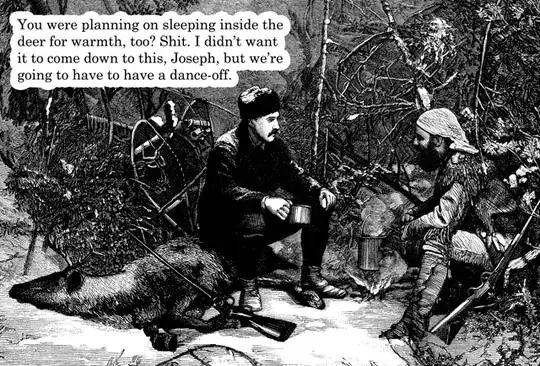
Why is there a comma in the following comic?
You were planning on sleeping insider the deer for warmth, too? Shit. I didn't want it to come down to this, Joseph, but we're going to have to have a dance-off.


The comma in this case implies that listener was planning to sleep inside the deer for warmth, as was the speaker. Without it, the sentence would imply the listener was planning to sleep inside the deer for warmth, and for some other reason.
That seems like rather a lot of work for one punctuation mark, but in the spoken language the emphases in the sentence would indicate which the speaker meant.

Most of us were taught to place a comma before a sentence-ending “too”:
We’re going shopping, out to dinner, and then to a movie, too.
But is that comma really necessary? “Too” in this context means “also,” but you’re not likely to see the sentence written like this:
We’re going shopping, out to dinner, and then to a movie, also.
No one seems to know how this particular quirk started, but it’s firmly entrenched in our over-cluttered writers’ brains. Even journalists do it, and modern-day practice is to strip news stories of as many commas as possible without hopelessly obfuscating meaning. Still, that niggling comma before “too” persists. The editors at the Chicago Manual of Style share their opinion:
Use commas with too only when you want to emphasize an abrupt change of thought: He didn’t know at first what hit him, but then, too, he hadn’t ever walked in a field strewn with garden rakes. In most other cases, commas with this short adverb are unnecessary.
The bottom line is, there’s no clear rule that either specifies using the comma or forbids it. It’s the writer’s choice. The rules of grammar don’t often allow writers to have choices. It’s kind of nice to be thrown a bone from time to time.
The example you provided is one in which the author pays particular attention to following the rules of comma placement. This looks like an old comic. In a modern publication, one might very well find:
You were planning on sleeping inside the deer for warmth too? Shit. I didn't want it to come down to this Joseph, but we're going to have a dance-off.
I always place a comma before too as a rule, but increasingly I find this is gradually becoming less of an issue, even in formal contexts and especially in American English.
As to why the comma is there in your example, that's an old rule some of us still happen to follow, depending on context.

A better question might be why isn't there a comma like such: "Shit, I didn't want it to come down to this..." The proper use of an interjection is either [interjection], [clause] or [interjection]! [clause] depending on severity. As for the [comma] too format, it seems to be a matter of style rather than a hard rule of grammar. "Too" is used almost like a conjunctive adverb; thus, separating it from the main clause with a comma seems like a natural choice.


And don't forget Matlab and Fortran, all of which have CUDA support. Mathematica supports CUDA, too.In this case Mathematica is not mentioned in the first statement, and after, it is added as a statement that also Mathematica supports the same as the previously mentioned. – awe Jan 07 '11 at 12:29