5

A thing I have never had the time to look more closely into. But I find both variants:

What I love most is ...

or

What I love the most is ...

I think the more common form is 'the most', and I think 'most' is only a matter of shortening the adverbial. But I may be mistaken. It might also be that it is a thing of regional or individual preferences or that American and British usage diverge.

Frank
  • 596
  • 2
    What possible difference could this make? Whichever one you choose, your audience will understand you to be choosing a favorite of some kind. They will not care whether you added the definite article or not. – Robusto Jul 07 '12 at 15:53
  • 4
    Actually you are right ,but this kind of questions is not really about the communication ,its just about the language itself – Frank Jul 07 '12 at 16:03
  • It seems to be about the language, but an answer will tell us nothing worth knowing. – Robusto Jul 07 '12 at 16:32
  • @Robusto: I'm inclined to agree with you, that this is a moot question. Just because something is more common doesn't mean it's always better in all circumstances. Since examples of both can be found, it might be more practical to ask something along the lines of, When would one be preferred over the other? But I took a stab at this nonetheless. – J.R. Jul 07 '12 at 19:16
  • Related question: http://english.stackexchange.com/questions/27021/do-i-need-to-put-the-before-most-in-this-sentence –  Jul 07 '12 at 19:33

4 Answers4

7

I did a few searches in Google books to see if I could find a pattern. It seems like more hits are found when the article is omitted rather than added. Here are my results (all searches were done "in quotes"):

Things I love most: 8310 results
Things I love the most: 1570

Things I hate most: 2060
Things I hate the most: 195

Things that bother me most: 859
Things that bother me the most: 207

Things I like best: 25,000
Things I like the best: 295

Things I do best: 6890
Things I do the best: 1870

Given that a pattern is emerging, the next question would be: Why?

I remember one tip for effective writing: eliminate extraneous words. That admonition is found all over the web. For example, such words are called flab in this blog; the same exhortation is buried into Tip #9 of this writer's guide:

9) Write more than one draft of your essay. Great writing comes from revision. Eliminate extraneous words and phrases. After you revise, be sure to proofread and spell-check your work. Proof-reading is not the same as revising!

I'm guessing that it's often omitted because it's unnecessary. Which leads me to the last pair of queries I ran (not in Google books, but just as a Google web search):

Eliminate extraneous words: 5890
Eliminate the extraneous words: 68

J.R.
  • 58,828
  • 5
  • 95
  • 196
2

There may be a slight difference in meaning. It would be somewhat awkward to omit "the" in the following, because we are referring to someone/something mentioned previously:

What I loved the most [about her] was her eyes.

On the other hand "the" would be unnecessary in the following, because we are not referring to any context much more specific than life in general:

What I loved most [of all] was being able to play in the woods as a child.

But one might say:

What I loved the most [about my childhood] was being able to play in the woods.

I would conclude that an indefinite "most" is slightly more general and less dependent on context than "the most." With the latter, there is usually some antecedent to answer "the most of what?"

JL344
  • 167
1

If your question is about frequency, in both the Corpus of Contemporary English and the British National Corpus there are three times as many records for most as for the most.

Barrie England
  • 140,205
  • 5
    Can you elaborate on how you arrived at your conclusion and more generally how someone could answer a question about word or phrase frequency? That would make a really great answer. – MetaEd Jul 07 '12 at 15:12
  • 6
    Also, how could there not be more records for a single word vs. a word combination? Are you taking into account all uses of most as adverb, determiner, and pronoun? Compare corpus responses for best, worst, and least vs. adding the to each. – Robusto Jul 07 '12 at 15:39
  • There are a lot of constructions containing most. Some don't normally take an article, e.g, most of the X, most of them, most recently, etc. Others, e.g, the most (that) you can expect/will happen, etc, require an article. Still others, like most ordinary superlatives, have an optional article. Depends on whether the speaker wants an extra syllable or not. – John Lawler Jul 07 '12 at 15:52
  • I was reporting the fact, not drawing any conclusion, but the fact seems to show that there is no difference between BrEng and AmEng in frequency of usage, a point that the OP was interested in. – Barrie England Jul 07 '12 at 15:56
  • 3
    Then would a more useful search be "love most" vs. "love the most"? – MetaEd Jul 07 '12 at 15:58
  • 1
    "There is no difference ... in frequency of usage" tells us nothing. You have offered a specious statistic masquerading as a fact. Unless I miss my guess, what the OP really wants to know is not answered by your query. – Robusto Jul 07 '12 at 16:01
  • @MetaEd: The COCA has over twice as many records for ‘love most’ as ‘love the most’. The BNC has twelve records for the first and none for the second. – Barrie England Jul 07 '12 at 16:02
  • 2
    @BarrieEngland: So just to be clear: the numbers in your answer are simply for "most" and "the most", no context? If so, how do you think that is relevant to the question? Why don't you replace what you have now with these results for "love most" and "love the most"? – Cerberus - Reinstate Monica Jul 07 '12 at 16:10
  • See, I'm learning … I have done my first two COCA searches. "I love most" has fewer records than "I love the most", which is the opposite result to the more general searches. So where does that leave us? – MetaEd Jul 07 '12 at 16:11
  • Query "I love most" will include results like "I love most sports". Unless you ignore those, the comparison of number of results proves nothing. – b.roth Jul 07 '12 at 18:18
  • @Bruno Rothgiesser: For all we know, any such "false positives" may be balanced out by false negatives such as "We all love the most attractive girl in our school". – FumbleFingers Jul 07 '12 at 18:48
  • @FumbleFingers: Exactly. But the point is that we don't know, and no one has constructed a valid query that would eliminate such false positives and negatives. – Robusto Jul 08 '12 at 15:20
  • @Robusto: Okay, well here are all 4 combinations of I love {the} most is/are, which I think are pretty unambiguous search strings, and which bear out Barrie's point. I agree oftentimes stats from NGrams etc. aren't the final authority no matter how they are used, but I don't see the point of unilaterally criticising them. Either show why they're misleading, or let them stand uncontested. – FumbleFingers Jul 08 '12 at 19:27
  • @FumbleFingers: So the burden of correctness falls to the reader, not the writer? – Robusto Jul 09 '12 at 00:36
  • @Robusto: In this case, I fully expected Barrie's point to be vindicated, so I was happy with the answer as it stood. You and Bruno weren't, so the onus should indeed have rested with you to refute it (if that had been possible - which it wasn't here, obviously). If I "know" something different to what an NGrams suggests, I'll look for reasons why it might be misleading. But why dispute the quality of supporting evidence if you agree with the conclusion anyway? – FumbleFingers Jul 09 '12 at 02:06
  • @FumbleFingers: I'm happy that you're happy. But you still haven't proven anything, except that you are capable of succumbing to confirmation bias. – Robusto Jul 09 '12 at 03:24
  • @Robusto: I don't get that. Thanks in no small measure to your own case-specific refutations of arguments falsely supported by misleading NGrams, I've learned not to blindly take them at face value. But my link above shows "most" outnumbers "the* most"* by 6830:1580 with "I love {the} most is", and by 1070:364 with "I love {the} most are". Given Barrie only addresses frequency of occurrence (not the reason for it), surely that's "proof enough"? Or am I missing something (again! :) – FumbleFingers Jul 09 '12 at 20:34
-1

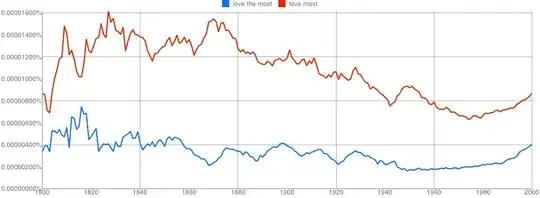
According to Google's ngram most seems to be more common than the most.

enter image description here

Noah
  • 13,490