6

What is the most common or correct spelling of "blah blah blah"?

  • blah blah blah
  • blah blah
  • bla bla bla
  • bla bla

My question stems from when I first wrote it as "bla bla bla" in an English text, but a friend told me it should have been written as "blah blah" so I decided to ask here.

Before that I had checked it out on some online English dictionary and Google search but I wasn't able to clear it out.

tchrist
  • 134,759
  • 4
    The phrase "blah blah blah" is so informal as to not warrant an official, correct spelling by any authority. So only practice defines (circularly) what is the most common. And that seems to me 'blah blah blah'. – Mitch Aug 24 '12 at 15:23
  • 1
    @Mitch The OED certainly covers this General Reference question adequately enough, if that is somehow a measure of “correctness”, whatever that means. It also provides citations of variant forms, by which might attempt to infer “commonness”, whatever that means. – tchrist Aug 24 '12 at 15:26
  • 3
    @hippietrail: the spelling of "blah" is GR, but that's not even what's being asked here. Frankly, I don't know what is being asked here - taken at face value, it's akin to asking, "How do you spell 'wub wub wub'?" - either you've answered your own question by asking it, or there's some fairly important context you've omitted. – Shog9 Aug 24 '12 at 16:17
  • 2
    @Shog9: Well I disagree. English has no academy. All the big dictionaries have disclaimers that they should not be used as language authorities but rather as descriptions. Style guides may have something to say but because of the colloquial nature of the terms they may not, making it not straightforward. But even if dictionaries and style guides don't have the answer it's perfectly reasonable for a non native speaker or anyone else to want to try to choose the best variant in their writing. No answer tells us what the references say and the answer with the statistical approach is wrong. – hippietrail Aug 24 '12 at 16:22
  • 1
    @hippietrail you sound like you're arguing against closing this as GR (or for that matter, closing anything as GR), but as you noted above it wasn't closed as GR. If you have some insight into what's actually being asked here, go ahead and edit. – Shog9 Aug 24 '12 at 16:24
  • 1
    Related: http://english.stackexchange.com/questions/12093/what-does-yadda-yadda-mean, http://english.stackexchange.com/questions/48557/any-other-way-of-saying-blah-blah-blah – Shog9 Aug 24 '12 at 16:25
  • 3
    I'm against closing it, especially with no comments apparently taking the question in good faith. And I'm also pointing out what seems to be an inconsistency in the reasoning behind the closing. To me it's perfectly clear what's being asked and perfectly obscure what problem you find with it. That said, @JohnS: do you think you could add some background or detail? – hippietrail Aug 24 '12 at 16:26
  • @hippietrail: It's not apparent to me, or several other people - I've elaborated on this here. If it is clear to you, then edit it to clarify. – Shog9 Aug 24 '12 at 16:27
  • 5
    I, too, am not quite sure how this question is fundamentally different from "pricy vs pricey", "despite vs despite of", "alright vs all right", "grey vs gray", and countless others. Some of these actually got Joel and Jeff gold Publicist badges. – RegDwigнt Aug 24 '12 at 16:44
  • "no comments...taking the question in good faith": mine was. But I gave it as a comment, not as an answer, because...because, well, both the question and my comment need more substance to be worthy. – Mitch Aug 24 '12 at 16:45
  • @ЯegDwight The difference is that his question is asking which spelling is more common. That is different from asking which one is correct, or if one is used in American English, and the other is used in British English. – apaderno Aug 24 '12 at 17:22
  • You might should also consider blahdy-blah and blahdy-blahdy-blah, too. – tchrist Aug 24 '12 at 17:36
  • @tchrist He could also consider blah, blah-blah, or blah, blah, blah. – apaderno Aug 24 '12 at 17:43
  • @JohnS Do you see anything cool with somebody writing "the typical kid, going out every night, blah, blah, blah" or "his blah feeling"? Those are all examples taken from a dictionary, together with "he battled a case of the blahs." – apaderno Aug 24 '12 at 17:55
  • 1
    Nobody who's anybody has said blah-blah-blah for twenty years. It is now obsolete in Correct Usage, having been replaced by yada-yada-yada. – StoneyB on hiatus Aug 24 '12 at 21:43
  • @kiamlaluno: He was asking both which variant was "right" and which was "most common". I read it that he expected English might not believe in "right spellings", which is indeed the case, but one is still likely to be more acceptable than the others but using the word "best" in SE questions is a big no-no. – hippietrail Aug 30 '12 at 07:45
  • @hippietrail He has forgot at least two variant. Then, I don't know how it is possible to say which one is more common; even if it would be possible, it sounds like one of those statistics about who lives longer between a person with brown eyes, and a person with blue eyes. – apaderno Aug 30 '12 at 08:27
  • It's possible by examining corpora. There's more and more such resources due to computerization and digitization. The most accessible if least scientific is Google, as long as you know how to do it properly. Currently blah blah blah seems to be clearly the most used but a more scientific reference would also be welcome. Things such "blah" might be better considered "related" than a "variant" because it's not always used the same. Commas and hyphens do slip through the nonscientific approach I mentioned though. I know nothing about correlation of eye colour and life expectancy. Interesting... – hippietrail Aug 30 '12 at 08:37
  • In the original ancient Greek, I believe, the correct expression was "βαρ βαρ βαρ." – Sven Yargs Aug 05 '16 at 22:38

4 Answers4

16

The phrase "blah blah blah" and the single word 'blah' are both very informal. In fact, even though the OED is pretty descriptive, I'm surprised it has an entry for 'blah' (it is not something I expect in print, and that's all that OED relies on).

As to what constitutes a standard, for English, there is no government supported official body, like the French Academy, which dictates usage. It is a little more decentralized in English writing culture, relying on style guide writers (from book or newspaper publishing houses or self declared but recognized experts), and the primary and secondary school systems.

The phrase is informal enough so as not warrant an official, correct spelling by any authority. Because of its informality, one would not expect a magazine or newspaper editor to regulate its spelling because they would just try not to have it appear at all.

This might seem disingenuous because after all it is in the OED and there are many instances written on the net. Some people do write it. But the authorities on what should be written would probably say that it should not be written at all.

Then it falls to practice. And only practice defines (circularly) what is the most common. And that seems to be 'blah blah blah'.

Your friend 'corrected' you by telling you what he's seen more often. 'correct' and 'common' are not the same thing, but when there's no correctness authority it is all we have to go on.

As to whether two or three repetitions, I've never heard or used less than three in speech; if you're going to spout nonsense, might as well go all the way.

Mitch
  • 71,423
  • 5
    One place you couldn't avoid writing it is in dialogue, another is in quoted speech. If somebody famous used it in something worth writing about, whoever writes it will have to choose a spelling (though they won't have to choose the number of repetitions). Another point I just thought of is that if you do have cause to include it in your own writing, and you use it more than once, then be consistent and use the same spelling each time. – hippietrail Aug 24 '12 at 17:46
  • @hippietrail Yes, I agree. Up until recently, it has however been the habit to edit speech considerably, removing infelicities, dysfluencies, interjections, vulgarities, and 'non-words' that -are- words but are just too informal. So it really could come up in a newspaper how to 'properly' spell some 'non-word'. Let's call up 'The New Yorker' and ask! – Mitch Aug 24 '12 at 19:56
  • 3
    It seems that the Australian newspapers currently all aways use "blah blah blah", though sometimes with intervening commas. It's much more common in the lower-brow paper though. – hippietrail Aug 24 '12 at 20:05
  • 2
    @hippietrail hmm...then I don't actually know anything. I feel the whole thing is like 'how to spell Tchaikovsky?', everyone tries their best until one is settled on. Everyone is low brow now (doesn't the NYT quote vulgarities now? eg the famous Bush slip). I mean, how do spell properly the sub-human grunt for 'No': nunh-unh? unh-huh? – Mitch Aug 24 '12 at 20:10
  • 1
    There was a bit more variation in the British papers I checked and the high-brow The Times only had about three hits... but yes this seems to be how it is. At least now we've investigated and documented it (-: – hippietrail Aug 24 '12 at 20:16
8

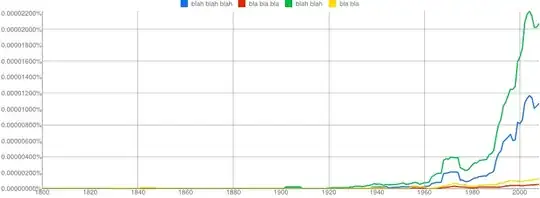
Just for giggles behold the Google Ngram: enter image description here "blah blah" is clearly more common. Due to feedback, here's another silly metric:

Google search results:

bla bla:        about 54,100,000
bla bla bla:    about 36,300,000
blah blah:      about 68,800,000
blah blah blah: about 54,400,000

Not exactly conclusive, but blah blah still wins... see hippietrails comment, he is better at googling than me.

Daniel
  • 619
  • 10
    Wait, if the text has "blah blah blah", then the string "blah blah" also matches it, but does it match twice? – GEdgar Aug 24 '12 at 16:08
  • 1
    It was smart answer but maybe google has counted 3-blah as both 2 and 3-blah. – Ali Shakiba Aug 24 '12 at 16:10
  • Yes every "bla bla bla" will also be counted as a "bla bla" so no direct comparison can be made using Google Ngrams alone. – hippietrail Aug 24 '12 at 16:11
  • 4
    @DanielCook: You can make a rough comparison using Google or another search engine that supports an operator to omit results with certain terms. This is what I got, your results may vary: "bla bla" -"bla bla bla": About 23,500,000 / "blah blah" -"blah blah blah": About 24,900,000 / "bla bla bla": About 26,500,000 / "blah blah blah": About 28,500,000 -- so they're all in the same ballpark but bla bla is least popular and counter to your findings, blah blah blah is most common. – hippietrail Aug 24 '12 at 16:17
  • 1
    Like most if not all Google N-Grams, this one is terribly, terribly misleading. It tells you nothing that’s real and should not be used as evidence of anything. – tchrist Aug 24 '12 at 16:33
  • 2
    @tchrist: I disagree: it tells you that blah is more common than bla, for one thing. I do agree that a comment is needed about how "blah blah" probably includes "blah blah blah". – Cerberus - Reinstate Monica Aug 24 '12 at 16:38
  • "blah blah" does not probably include "blah blah blah". It definitely includes it. The edits to the answer improved it, but it's still wrong so I still voted it down. – hippietrail Aug 24 '12 at 16:45
  • @Cerberus And what about “blah-blah” and “blah, blah” and “blah-blah-blah” and “blah, blah, blah” and *“blah, blah-blah” and such? What does it say about them? – tchrist Aug 24 '12 at 16:45
  • I believe but I'm not sure that Google Ngrams also has problems with hyphenated terms. At least I've had trouble with them in the past. It's a great tool but as noted several times, neither it nor google hit counts are perfect measurements. They definitely have their place as part of a good answer to this question though. – hippietrail Aug 24 '12 at 16:47
  • 5
    @hippietrail: We don't know how Google's search algorithms work exactly. I have found some extremely contradictory results at various times, where things like "hello -hi" got more results than "hello" (something like that). – Cerberus - Reinstate Monica Aug 24 '12 at 16:47
  • @tchrist: Nothing, I believe. – Cerberus - Reinstate Monica Aug 24 '12 at 16:48
  • 1
    @Cerberus: Exactly. Google is a distributed system so you can get different answers depending on which servers in which parts of the world got your request at any given time. Google also tracks you in various ways so may alter its result depending on where it thinks you are from, where it thinks you are now, your search history, who knows. You can put more work in and get better results if you really want. Try google.com and google.co.uk and google.com.au , try logging out, and of course trying other search engines or searching books and/or news too. But it will still be a rough guide. – hippietrail Aug 24 '12 at 16:57
  • 1
    @hippietrail: You should also always try going to page 10 of the results. You will often see that results decrease from, say, 33,000 to 87. I have seen it happen. Or increase. It is fairly random. – Cerberus - Reinstate Monica Aug 24 '12 at 17:02
  • @Cerberus “Anyone who considers arithmetical methods of producing random* digits is, of course, in a state of sin.”* —John von Neumann (1951) – tchrist Aug 24 '12 at 17:04
  • @tchrist: Did he say anything about fairly random? – Cerberus - Reinstate Monica Aug 24 '12 at 17:06
  • True @Cerberus! I used to use that technique all the time but it seems I'd forgotten about it. I've read about why this is and apparently it's extremely expensive to truly calculate the number of hits so they have some heuristics to guesstimate it... until you follow it through enough pages and force it to do the calculation. – hippietrail Aug 24 '12 at 17:11
  • 6
    The Google search results are useless here, because they include all languages. In German, for example, "bla bla" is the equivalent of the English "blah blah blah". I suggest we check COCA and BNC instead. – RegDwigнt Aug 24 '12 at 17:12
  • 1
    The more we comment on this the more I find this an interesting question... or at least a question on an interesting topic, determining the most acceptable of several variants of a colloquial phrase. I wonder what actual editors do when they come across these - it must happen all the time. – hippietrail Aug 24 '12 at 17:14
  • @ЯegDwight: You can restrict Google searches by both domain (almost but not quite country) and language though. It's all effort though of course (-: ... In fact I think this is a great idea for a webapp - search all the search engines automatically with all combinations of country and language restrictions applicable! – hippietrail Aug 24 '12 at 17:15
  • 1
    @hippietrail: Right, that makes sense, although they could have explained this more clearly, because the current system is weird... – Cerberus - Reinstate Monica Aug 25 '12 at 16:08
  • +1 for using the Google Ngram viewer. I think it's reasonable to assume that relative usage of "blah" and "bla" will be fairly consistent regardless of whether they're repeated twice or three times, so you might consider looking at just the comparison of "blah blah blah" and "bla bla bla". http://books.google.com/ngrams/graph?content=blah+blah+blah%2Cbla+bla+bla&year_start=1940&year_end=2008&corpus=15&smoothing=3&share= – Simon Whitaker Jan 02 '13 at 13:58
2

Blah blah blah is the normal way to spell it. Bla looks kind of blah.

RegDwigнt
  • 97,231
Arlen Beiler
  • 2,047
2

"Bla bla" to me looks like I would spell it in German. In English you probably (my theory) need the "h" at the end to ensure pronunciation.

A dictionary is seen by most people as a language reference. However, the editors of a dictionary do not define a language.

In the German-speaking world, the verb "to google something" for "to look something up on the internet" was included in a famous German dictionary for the wide and common usage. This demonstrated how language is not defined by dictionaries. If words enter common usage they become part of the language and therefore the dictionaries are at some point obliged to include this words.

So, if "blah" is the most common spelling of this word, you probably will find it at some point in time in you trusted English dictionary.

Dohn Joe
  • 910
  • 8
  • 13