9

Whilst plodding through Patrick Rothfuss' "The Name of the Wind", I came across:

Our dinner was nowhere near as grand as last night's. We made due with the last of my now-stale flatbread, dried meat, and the last potatoes baked on the edge of the fire.

I've seen "make do" mangled into "make due" before on the Interwebz. But this is the first time that I've run across it in a professional work. A quick search on Google Books reveals that Rothfuss and his editor are not the only ones who are happy to let this one pass.

Most language sites on the net including this one continue to gently correct the questioner by pointing out the correct form. Yet, there are some which appear to condone this practice with a dispassionate that-is-the-way-language-works stance on the matter.

So, what's the deal? Is "make due" now considered acceptable?

P.S. It might be relevant to note that Rothfuss is a professor of English at the University of Wisconsin.

coleopterist
  • 31,031
  • I certainly wouldn't use it, unless I was talking about how my friend owed me some money for which we hadn't really discussed a payback period, and because I needed new tires for my car, I made due his debt. – Jim Sep 12 '12 at 04:41
  • 8
    In my book, "make do" and "make due" are very different things, and can only attribute this to poor proof-reading and/or relying on spell-checker or grammar-checker – Andrew Sep 12 '12 at 04:58
  • 7
    I have never seen or heard 'make due' used to mean 'make do'. – Barrie England Sep 12 '12 at 06:02
  • 1
    Statistics aren't everything, but here's the Ngram which does seem conclusive. Interesting that made do with only seems to gain currency around 1920. – Andrew Leach Sep 12 '12 at 06:44
  • @BarrieEngland Besides the ones in my question, see here, here, and here for more examples. – coleopterist Sep 12 '12 at 08:09
  • @AndrewLeach Conclusive in what way? – coleopterist Sep 12 '12 at 08:09
  • @coleopterist: All NYT, I notice. – Barrie England Sep 12 '12 at 08:25
  • coleopterist: I think @Andrew means "conclusive" about two things: (1) made do with is used overwhelmingly more than made due with, and (2) there is a very recent blip of hits on made due with. (Sometimes people can read too much into a single ngram, his seems to safely support those two deductions.) I think this slightly modified ngram is even more interesting, though (it extends an extra 8 years, and shows something rather intriguing.) – J.R. Sep 12 '12 at 08:50
  • Here's Language Log's disappointingly short take on "make due": http://itre.cis.upenn.edu/~myl/languagelog/archives/005390.html – Avner Shahar-Kashtan Sep 12 '12 at 09:17
  • @J.R. I wasn't sure if Andrew was making the same point that you are. I think turning down the smoothing makes the recent changes even more readily apparent. – coleopterist Sep 12 '12 at 12:36
  • 1
    @BarrieEngland The first link in my comment is NYT only. The second is Guardian only. The last link is Wired only. But I agree that it appears to be more of an American affectation. – coleopterist Sep 12 '12 at 12:37
  • @AvnerShahar-Kashtan Thanks. I've actually linked to the same post in my question :) – coleopterist Sep 12 '12 at 12:38
  • One note: do and due are homonyms in much of the U.S., but not in RP, so this mistake is likely to be found mainly in America. – Peter Shor Sep 12 '12 at 12:45
  • @coleopterist: Seems so. The COCA has 23 records for ‘make due’, nearly all in the sense of ‘make do’. The BNC has 2, both followed by ‘allowance’. – Barrie England Sep 12 '12 at 12:48
  • Oh, sorry. There were too many links in the OP and the comments, so I missed that in my hasty scan. :) – Avner Shahar-Kashtan Sep 12 '12 at 13:00
  • 2
    Not unrelated: I once marked papers and more than once came across "X is do to Y" meaning "X is caused by Y." – JAM Sep 12 '12 at 13:44
  • 7
    This is deep due-do. Remember that spelling is arbitrary, like phone numbers, and remember how eggcorns come about. – John Lawler Sep 12 '12 at 16:02
  • 1
    Too Localised. Eggcorn or not, it's obviously either an exceptionally ignorant writer, or more likely a simple transcription error. – FumbleFingers Sep 12 '12 at 21:16
  • 1
    @FumbleFingers If you take the time to look through the links I've provided in the post as well as in the comments, you'll see that it's a pretty widespread malaise. The instances in NYT, Wired, The Guardian, a number of published books, etc. prove that this is not a "local" problem. – coleopterist Sep 13 '12 at 05:37
  • 1
    @coleopterist: A widespread error is still an error. Even if you can find some way for "due" to make sense, which I can't. – FumbleFingers Sep 13 '12 at 12:10
  • 1
    @FumbleFingers But it isn't "too localised" as you contended in your last comment. This question is also not about whether it's right or wrong. Spelling evolves from such "errors" and I'm questioning whether this one has entered the realms of acceptability. Furthermore, if you take the time to read through the Language Log link provided in my post, you will find somebody actually stating that due makes more sense than do. – coleopterist Sep 13 '12 at 12:28
  • 1
    That may be someone's opinion on language log, and you might agree with it. I think "due" is incorrect, and doesn't make sense. As John says, spelling is arbitrary anyway, but there's only one "correct" word, with one correct spelling, and one meaning. All else is ignorance, regardless of prevalence. Do you seriously want me to post an answer saying "No, it's not acceptable"? – FumbleFingers Sep 13 '12 at 14:12
  • @FumbleFingers: I'll say it. It's wrong. It's not acceptable. If enough people start doing it, it may become acceptable, but it's still wrong now. – Mitch Sep 13 '12 at 14:45
  • 1
    @FumbleFingers No, I expect you to say that, "No, this question is not too localised as it appears to be a reasonably widespread practice. I was hasty and did not read things through.". I would like that written in your blood and mailed to me :) My question is not on correctness as such, but on acceptability. The Ngrams and COCA approach is a good way to demonstrate the growing acceptability (or otherwise) of this usage. Why people prefer to answer in comments instead of via answers defeats me. – coleopterist Sep 13 '12 at 15:03
  • @coleopterist: Okay, well it's not been closed, so I've answered. – FumbleFingers Sep 13 '12 at 17:09
  • There are very few multi-word verbs consisting of verb + verb: hear say (archaic) hear tell leave / let (someone) be leave go (of) let drive let drop (= announce unexpectedly) let fly (at) let go (= release, not allow to leave) let slip (= spill the beans) let (sb) get away/by with let (sb) have it let (something) slide make believe (that) make do (= manage), and not many more. If one stops to analyse these structures rather than unquestioningly uses the more common ones, they sound disturbingly odd and extragrammatical. Using (wrongly) the adjective due with make may be a hypercorrection. – Edwin Ashworth Sep 14 '12 at 00:03

3 Answers3

7

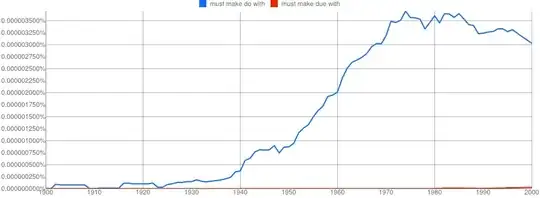
As a Brit, I'd never confuse "make due" and "make do", but per comments above, they are homophones for some Americans (which as John Lawler comments, could put us in deep do-due here). I still don't really understand how anyone could think "due" makes sense, but here's someone on The Eggcorn Database who says he can (I think he's not exactly a "careful thinker", but there you go).

This NGram claims 44,400 instances of "make do", and 288 of "make due"...

enter image description here

...but when I scroll through them it seems there are actually only 74 instances of the incorrect form. But the actual numbers are irrelevant - it's incorrect, meaningless, and unacceptable.

FumbleFingers
  • 140,184
  • 45
  • 294
  • 517
  • Thank you. But why are both the NGram as well as your Books results comparing "must make due with" and not just "make due with"? As you will find, the results are far more significant in number. Also, as per J.R.'s comments, refining the NGram to include the noughties as well as turning off smoothing brings to notice the dip see towards the end of your graph. – coleopterist Sep 13 '12 at 17:30
  • @coleopterist: I'm not trying to twist the figures, honestly! It's just that there are still enough results to be "significant" with "must/with" before/after the target phrase, and I thought the longer phrase would make absolutely sure I wasn't distorting things with any "false matches". But at the end of the day, it makes no difference to my answer if the errorneous form occurs ten times more often than my graph suggests. It's still incorrect, meaningless, and unacceptable. – FumbleFingers Sep 13 '12 at 18:01
  • 2
    :) It makes a difference when you attach importance to the scalar magnitude of the results ("actually only 74") rather than rely solely on relative observations. The comparison is currently flawed as is the use of must which needlessly pollutes the results in this case. It makes sense to use additional keywords to refine the results only when there are a number of false positives. Based on the first couple of pages, I do not see any. IMHO, it is also important to note the dates of the books in the results. A majority of them were written in the last few years. Hence my question. – coleopterist Sep 13 '12 at 18:21
  • 1
    FumbleFingers and John Lawler (in the comments) have it right: it's an American eggcorn, since due and do are homophones for a very large number of Americans. It's just as wrong as calling an acorn an eggcorn. – Peter Shor Sep 13 '12 at 20:10
  • @Peter Shor: I guess you habitually interact with a wide variety of different accents (I think you flagged up "regional homophony" more than once before). But it's still a bit worrying to learn from OP that "Rothfuss is a professor of English at the University of Wisconsin. I'm not even sure what "professor" means in that context, but one would like to hope that people with that level of accreditation would be reasonably literate. I'm going to be charitable and assume a transcription error somewhere along the line. – FumbleFingers Sep 13 '12 at 22:10
  • @FumbleFingers: searching in the Google Books preview of The Name of the Wind, Rothfuss's first book, I can find "making do" used twice and "make due" used once. So either Rothfuss or his copy editor really knows the right expression, but slipped up on one instance. I don't think it's any worse than a Brit slipping up and using "there" instead of "their", something which I've done, and which I'm sure happens a lot even in U.K. – Peter Shor Sep 14 '12 at 00:05
  • @FumbleFingers: I think you're a little unfair to LanguageLog; he's not claiming it makes sense, he's quoting somebody else conjecturing why yet other people might think it makes sense - and offering some evidence for the conjecture. – StoneyB on hiatus Sep 14 '12 at 01:02
  • @StoneyB: You're right - the guy on LanguageLog is only a little bit culpable, on account of reproducing it (I've changed the link to point to the original and real villain of the piece! :) – FumbleFingers Sep 14 '12 at 02:29
  • @Peter Shor: Yeah, I make those sort of mistakes, it's true. And even with proofreading, mistakes will happen. I was overreacting, and conflated one aberrant usage (which would presumably be disowned on exposure) with OP's apparent wish to find in it evidence of increasing acceptability. – FumbleFingers Sep 14 '12 at 02:34
  • @FumbleFingers due you really insinuate you could regularly fudge up do to become due, whether homophone or not? Eye see it's in many ways more likely to go the other way around (and the Editor of Rothfuss, systematically doing so, simply missed one of three instances, or left one as a compromise). Please think again. Pin pointing the etymology of make do isn't trivial. It looks like hypercorrection to me. – vectory Jan 08 '19 at 02:07
  • @vectory: I don't really understand your point. How does "hypercorrection" come into it? Clearly a not insignificant number of people (writers, typesetters, or whatever) have made this particular error. And the fact that *do/due* are not homophones for me makes it really stand out. But as I acknowledged in later comments above, I can't deny that I myself will definitely have come out with similar howlers involving *their/there, for example. So being "shocked" that a professor* (or his typesettter) could do the same thing was a bit of an overreaction on my part. – FumbleFingers Jan 08 '19 at 13:51
5

FumbleFingers's Ngram chart very clearly shows the overwhelming preference for "make do" over "make due" in published English writing through the year 2000. But now let's look at the progress of the phrase "to make due with" relative to its own past frequency in published writing, without reference to the competing "to make do with" option. Here is the Ngram chart for the period 1900–2005:

As you can see, the frequency of "to make due with" rises from approximately zero during the years 1900–1969, traverses some foothills during the 1970s and 1980s, and then begins ascending the flank of K2 in the early 1990s.

One simple explanation for the trajectory of this line graph during the period 1970–2005 is that a spontaneous movement has emerged among writers and publishers in favor of "make due" as a legitimate variant spelling of "make do."

Another theory (which I consider far likelier to be true) is that instances of "make due" have cropped up in manuscripts for decades, but until fairly recently publishers' teams of proofreaders and copy editors rooted out most of those variant spellings (aka "accidents" or "mistakes") before they could slip into a finished book or periodical. In this regard, "make due" is only a snowflake on the tip of an iceberg.


A rant

Because publishing has traditionally employed squads of editors and proofreaders to assault innocent manuscripts and force orthographic (and stylistic) conformity on them, people outside the industry sometimes suppose that the finished products that the publishers sell reflect the near-unanimous preferences, precision, and spelling expertise of the named authors; and on the other hand, those same outsiders sometimes interpret variants that slip through the process as being evidence of thoughtful, intentional, and informed dissent from the otherwise monolithic spelling and style choices of the majority.

In my experience, nothing could be farther from the truth. Most authors want to spell words and phrases the way the vast majority of their peers do, and publishers even more ardently want them to do so. But maintaining a high level of consistency and conformity is expensive and, in the Internet era—an era when readers expose themselves daily to writing that has undergone little or no editorial cleanup before being posted online—strikes publishers as being less and less important.

What happens when you spell "make do" as "make due" in an online article? If you notice it later, or if someone points it out to you, and you don't like the idea that some percentage of your readers will think that you don't know how to spell "make do" correctly, you simply go back into the article and change the spelling. No permanent harm, no foul. And let's face it: It's quite a luxury to keep a bunch of editors and proofreaders on staff just to intercept those types of problems preemptively. That's why, in the past couple of decades, copy editors and proofreaders have become the whooping cranes and California condors of the publishing industry.

The 15 matches for "to make due with" gleaned from a Google Books search over the period from 1970 through 1982 hint at the underpinnings of this phenomenon. They include unique instances from these fine publishers: the U.S. Congress (five instances); the U.S. Air Force; the U.S. Forest Service; Manpower Information, Inc.; IEEE; Business Intercommunications, Inc.; Turtle Creek Publishing Company; Rogers Publishing Company [Electrical Design News]; Balaban International Science Services; Library and Information Technology Association; and Horizon House-Microwave [Microwave Journal]. Not exactly Alfred A. Knopf; Farrar, Straus and Giroux; and the Bodley Head, is it? I doubt that any of these "make due" publishers employed a process that included independent reads of the manuscript by two copy editors, followed by a cleanup read by one of the first two copy editors, followed by a proofread by a third staffer. But that series of interventions was standard practice in many publishing houses thirty years ago. In the years since 1990 or so, it seems to me, we've seen the print publishing industry, more or less en masse, heading up Turtle Creek.


Getting back to coleopterist's question

My answer to the question "Is 'make due' now considered acceptable?" is, It depends on what you mean by "acceptable." For their own financial survival—and in deference to the lowered expectations of readers who spend most of their reading time online, where editorial standards are generally much lower than in print—publishers have accepted that they can't afford to police the content they publish with anything like the number of staffers that they once set to the task. In that sense, the publishers have voted with their budgets that variants like "make due" are acceptable (though perhaps not welcome) in their publications. As for readers, they've always had the choice of taking what they get or looking elsewhere for their reading material.

I think that you'll see many more instances of "to make due with" (and similar variant word and phrase spellings) in coming years. You may even start to see instances of "in do coarse" to balance the results out a bit. Ultimately, without the publishing industry's goon squads of copy editors and proofreaders roaming around and terrorizing manuscripts, we may finally get clear of the artificial constraints on spelling that began in earnest with Samuel Johnson's dictionary and the modern publishing house.

It will be interesting to see what emerges from the resulting freedom-for-all. My guess is that eventually a more-sophisticated but still far-from-human word-processing standard (along the lines of Word) will take over the task of spelling regulation and will inexpensively mash everything into conformity with its programmers' views of what constitutes appropriate spelling—if only to make standardized commercial tracking of key phrases in published content more convenient. And people on the receiving end of the process will have to make do with the choices that it permits us.

Sven Yargs
  • 163,267
-1

I think that as is our wont, we have lost the historic context of "make due". Once again leading to a debasement of the English language due to our lack of understanding. Then we have "turned around" and claimed that our version, is the correct one. The other version being just a spelling mistake. I do believe if explored in more detail, the historic context of "make due", involved money/tithe owed. As in being able to get together enough to cover you due.

I owe much on my farm and times are hard. However, I will do my utmost to "make due".

In modern English, everyone uses "make do". That does not make it historically correct. Just as 'ain't' is not really proper English, simply because a lot of people use it in the vernacular.

due noun : something due or owed: such as - something that rightfully belongs to one give him his due or a payment or obligation required by law or custom : DEBT

In this context to "make do" would have a different meaning that "make due". One would imply doing more with less and the other would imply doing enough to cover what is owed.

Does that not make sense in context? So I would choose the version that fits your situation.

My mortgage payment has to be in on the first of the month and I am lacking funds. I will find a way to "make due". I only have 6 potatoes and have to feed 10 people. I will find a way to "make do".