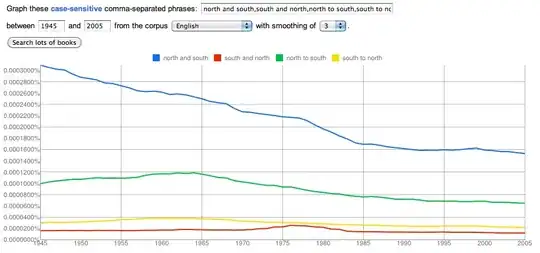
Would you describe Japan as a long country "from south to north", or "from north to south"? I suspect that "from north to south" is more common, and Google ngram agrees, but is this is the case?
Asked
Active
Viewed 2,986 times
3

-
1Interesting. I wonder if they do it from south to north down under. But that's where you're from. I'd (USA) say from north to south. – Oct 14 '12 at 10:07
-
Similarly, I've always heard east to west, and NGram tentatively confirms this (it was 4 to 8 times more common at some points), though they've been neck and neck since the 20th century. In fact, the NGram graphs are very much like Andrew's, so perhaps there's something at work there, especially the spike in the early 19th century. – Zairja Oct 14 '12 at 10:09
-
1I think it can at least partly be chalked up to the order of cardinal directions: In English the conventional order of the directions is "north, south, east, and west". – Zairja Oct 14 '12 at 10:13
-
1Slightly off topic, but in cockney rhyming slang North & South means mouth. The words just seem to go together well that way round. – Alan Gee Oct 14 '12 at 10:56
3 Answers
5
From north to south sounds more natural to my ears. In fact, when I checked the Ngram, I was a bit surprised to find so many instances of from south to north. However, when I investigated further, I realized why: sometimes, you need to say south to north. For example, when a river flows from south to north, that's the easiest way to describe the flow of the river. Also, many of the hits were simply orienting the reader, this this one:
The main towers, from south to north, are Sister Superior, North Sister, Chimney Spire, and Baby Sister.
The same would be true when describing a south-to-north migration, or shipping route, or moutain ascent.
So, I'd guess that from north to south would be more common when you can use either one:
The nation of Chile runs from north to south.
Sometimes, however, you don't have the liberty to choose the order of the directions:
We traveled through Chile from south to north.
That might explain why the gulf in the Ngram between north and south and south and north is much wider than the gap between north to south and south to north:

J.R.
- 58,828
- 5
- 95
- 196
-
You could afford to restrict your NGram by checking for *to the north and south/south and north, which I think eliminates a fair number of "false positives". It still finds 14.5M instances of the "standard" sequence, against only 1.2M for the other way around. A 12:1 preference should be quite enough to convince anyone the bias is both real and* pronounced. – FumbleFingers Oct 14 '12 at 16:57
3
What sort of evidence are you looking for?
You can collect anecdotal evidence here, or you can search a corpus.
From the British National Corpus :
North to south: 65 results.
South to north: 15 results.
So that corpus seems to agree with your intuition.

donothingsuccessfully
- 2,479
- 15
- 15
-
3
-
1@Kris The question asks if "from north to south" is more common, that's an empirical question that has to be established with data. – donothingsuccessfully Oct 14 '12 at 11:58
-
2"Natural Order" is based on Nature. Where's the evidence that Nature favors left over right, north over south, east over west, etc? That's merely your intuition and not the "natural order" of things. Some people claim that there is such a thing as "Natural Law". This is nonsense because it's strictly metaphysics. If you're older and read and write in Chinese or Japanese, the "natural order" is right-left, not left-right. Absolutism is always suspect. No proof means it's a spoof. – Oct 14 '12 at 12:02
-
What @Kris said. There's a convention whereby in most X and* Y* pairings, the "most important" item comes first. Historically, English is mainly a Northern hemisphere language, within which North is without doubt a more significant direction than South. – FumbleFingers Oct 14 '12 at 15:06
-
@F: Terminology is always a problem when technical terms like natural order aren't defined. The conventional order is not controversial. The order of adjectives in English is strictly conventional, but, in a limited sense, the natural order for native speakers of English. There are many unjustified absolutist statements made on ELU. Some may be unintentional, but others seem to smack of arrogance & a belief that the writer knows all there is to know about English & English speakers. None of us knows that much. There's the natural order of convention is unexceptional. – Oct 15 '12 at 00:05
3
The "natural" order in such pairs is:
left - right
up - down
north - south
east - west
forward - backward
fore - aft
...
and not the other way.

Kris
- 37,386
-
2I disagree with the use of "natural". I think "typical order in English" is more apt. The "natural" order seems dependent on what culture or language one hails from, i.e. it doesn't seem that "natural". – Zairja Oct 14 '12 at 11:43
-
1You're right about that. It's often opposite for NSEW in Chinese and Japanese. – Oct 14 '12 at 11:55
-
I did consider those aspects: of diverse geographies, cultures and languages. It's natural in many of them, including European and Eastern ones. Exceptions do exist. ["From north to south sounds more natural to my ears." -J.R.] – Kris Oct 14 '12 at 14:31
-
-
I don't have a problem with "natural" here, since we're obviously talking about English on ELU, This link in John Lawler's excellent answer goes some way to "explaining" a wide variety of idiomatic word sequences in various conjunctions. But as I understand it, no particular pairing sequence is inherently fixed by any particular "rule" - it's just that the sequence may become "idiomatically fixed" over time (and may then be called a "freeze"). – FumbleFingers Oct 14 '12 at 16:50
-
3A lot of folks seem to take exception to the phrase "natural order," as if that's meant to be declarative, universal and absolute. When I read this answer, though, I interpreted "natural order" to mean "the order that an English-speaking person generally uses when saying these things," which is what the question asked about. I didn't see it as anything to jump up and down about. – J.R. Oct 14 '12 at 21:29
-
-
1Up naturally comes before down when you are jumping in the air. There is nothing equally natural about left before right or north before south. Arguably east before west is a natural order because we observe the procession of the heavens. Forward before backward is not something we naturally do in a particular order, but an ordering based on what we do most frequently. – MetaEd Oct 15 '12 at 04:17
-
@MετάEd: As for backward & forward vs. forward & backward, that one has a most interesting Ngram – J.R. Oct 15 '12 at 18:29
-
@J.R. Interesting indeed. And stranger still because "back and forth" is a fixed idiom even today. – MetaEd Oct 15 '12 at 18:48
-
@MετάEd 'back and forth', not 'back' and 'forth' -- that's a set phrase/ idiom not related to the phenomenon we are dealing with here, such as 'forward and backward'. – Kris Oct 16 '12 at 04:37
-
@Kris Would like to see some of the result of this commentary reflected in edits. But I think you'd have to find a way to defend the distinction you're drawing that leads you to believe "back and forth" is a set phrase and "forward and backward" isn't. – MetaEd Oct 16 '12 at 16:16