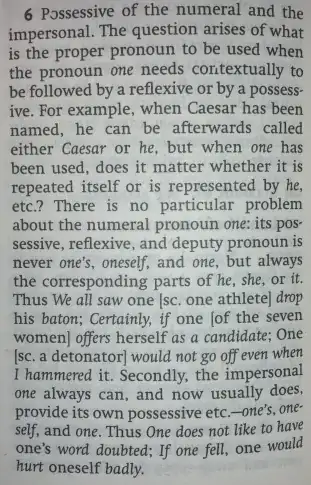
This is more of a distributive than a reflexive (or reciprocal) pronoun. However, that usually applies each of a plural subject singularly, which together are still many. You want something that picks out just one, and still has grammatical agreement. This is perhaps easier done with rephrasing, but many native speakers will use something involving their or own, or sometimes both.
You will not see an exact English equivalent to Russian свой because it has grammatical agreement with the subject of the sentence no matter what the person is. Or at least, that’s what they say here.
It looks to me like it can not only match any one of the plural subject, it can match each of them separately. If so, that makes it a distributive pronoun, and English doesn’t really have one of those. We tend to add words like own or even respectively, but that doesn’t work everywhere.
English either, which means just one of two (rarely, more) things, normally take singular agreement, which may perhaps be what is troubling you here. One solution is to apply own, like this:
- By tomorrow, either of us will see money in our own account.
- By tomorrow, either of you will see money in your own account.
- By tomorrow, either of them will see money in their own account.
No, it isn’t always a perfect solution, but at least and there may be a bit of ambiguity left, but at least that way you don’t have to switch persons for the account. The own lets you use a plural pronoun but apply it singularly to just one of them.
The referenced Wikipedia article on distributive pronouns neglects to name a much closer language to English than Hebrew has one having such a thing. Spanish has words corresponding to English each (cada), both (ambos), and all (todos), but which applies distributively to just one per. That is sendos, which means one for each of two or more persons or things. It has no exact one-for-one translation into English, no moreso than does your Russian word. (Like the Spanish word for both — ambos — sendos is defective in that it has no corresponding singular. It is inherently plural.)
Normally, both in English is also automatically plural because by default it applies to each together. Sometimes, however, it can apply to each of two things singularly. So sometimes we do use both distributively, as in:
- I gave both (of them) dollar of their own.
which has the sense of each of them separately receiving a dollar, but talks about them in the plural. That’s because own somewhat distributes to each:
- He gave each of us our own dollar.
That clearly talks about individual ownership.
However, in your Russian case, that doesn’t quite apply, because it is an exclusive individual, someone this way:
- One of us will keep it for our very own.
That’s not an altogether uncommon pattern in English, although it may be unsettling to some fussbudgets. It’s certainly a whole lot better than saying any of:
- One of us will keep it for that person’s own.
- One of us will keep it for their own.
Although that does lead to one possible alternate rephrasing of your original to dodge the issue of which pronoun (well, possessive determiner) in the second part by using a possessive noun instead:
- By tomorrow, either of us will see it in that person’s account.
- By tomorrow, either of you will see it in that person’s account.
- By tomorrow, either of them will see it in that person’s account.
That seems a bit unnatural to me, though. It is perhaps especially odd to use that sort of thing in the first or second persons. That normally is for something away from the speaker, and you just can’t say *in this person’s account for talking about oneself.