In words such as salad /sæləd/, you have a VCV pattern (vowel-consonant-vowel), in which the first vowel is short. The syllable division of such words is generally done after the consonant, i.e, as VC-V. Here are a few examples:
salad /sæl-əd/
lemon /lem-ən/
never /nev-ər/
balance /bæl-əns/
This division is in agreement with the notion that generally, a short vowel do not end a syllable.
Cambridge and the American Heritage dictionaries divide these words this way. Also, phonics and spelling textbooks do the same. However, Merriam-Webster dictionaries, such as the Collegiate and the Unabridged, divide these words before the consonant. So you have:
salad /sæ-ləd/
lemon /le-mən/
never /ne-vər/
balance /bæ-ləns/
I would like to ask why there is such a disagreement between the dictionaries, and which division is natural for you. You may want to mention whether your English is American, British or other.

- 435
-
2Determining why different dictionaries do things differently is not under the purview of this site. – Robusto Dec 01 '12 at 16:08
-
4@Robusto: The reason for which English dictionaries do things differently may be explained through the history and characteristics of the English language. On the other hand, the fact that English dictionaries do things differently my explain phenomena of the English language. – Bohoo Dec 01 '12 at 16:24
-
"[T]he fact that English dictionaries do things differently [may] explain phenomena of the English language": can you explain that hypothesis, and what you are hoping to learn about the language from such an exercise? – Robusto Dec 01 '12 at 16:34
-
1@Robusto: When you are learning a subject, it is of a value to be exposed to different treatments of it by different scholars. Dictionaries do a lot of things differently, and some of these differences can definitely teach us somethings about English Language and Usage. – Bohoo Dec 01 '12 at 19:19
-
1I am astonished this question was closed. What could be more interesting and relevant to a site about the English language than a good question about ambiguous syllable division! The fact that the question originated from inspecting dictionaries seems hardly relevant. – nohat Dec 15 '12 at 02:23
4 Answers
Syllable division in English is very complicated, and almost none of the dictionaries do it right. At least, according to John Wells, one of the experts on the subject (I assume he believes his own dictionary, the Longman Pronunciation Dictionary, gets it correct. See also this blog entry of his.)
Simplifying Wells' argument drastically, I believe he is saying that in these cases, if the first syllable is stressed, the consonant affects the length of the previous vowel (e.g., high tens and heightens are pronounced differently). Thus, if the first syllable is stressed, the consonant should go with the first syllable.

- 88,407
-
-
You might be right regarding Wells. It will be of a value if one can confirm that in the Longman Pronunciation Dictionary these words are divided VC-V. – Bohoo Dec 01 '12 at 18:53
-
-
2@Bohoo, yes, I confirm that in LPD-3 (Wells 2008) "salad", "lemon", "balance", and "never" are divided CVC-V(C). – Alex B. Dec 15 '12 at 02:35
Since you ask about personal use:
In my speech, the consonant heads the following syllable: ne - ver, ba - lance. This is my idiolect, which is basically educated East Alabama speech; and it was confirmed by my speech instructors when I was a student of acting.
In writing, however, if I were compelled to hyphenate such a word at the end of a line of text, I would place the hyphen after the consonant, because leaving the bare vowel at the end of a line would lead the reader to expect a word in which it is long. (With such short words, however, I would make every effort to avoid hyphenation.)
It would not surprise me to find that it is just such conflicting uses which leads to the disagreement between dictionaries.

- 68,905
-
2I'm not really clear on what you mean by "in my speech" there. It seems to me that in my speech there's no meaningful division that associates the middle consonant more strongly with either the preceding or the following syllable. It only becomes an issue if you're writing it, in some context where you either need to hyphenate, or to separate the syllables so you can indicate which one is stressed. In effect, it seems to be just a matter of orthography to me. – FumbleFingers Dec 01 '12 at 16:53
-
1@FumbleFingers Consider, however, the singer — in “Somewhere over the rainbow” (in the originally published key of C — Garland sang it in G), is the /v/ included in the B, or does it start the G? The actor speaking Lear’s “Never, never, never, never, never” faces the same problem. – StoneyB on hiatus Dec 01 '12 at 18:01
-
Wells argued that only coda /t/ can be flapped in AmE. Do you really not flap /t/ in e.g. better (assuming Wells's description matches your idiolect)? Another argument against the syllabifications /nɛ.vψ̩/ and /ˈbæ.lən(t)s/ is that they put /æ/ and /ɛ/ in open syllables, which (except in a few interjections) is phonotactically forbidden otherwise. Do you have words that end in /æ/ or /ɛ/? – Mechanical snail Dec 12 '12 at 03:50
-
@Mechanicalsnail I can't think of any -Cæ or -Cɛ words. But if I get real down-home, I diphthongalize actual closed syllables: the name ‘Bev’ is /bɛəv/ or even / bɛjəv/; ‘Hal’ is something like /hæəl/, almost /hæʊ/. And in fact in ordinary rapid speech, the medial consonant in balance almost disappears; it’s almost /bæʊnts/. – StoneyB on hiatus Dec 15 '12 at 04:09
-
@Mechanicalsnail As for the /t/ in better—I'm not entirely clear what Wells is describing, but mine's deaspirated and somewhat voiced. – StoneyB on hiatus Dec 15 '12 at 04:25
-
@StoneyB: Which are evidence that they're part of the coda of the preceding syllable (/bet.r̩/, /bæl.n̩ts/). /l/-vocalization and voicing of /t/ are common in syllable codas, but do not occur in syllable onsets. – Mechanical snail Dec 15 '12 at 09:59
-
@Mechanicalsnail I've read Wells more carefully now; and it seems to me that what he's done is redefine “syllable” as a linguistic rather than a physiological fact. Which is fine, as long as the distinction is understood. – StoneyB on hiatus Dec 15 '12 at 14:22
I am undercertain whether you asking about syllables, or about hyphenation, or both, but as far as hyphenation is concerned, the standard Knuth–Liang hyphenation algorithm (used not only by TeX but by many other pieces of software) says that one should hyphenate those four words this way:
- sal·ad
- lemon
- nev·er
- bal·ance
Yes, that’s right: they say you should not hyphenate lemon at all. On the other hand, Bringhurst’s first rule of hyphenation, located on page 42 of version 3.2 of The Elements of Typographic Style, says that:
2.4.1 At hyphenated line-ends, leave at least two characters behind and take at least three forward.
Fi-nally is conventionally acceptable line-end hyphenation, but final-ly is not, because it takes too little of the word forward.
Therefore according to Bringhurst, only bal-ance is acceptable from your initial set, since it is the only one that carries at least three letters forward.
How hyphenation aligns with perceived syllabication, however, is a more complex matter.


-
My question is about syllables, but since hyphenation and syllable division are not unrelated, I will see if learning more about hyphenation will illuminate this issue. – Bohoo Dec 01 '12 at 18:36
Does it really matter? I think that, whether or I say nev·ər, or ne·vər, once it's put together and spoken as a two-syllable word, it's going to come out as the same nevər, irrespective of where I might divide the word – if I can even discern where the syllables might happen to be separated, and that might not be so easy to figure out. Truth be told, it's something I don't think about, it's something I would have trouble determining, and it doesn't effect how I pronounce words like these.
The only time I've ever been concerned about the proper division of such words has been when I've needed to hyphenate one. Then, I've simply consulted a dictionary.
If different dictionaries show different breaks, then I suppose you could hyphenate the word in either place.
M-W's online dictionary entry for lemon is interesting, in that it shows the word broken into syllables between the m and o, yet its pronunciation guide shows a break between the e and m:
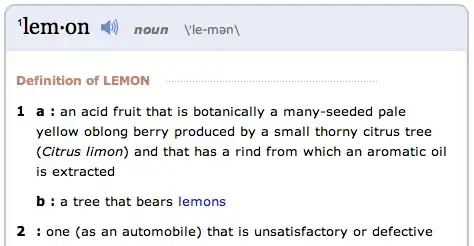
It's hard to tell if that's intentional (and, if so, what that means), or if that's just evidence that M-W is a lemon of a dictionary. For what it's worth, HM's American Heritage is more consistent in this matter:
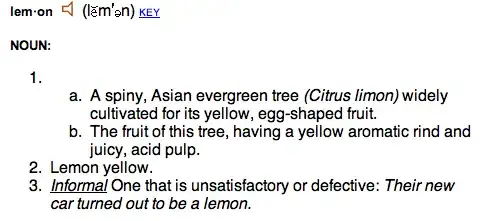

- 58,828
- 5
- 95
- 196
-
1I think you’ve correctly identified that this syllabication quest is a useless wild goose chase with no meaning or applicability. – tchrist Dec 01 '12 at 20:04
-
1It might matter when you learn or teach English pronunciation.The way people actually divide words into syllables is part of the phonetics of the language. Besides, if it didn't matter, dictionaries wouldn't indicate it, and many studies regarding how people actually divide words wouldn't be conducted. – Bohoo Dec 01 '12 at 20:36
-
@Bohoo: Please don't mis·in·ter·pret what I am say·ing. I un·der·stand that most words have clear·ly de·lin·e·at·ed syl·la·bles. But you spe·cif·i·cal·ly asked a·bout words that are so hard to de·ter·mine how the words are di·vid·ed, e·ven the dic·tion·ar·ies don't a·gree! In those ca·ses, the di·vi·sions are much more ar·bi·trar·y. You asked, "Which di·vi·sions are more nat·u·ral for you?" I an·swered can·did·ly: I don't know, I can't tell, and it has no ef·fect on how I pro·nounce those words. But my an·swer is·n't meant to im·ply that syl·lab·i·fi·ca·tion is never rel·e·vant. – J.R. Dec 01 '12 at 21:22
-
@Bohoo: BTW, I've written about syllabification on ELU before. Once again, my answer here isn't meant to say that syllabification "doesn't matter," or isn't part of language. But one dictionary might say le·mon, and another lem·on, and I wouldn't call either one "wrong." I'd simply say, "Yes, that is a tricky one to figure out; it can be broken in either place." – J.R. Dec 01 '12 at 21:36
-
@tchrist: Are you seriously suggesting that syllabification is a useless concept? That's like John Lawler saying that 'parts of speech' is useless. Just because a concept is not (yet) simple doesn't mean you dismiss it altogether. – Mitch Dec 01 '12 at 22:28
-
-
@J.R.: Sorry for the misinterpretation. Regarding the case of the word lemon you have pointed out - the word is not unique, all the words of that kind are treated this way by M-W and American Heritage. – Bohoo Dec 01 '12 at 23:33
-
Bohoo: That's some pretty nice detective work for you to have picked up on that trend. As for why the editors have opted to use that convention, the front matter of a print edition might explain that, but that's just a possibility. – J.R. Dec 01 '12 at 23:44
-
-
1Syllabification can be important in English. Consider the pronunciation difference between White·stone and Whites·tone—there's a substantial difference there. The difference between lem·on and le·mon is much smaller. In another question on this site, I realized that I say wait·ress and many other people say wai·tress (although I think John Wells argues it's waitr·ess). I never noticed this difference until it came up in the comments there. – Peter Shor Dec 08 '12 at 15:20
-
@PeterShor: I didn't mean to trivialize syllabification as a whole, but I did want to point out that some words pretty much sound the same even if you shift the syllable break by one character. On the other hand, there are some other interesting cases, like threshold, which seems to need an extra h (at least in my mind), because I use the h to make the sh sound, yet I pronounce it more like thresh·hold than thresh·old. – J.R. Dec 08 '12 at 17:40
-
I agree that for the example words given there is no fully principled way to decide what the syllabification should be, and nothing in the speech signal to suggest an answer. the syllable boundary in question is foot-internal and in these particular words the consonant might even be fully vocalized in rapid speech. useful tricks like expletive infixation won't work either. do you say le-fucking-mon or lem-fucking-on?. for english disyllabic trochaic words, the correct answer is "who cares?" – Dec 15 '12 at 03:03
-
@tchrist: It explains which allophones of /t/ are possible in a given context. When the segment following the first vowel is voiceless, it determines whether the first vowel will be allophonically shortened by having a voiceless segment in the syllable coda. – Mechanical snail Dec 15 '12 at 10:03
-
Syllabification is very important to language learners and teachers. For example, Catford 2002 argues that English speech is delivered in a series of isochronous and isodynamic feet, whereas in French and Japanese speech is delivered in a series of isochronous and isodynamic syllables. – Alex B. Dec 15 '12 at 18:24