S-R-G-m-P-d-n-S
Adopted from a Carnatic ragam, Charukeshi (‘One with Beautiful Hair’) calls for wide-open melodic exploration, favouring long lines which wind around themselves while visiting the furthest reaches of all three octaves. Like many Southern scales, it may be used as a canvas for recolouring multiple ideas from adjacent ragas (see avirbhav–tirobhav), while itself presenting an odd marriage of Major and Minor – with an ‘all-shuddha‘ poorvang (SRGm) and ‘all-komal‘ uttarang (PdnS) offering contrasting emotional shades (Aarshin Karande: “Charukeshi possesses multiple personalities, and lends itself well to contradictory emotions and moods”). Assumed to be a recent addition to the Northern ragascape, based on its lack of inclusion in Rao’s 1956 Raga Nidhi Vol. 1 (which states that “there is no raga called ‘Charukeshi’ in Hindustani sangeet“) – although S.N. Ratanjankar and Ravi Shankar were performing it soon after this date. Perennially popular for North-South jugalbandis (e.g. Purbayan Chatterjee & Shashank Subramanyam in Darbar VR360). Also compare to its murchana partners Patdeep, Ahiri, and Vachaspati – as well as Shankar’s other Carnatic imports, notably including Kirwani, Malay Marutam, and Simhendra Madhyamam.
• Raga Megalist (365+) •
राग चारुकेशी

Search | Glossary | Tags
• Hindustani Raga Index •


Context | Melodics | Classifiers | Listenings | More
Aroha: SRGmPdnS
Avroh: SndP, mGRS, dnS
Chalan: variable – e.g. dnSRGmGR; RGmdP; RGmRS

• Support open-access, ad-free raga musicology by joining my brand-new PATREON (launched mid-2024). And if you’re seeking to learn raga on non-standard instruments…get started with online lessons!
–Shahid Parvez (2012)–
“I just heard Charukeshi and liked it. It was easier because it was a melakarta raga. I observed that in Carnatic music when they sing it, they treat the notes equally…There is no vadi-samvadi in the scale…I felt free to play it, and didn’t have to worry! But I didn’t dare with other ragas.” (Ravi Shankar)

—Context—
Origins, myths, quirks, & more
[COMING SOON: click here to hasten the project’s expansion, so all 365+ raga pages can eventually look more like these]
—Phraseologies—
Melodies, movements, characteristics…
[coming soon]
—Parichay demo (2021)—
“The Hindustani instinct is to view Charukeshi’s scale in terms of already-familiar templates. Thus, for instance, the poorvang cluster, SRGm, suggests itself as a staging ground for Nat-like behaviour. That would entail positing a powerful ma with concomitant dilution of Ga (e.g. Ramrang), while an alternative is to advance Ga (e.g. Ravi Shankar). Similarly, the uttarang opportunities include Asavari (and through it, Darbari-like behaviour) and Bhairavi – while the strength and importance of the dha nyas seems to have been appreciated by all. The S(n)d vault in avroh brings in a fleeting avirbhav of Darbari, but since the full Darbari machinery is not employed, the promise remains unfulfilled. Bridging the poorvang-uttarang interface is yet another familiar phrase: the definitive Bhairav cluster Gmd, dP…” (Parrikar)
—Listen—
A brief selection of superb renditions
–Manu Seen (2015)–
- Imdadkhani sitar (7m): a captivating solo take from the senior disciple of Shahid Parvez, filmed for Darbar near Amritsar – with their gharana‘s fierce right-hand techniques in full effect on long lines which leap through the raga’s full scale form at pace (Rik Raunaak: “like an endless tapestry in space…”):
[jhalla sangatis, e.g. 3:32] (d)nd, (n)Sn, (G)mR, (S)RS…
–Ajoy Chakraborty (2006)–
- Patiala khayal (11m): a self-composed thumri (Saiyan Mora Din Rajni Kaise Beetey) including various mishra flourishes accentuated by his own harmonium accompaniment – with Chiranjib Chakraborty on a second harmonium, and the late Subhankar Banerjee on tabla (“With a pathos-laden gait, Pandit Chakraborty wanders across a romantic, poignant sea of emotions, broadening the canvas by bringing in vignettes of other ragas“: also hear his daughter Kaushiki’s Mishra Charukeshi):
[mishra themes, e.g. 0:45] SR(GRGmGR)S (NSNSR)S (ndm)m; S(NSNS) (N)S, S(RSNSN)n, dnS (nS)P, Pd(N)S S(N)S; Pd(nSRgRSndP)n, (gRg)S nd…
–Further Recordings–
- Ravi Shankar (6m): another excerpt from the raga’s primary borrower, from an unknown TV show with Alla Rakha on tabla
- Ramrang (9m): Parrikar: “from a whole suite in Charukeshi; exquisite, every matra of the tala and the swara are coupled…”
- Rashid Khan (14m): using the scale’s sampurna freedoms in a soothing performance, drenched with swarmandal strums
- Kala Ramnath (16m): at Komal Nishad 2010 with Mithilesh Jha on tabla, the violin hints at the raga’s Carnatic roots
- Amir Khan (17m): a vilambit refrain from an unknown baithak, with recurring phrases centred around GmRS; n(dn)S
- Shivkumar Sharma (22m): a finely-balanced compositional suite, building outwards from launchphrases of mPdSn
- Nikhil Banerjee (23m): for Harmonia Mundi, featuring an unusually rapid-cycling tanpura sequence (G-P-S-S-S)
- Sanjeev Abhyankar (28m): a pristine Mewati interpretation, released on his 1996 Following the Footsteps album
- Debashish Bhattacharya (63m): a well-filmed performance featuring razor-sharp interplay with Kumar Bose on tabla
- Sultan Khan (60m): from his well-known Sonorous Sound of Sarangi album, with Zakir Hussain on fantastic form

• Carnatic Origins •
—Ragam Charukeshi—
(Mandolin Srinivas)
[All ragas of Carnatic origin]
• Classifiers •
Explore hidden inter-raga connections: swara geometries, melodic features, murchana sets, ragangas, & more (also see the Full Tag List):
Swaras: -4 | 5 | 6 | 7 | 8 | 9 | 10+
Sapta: Audav | Shadav | Sampurna
Poorvang: SRGM | SRG | SRM | SGM
Uttarang: PDNS | PDS | PNS | DNS
Varjit: Re | Ga | Ma | Pa | Dha | Ni
Double: rR | gG | mM | dD | nN
Thaat: 10 | 32 | Enclosed | Inexact
Chal: All-shuddha | All-komal | Ma-tivra
Gaps: Anh. | Hemi. | 3-row | 4-row | 5-row
Symmetries: Mirror | Rotation | Palindr.
Aroha: Audav | Shadav | Sampurna
Avroh: Audav | Shadav | Sampurna
Jati: Equal | Balanced | Av.+1 | Av.+2
Samay: Morning | Aftern. | Eve. | Night
Murchana: Bhup. | Bihag | Bilaw. | Charu.
Raganga: Bhairav | Malhar | Kan. | Todi
Construction: Jod | Mishra | Oddball
Origin: Ancient | Carnatic | Modern
Dominance: Poorvang | Uttarang
Prevalence: A-list | Prachalit | Aprach.
• Prakriti: Thaat #27, Malayalam
–Proximate Forms–
Khamaj = ‘Charukeshi shuddha Dha‘
Nat Bhairav = ‘Charukeshi shuddha Ni‘
Darbari = ‘Charukeshi komal ga‘
Basant Mukhari = ‘Charukeshi komal re‘
Gangeshwari = ‘Charukeshi no Re‘
Imratkauns = ‘Charukeshi no Pa‘
Zeelaf = ‘Charukeshi no Re/ni‘
(n.b. these are just ‘scalar similarities’, with nothing particular implied about phraseological overlap)

–Swara Geometries–
• Core form: S–R–G–m–P–d–n–S
• Reverse: SRGmPdnS (=itself)
• Negative: 2-2-3-3-2 (e.g. Tivrakauns)
• Imperfect: 3 (Re, Ga, dha)
• Detached: 2 (Ga, dha)
• Symmetries: mirror (S—M)
• Murchanas: Charukeshi set
• Quirks: ‘palindromic‘ (same intervals forwards & backwards) • ‘maximal‘ (swaras are optimally ‘spread out’)
–Global Translations–
• Carnatic: Charukeshi
S-R2-G3-M1-P-D1-N2-S
• Jazz: Major-Minor
1-2-3-4-5-b6-b7-8
• Pitch classes (‘fret-jumps’):
0-2-4-5-7-8-10-0
(2–2–1–2–1–2–2)
o • o • o o • o o • o • o

–Around the World–
Charukeshi’s ‘Mixolydian b6‘ scale also makes a curious appearance in classic rock – namely, as a main element of Led Zeppelin’s Ten Years Gone, from the 1975 Physical Graffiti album. This may well be no coincidence – Zeppelin were broad listeners, using tabla on Black Mountain Side, and Jimmy Page’s layered guitars here are reminiscent of a sitar’s sparkle. So I’d wager that Page may have been putting some recordings of Charukeshi on his stereo. Producer Rick Rubin’s description of Zeppelin’s track could certainly fit many renditions of the raga too: “A deep, reflective piece with hypnotic, interweaving riffs. Light and dark, shadow and glare. It sounds like nature coming through the speakers…”.
—Ten Years Gone (UK)—
(Led Zeppelin, 1975)
• Tanpura: Sa–Pa (+dha)
• Names: Charukeshi, Charukesi, Carukesi, Chaarokeshi, ‘Hindustan mode’
• Transliterations: Hindi (चारुकेशी)
—More—
Further info: links, listenings, learnings, etc
- Raag Charukeshi: [coming soon]
- Header audio: Elaboration by Sikar sarangiya Sultan Khan (2002)
- Header image: 13th-century musical instrument carvings from the Keshava Temple in Somanathapur, Karnataka (Commons)
• Get started with learning raga! •
Share these ragas! My site is 100% reliant on organic visitors (and none of your donations go to ad agencies…) – share this with fellow sonic searchers!
[Join my PATREON!]
Like everything on my site, the Raga Index will always remain open-access & ad-free: however, anti-corporate musicology doesn’t pay the bills! I put as much into these resources as time and finances allow – so, to hasten the project’s expansion, you can:
• Support the Raga Index! •
—Riyaz-focused notations & bandish—
—Resurrecting rare and ancient ragas—
—Further melodic & geometric analysis—
—Engaging with Hindustani performers—
—Ensuring that high-quality raga knowledge will remain open to all, at no cost: free from commercial motive!—

—Hindustani Raga Index—
An open-ended project seeking to bring North Indian raga closer to all who approach with open ears. Combines direct input from dozens of leading Hindustani artists with in-depth insights from music history, global theory, performance practice, cognitive science, and much more besides!
–Megalist (365+ ragas)–
• Search: Find your new favourite •
• Tags: Classifying the ragascape •
• Glossary: Raga jargon demystified •
• Murchanas: Swara-set rotations •
• Thaat: Bhatkhande’s base scales •
• Ragatable: Analytical connections •
• Tanpuras: Divine overtonal drones •
• Quotes: Musings from raga artists •
• Talas: Hindustani rhythm cycles •
• Instruments: Singing sculptures •
Sa | Re | Ga | Ma | Pa | Dha | Ni
[Random Raga]
—Search the Raga Index—
• Feedback / Contact •
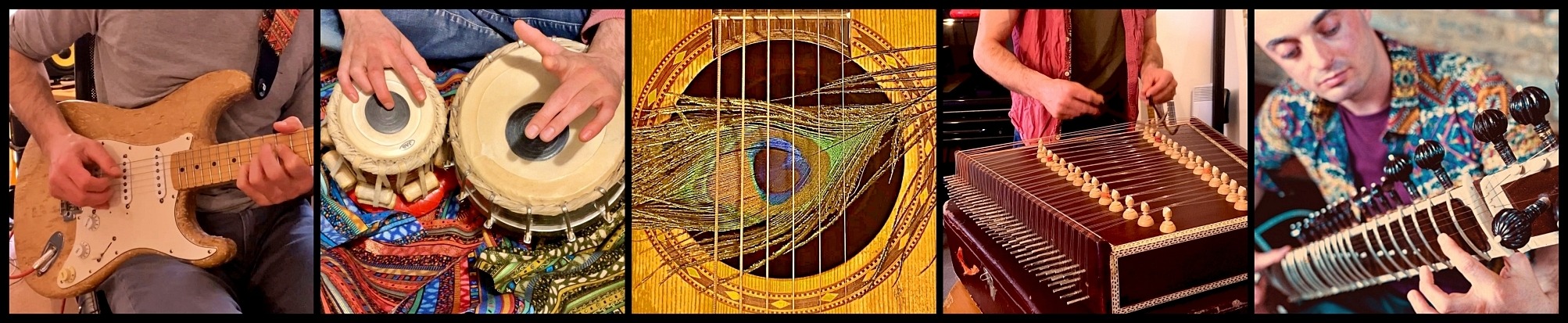
George Howlett is a London-based musician, writer, and teacher (guitars, sitar, tabla, & santoor). Above all I seek to enthuse fellow sonic searchers, interconnecting fresh vibrations with the voices, cultures, and passions behind them. See Homepage for more, and hit me up for Lessons!
• Projects & articles: full list •
[Join the Patreon!]