S-R-G-m-P-D-N-S
Profiled by Parrikar as “a compound melody formed by joining elements of Chaya to the Malhar raganga signature [mRm\RP]…The nyas on Pa is important, but an inapposite nyas on Re or undue brightening of ma may tilt the development towards Nat Malhar”. Listen to his Gwalior guru Ramrang’s rendition, seasoned with a particularly prominent P\R antara meend – as well as Bhimsen Joshi‘s numerous takes, sometimes performed in conjunction with Chaya itself (bandish transcribed below). Aside from this pair of pioneering vocalists, nobody else seems to have formally recorded the raga – and neither can I ascertain much about its origins (although Savitri‘s writeup describes it as “a stamp of the Gwalior school”).
• Raga Megalist (365+) •
राग छाया मल्हार

Search | Glossary | Tags
• Hindustani Raga Index •

—Bhimsen Joshi (1960s)—
[bandish, e.g. 0:41] GRG R, GmG S, G\R, S SR, GmG(RS)R, N N\P, (P)NS, (NS)R, Gm(GR)G, RSR, S, S(NRS), R, Gm(GR)G…

• Support open-access, ad-free raga musicology by joining my brand-new PATREON (launched mid-2024). And if you’re seeking to learn raga on non-standard instruments…get started with online lessons!

• Classifiers •
Explore hidden inter-raga connections: swara geometries, melodic features, murchana sets, ragangas, & more (also see the Full Tag List):
Swaras: -4 | 5 | 6 | 7 | 8 | 9 | 10+
Sapta: Audav | Shadav | Sampurna
Poorvang: SRGM | SRG | SRM | SGM
Uttarang: PDNS | PDS | PNS | DNS
Varjit: Re | Ga | Ma | Pa | Dha | Ni
Double: rR | gG | mM | dD | nN
Thaat: 10 | 32 | Enclosed | Inexact
Chal: All-shuddha | All-komal | Ma-tivra
Gaps: Anh. | Hemi. | 3-row | 4-row | 5-row
Symmetries: Mirror | Rotation | Palindr.
Aroha: Audav | Shadav | Sampurna
Avroh: Audav | Shadav | Sampurna
Jati: Equal | Balanced | Av.+1 | Av.+2
Samay: Morning | Aftern. | Eve. | Night
Murchana: Bhup. | Bihag | Bilaw. | Charu.
Raganga: Bhairav | Malhar | Kan. | Todi
Construction: Jod | Mishra | Oddball
Origin: Ancient | Carnatic | Modern
Dominance: Poorvang | Uttarang
Prevalence: A-list | Prachalit | Aprach.
• Prakriti: Bilawal thaat, Bilawal, Tilak Kamod, Nat, Hem Bihag, Bihari, Savani, Swanandi, Gagan Vihang, Maluha, Mand, Hemant, Manjari Bihag
–Proximate Forms–
Khamaj = ‘Chaya Malhar komal ni‘
Patdeep = ‘Chaya Malhar komal ga‘
Yaman = ‘Chaya Malhar tivra Ma‘
Bihag = ‘Chaya Malhar double Ma‘
Nat Bhairav = ‘Chaya Malhar komal dha‘
Bhatiyari Bhairav = ‘Chaya Malhar komal re‘
(n.b. these are just ‘scalar similarities’, with nothing particular implied about phraseological overlap)

–Swara Geometries–
• Core form: S–R–G–m–P–D–N–S
• Reverse: SrgmPdnS (=Bhairavi)
• Negative: 3-2-3-2-2 (e.g. Malkauns)
• Imperfect: 1 (Ni)
• Detached: none
• Symmetries: mirror (R—d)
• Murchanas: Bilawal set
• Quirks: ‘maximal‘ (swaras are optimally ‘spread out’)
–Global Translations–
• Carnatic: ~Sankarabharanam
S-R2-G3-M1-P-D2-N3-S
• Jazz: Major / Ionian
1-2-3-4-5-6-7-8
• Pitch classes (‘fret-jumps’):
0-2-4-5-7-9-11-0
(2–2–1–2–2–2–1)
o • o • o o • o • o • o o

• Tanpura: Sa–Pa
• Names: Chaya Malhar, Chhaya Malhar
• Transliterations: Hindi (छाया मल्हार); Bengali (ছায়া মল্লার)
—Bhimsen Joshi (1968)—
• Get started with learning raga! •
Share these ragas! My site is 100% reliant on organic visitors (and none of your donations go to ad agencies…) – share this with fellow sonic searchers!
[Join my PATREON!]
Like everything on my site, the Raga Index will always remain open-access & ad-free: however, anti-corporate musicology doesn’t pay the bills! I put as much into these resources as time and finances allow – so, to hasten the project’s expansion, you can:
• Support the Raga Index! •
—Riyaz-focused notations & bandish—
—Resurrecting rare and ancient ragas—
—Further melodic & geometric analysis—
—Engaging with Hindustani performers—
—Ensuring that high-quality raga knowledge will remain open to all, at no cost: free from commercial motive!—

—Hindustani Raga Index—
An open-ended project seeking to bring North Indian raga closer to all who approach with open ears. Combines direct input from dozens of leading Hindustani artists with in-depth insights from music history, global theory, performance practice, cognitive science, and much more besides!
–Megalist (365+ ragas)–
• Search: Find your new favourite •
• Tags: Classifying the ragascape •
• Glossary: Raga jargon demystified •
• Murchanas: Swara-set rotations •
• Thaat: Bhatkhande’s base scales •
• Ragatable: Analytical connections •
• Tanpuras: Divine overtonal drones •
• Quotes: Musings from raga artists •
• Talas: Hindustani rhythm cycles •
• Instruments: Singing sculptures •
Sa | Re | Ga | Ma | Pa | Dha | Ni
[Random Raga]
—Search the Raga Index—
• Feedback / Contact •
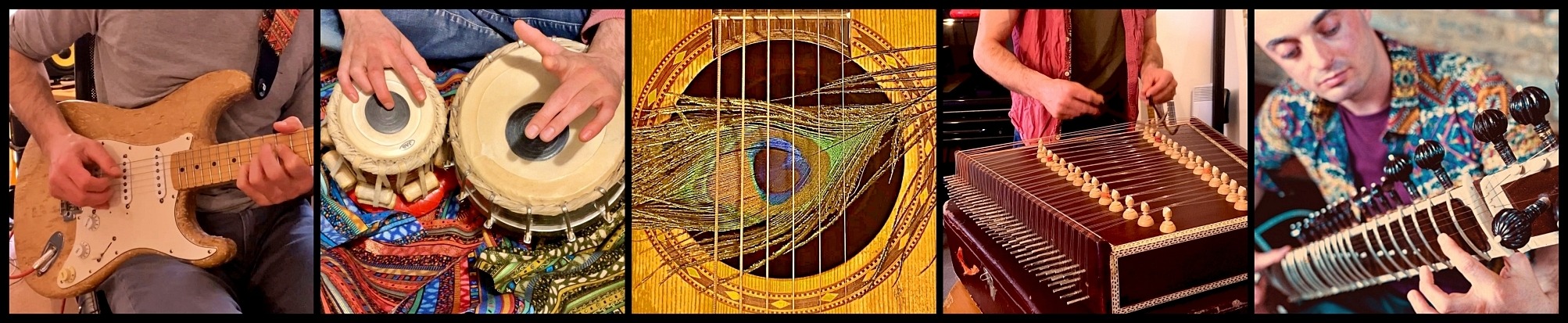
George Howlett is a London-based musician, writer, and teacher (guitars, sitar, tabla, & santoor). Above all I seek to enthuse fellow sonic searchers, interconnecting fresh vibrations with the voices, cultures, and passions behind them. See Homepage for more, and hit me up for Lessons!
• Projects & articles: full list •
[Join the Patreon!]