S-r-m-P-d-S
An enchanting morning raga, matching the swara set of ‘Bhupali komal re/dha’ (or ‘Shobhawari komal re’), described by Tanarang as “an epitome of bhakti and karuna…straightforward, and expandable in all three octaves”. While audav at its core, multivariate forms of the raga are in existence: some include shades of shuddha Ga in avroh (bringing hints of Bhairav), and Kumar Gandharva’s ever-unconventional take also features varied use of both Ga and Ni – while Aarshin Karande‘s rendition of a Sufi-infused bandish exemplifies an older Jogiya-ang interpretation from the Mewati tradition. Also refer to a concise demo by Ajoy Chakraborty, a superb performance by Kedar Bodas (transcribed below), and a captivating bandish by Ramrang (“describing Shiva’s visit to Brindavan to see baby Krishna, the text verbalises the great Yogi’s response to an apprehensive Jashoda”). Generally considered distinct to Gunakri, despite considerable overlap – with their basic SrmPdS scale shape also forming an exact Ga-murchana of Kaushik Dhwani – and approximating the ‘In / Miyakobushi‘ mode of Japanese court music.
• Raga Megalist (365+) •
राग गुणकली
Search | Glossary | Tags
• Hindustani Raga Index •

—Kedar Bodas (2015)—
[bandish, e.g. 7:43] d P m, (P)m\r, rS(rS) PP, (S)dd P(d)P m(P)m\r(m)r S, Pm r(m)r S(r)S d(S)dS, rrS S(PmP)m m\rr rS S\dd rS (S)PmmP, dPdmPdd, Pdd, Pdd P m…

• Support open-access, ad-free raga musicology by joining my brand-new PATREON (launched mid-2024). And if you’re seeking to learn raga on non-standard instruments…get started with online lessons!

• Ragmalas •
Historic miniature paintings (learn more)

“Gunakali Ragini, from a Rajasthani folio: opaque watercolor and gold on paper” (Jaipur, c.1760) / “This unfinished painting of Gunakali gives us insight into how ragmala artists created their works. After the master’s outline is completed, the sketch would be handed to junior artists in the workshop: to block in colors with brushes, make pinpricks into gold areas with a blunt needle, and rub a smooth stone over the back of the painting to make the pigments glossy. Then, the painting was returned to the master artist for its final details. Only natural materials were used: organic inks and dyes, conch shells, vegetable colors and minerals, including precious stones, pure gold, silver, zinc, and lead…” (Bundi, c.1680)

• Classifiers •
Explore hidden inter-raga connections: swara geometries, melodic features, murchana sets, ragangas, & more (also see the Full Tag List):
Swaras: -4 | 5 | 6 | 7 | 8 | 9 | 10+
Sapta: Audav | Shadav | Sampurna
Poorvang: SRGM | SRG | SRM | SGM
Uttarang: PDNS | PDS | PNS | DNS
Varjit: Re | Ga | Ma | Pa | Dha | Ni
Double: rR | gG | mM | dD | nN
Thaat: 10 | 32 | Enclosed | Inexact
Chal: All-shuddha | All-komal | Ma-tivra
Gaps: Anh. | Hemi. | 3-row | 4-row | 5-row
Symmetries: Mirror | Rotation | Palindr.
Aroha: Audav | Shadav | Sampurna
Avroh: Audav | Shadav | Sampurna
Jati: Equal | Balanced | Av.+1 | Av.+2
Samay: Morning | Aftern. | Eve. | Night
Murchana: Bhup. | Bihag | Bilaw. | Charu.
Raganga: Bhairav | Malhar | Kan. | Todi
Construction: Jod | Mishra | Oddball
Origin: Ancient | Carnatic | Modern
Dominance: Poorvang | Uttarang
Prevalence: A-list | Prachalit | Aprach.
• Prakriti: Gunakri
–Swara Geometries–
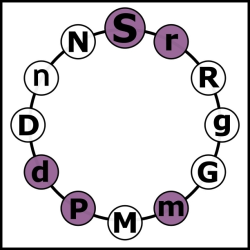
• Core form: S–r–m–P–d–S
• Reverse: SGmPNS
• Negative: 3-1-1-2-3-1-1 (e.g. Todi)
• Imperfect: 2 (Pa, dha)
• Detached: none
• Symmetries: none
• Murchanas: Kaushik Dhwani (on dha)
–Global Translations–
• Carnatic: ~Salanganata
S-R1-M1-P-D1-S
• Jazz: Phrygian (no 3rd/7th)
1-b2-4-5-b6-8
• Pitch classes (‘fret-jumps’):
0-1-5-7-8-0
(1–4–2–1–4)
o o • • • o • o o • • • o

• Tanpura: Sa–Pa (+dha)
• Names: Gunkali, Gunakali, Gunakari, Gunkeli (not Gunakri)
• Transliterations: Hindi (गुणकली); Bengali (গুণকেলী)
—Ajoy Chakraborty (~2000s)—
• Get started with learning raga! •
Share these ragas! My site is 100% reliant on organic visitors (and none of your donations go to ad agencies…) – share this with fellow sonic searchers!
[Join my PATREON!]
Like everything on my site, the Raga Index will always remain open-access & ad-free: however, anti-corporate musicology doesn’t pay the bills! I put as much into these resources as time and finances allow – so, to hasten the project’s expansion, you can:
• Support the Raga Index! •
—Riyaz-focused notations & bandish—
—Resurrecting rare and ancient ragas—
—Further melodic & geometric analysis—
—Engaging with Hindustani performers—
—Ensuring that high-quality raga knowledge will remain open to all, at no cost: free from commercial motive!—

—Hindustani Raga Index—
An open-ended project seeking to bring North Indian raga closer to all who approach with open ears. Combines direct input from dozens of leading Hindustani artists with in-depth insights from music history, global theory, performance practice, cognitive science, and much more besides!
–Megalist (365+ ragas)–
• Search: Find your new favourite •
• Tags: Classifying the ragascape •
• Glossary: Raga jargon demystified •
• Murchanas: Swara-set rotations •
• Thaat: Bhatkhande’s base scales •
• Ragatable: Analytical connections •
• Tanpuras: Divine overtonal drones •
• Quotes: Musings from raga artists •
• Talas: Hindustani rhythm cycles •
• Instruments: Singing sculptures •
Sa | Re | Ga | Ma | Pa | Dha | Ni
[Random Raga]
—Search the Raga Index—
• Feedback / Contact •
George Howlett is a London-based musician, writer, and teacher (guitars, sitar, tabla, & santoor). Above all I seek to enthuse fellow sonic searchers, interconnecting fresh vibrations with the voices, cultures, and passions behind them. See Homepage for more, and hit me up for Lessons!
• Projects & articles: full list •
[Join the Patreon!]