In Russian we have idiom/saying "To shoot out of cannon into sparrows" (literal translation) which is used to convey an idea of applying too drastic measures to small problems. I believe there should be some native-English equivalents to this saying. Can you share if there are any?
Asked
Active
Viewed 2.7k times
50

-
9This should probably be translated as "To shoot sparrows with a cannon". Sparrows are small but cannonballs are huge and simply obliterate tiny birds. – Jan 16 '13 at 11:58
-
6Yeah, as an American, I don't think the idiom is lost translated as "To shoot sparrows with a cannon." We have almost identical idioms that generally involves a small creature (typically an insect, but sometimes birds) with some large weapon or device, so while it may be a new version of the expression to most readers, it won't be lost on them. Personally, I would have more trouble with "to break a butterfly on the wheel" or "to crack a nut with a sledgehammer" than your version. – AJ Henderson Jan 16 '13 at 14:10
-
1I have often heard the supposed Confucius quote Never use a cannon to kill a fly. Although the word "overkill" seems to mean that entire sentence... it won't let me post as an answer. – Sled Jan 16 '13 at 16:41
-
"Use a cannon to shoot a mosquito." (Dutch.) – Jan 16 '13 at 13:31
-
2"Chop a chicken using the blade for cow" as in Chinese. – MeadowMuffins Jan 16 '13 at 14:49
-
5It's the exact same idiom in German, too: "Mit Kanonen auf Spatzen schießen." – Tim Pietzcker Jan 16 '13 at 18:51
-
And here I just thought the sparrows would fly around the cannon ball... – Jan 17 '13 at 20:36
10 Answers
54
We speak of using a sledgehammer to crack a nut.

Noah
- 13,490

Barrie England
- 140,205
-
8Interesting, I've never heard that one in America. The ones I've heard are always much closer to the original question. – AJ Henderson Jan 16 '13 at 14:12
-
1I'm wondering whether there may be a small difference in meaning though: A sledgehammer is likely to crack a nut, a gun is likely to be useful at a knife fight. But cannons are unlikely to hit a sparrow. What if we want to convey that the tools applied are not only overkill but also ill-suited for the task? – us2012 Jan 16 '13 at 14:30
-
@us2012: is that the connotation of the original phrase, inappropriate? "A woman needs a man like a fish needs a bicycle"? – Mitch Jan 16 '13 at 14:32
-
@Mitch: You would have to ask Mikhail about the connotations in Russian. The phrase exists in German, too, and I have been under the impression that it usually includes that connotation there. – us2012 Jan 16 '13 at 14:38
-
2@us2012 a cannon loaded with canister shot would have a good chance of taking out the sparrow. – Jon Hanna Jan 16 '13 at 14:48
-
-
1I don't think I've ever heard the sledge hammer-nut one (and as I kid, did use a baby sledge on hickory nuts occasionally). Instead I'd use "using a sledgehammer to crack an egg", or "nuclear fly swatter" depending on how hyperbolic I wanted to be. – Dan Is Fiddling By Firelight Jan 16 '13 at 15:25
-
2Surcouf once loaded his guns with gold coins. That definitely works against British troops, so it probably works against sparrows. – Kheldar Jan 16 '13 at 15:40
-
2I haven't heard this one in America either, but I've heard the similar phrase "killing a fly with a sledgehammer" a number of times. – Briguy37 Jan 16 '13 at 15:42
-
I've heard variations of this one tons of times in the US. Usually it's not written like this, though - it's more like "Hammer, meet peanut". – Izkata Jan 16 '13 at 22:03
-
"Surcouf once loaded his guns with gold coins." Can somebody provide details on this or where to read about it? Sounds interesting... – Mike Feb 13 '13 at 06:56
-
32
Overkill is originally a military analysis term from the Cold War, referring to the fact that the belligerents each had far more nuclear weapons than they would need to completely destroy the other. These days it's generally used metaphorically to mean precisely the sort of excessive effort or excessive means you talk of.
Bring a gun to a knife-fight is another that comes from combat originally.

Jon Hanna
- 53,363
-
15
-
2
-
@Kheldar both are found, with clearly opposite meanings - of being under-prepared and hence in danger, or over-prepared and hence escalating things. Your version is more common, with this being by analogy. – Jon Hanna Jan 16 '13 at 15:04
-
Yes, indeed with the opposite meaning, I did not know the other existed. – Kheldar Jan 16 '13 at 15:39
-
3I had heard it as Don't bring a knife to a gunfight, but that particular phrase suffers from a lack of just. Nothing wrong with having a knife at a gunfight, as long as you have a gun, too. Also, as anyone who has been in close-quarters combat will tell you, having just a gun at a knife fight is not overkill, it is ineffective. – kojiro Jan 16 '13 at 19:08
-
@kojiro I have heard it said that knives can beat guns in the hands of trained opponents at very close quarters. Not being so-trained, and having never had to use any weapon more advanced than a fist or a forehead, I'm quite happy not knowing whether or not the analogy matches reality well or not :) – Jon Hanna Jan 16 '13 at 19:51
23
One American variant, "kill a mosquito with a bazooka".

Alex Feinman
- 871
-
1
-
1In spanish we say something very similar "Don't use a cannon to kill a mosquito" I think this is traced to Confucio. http://www.quoteworld.org/quotes/3150 – MGP Mar 15 '13 at 12:59
18
Two idioms would be:
- To crack a nut with a sledgehammer.
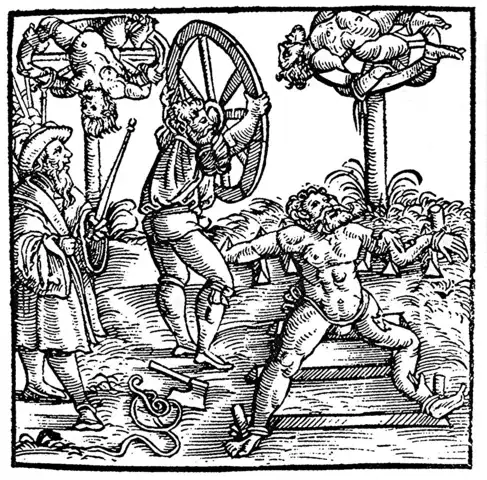
- To break a (butter)fly on the wheel.
The wheel in question being a device for capital punishment of humans. So using it on a tiny fly would, quite literally, be overkill and it is also not clear if you would actually hit the fly at all or if it would be able to get away swiftly — a connotation it has in common with the Russian idiom you are translating.

RegDwigнt
- 97,231
-
2I think "breaking a butterfly on the wheel" is from Alexander Pope. My impression is that it means not just unnecessary effort, but excessive rage and vindictiveness against a basically harmless little annoyance (and maybe a beautiful and innocent one). – Beta Jan 16 '13 at 15:37
-
1Just saw the "breaking a butterfly on the wheel" today in an article regarding U.S. Federal Prosecutors. – Jan 17 '13 at 20:43
-
The word-order "use a sledgehammer to crack a nut" -- as in Bernie England's answer -- is much commoner, even than "V a nut with a sledgehammer" with any verb: NGram comparison – Rosie F Jul 11 '20 at 08:00

10

-
1-1 because I don't think it's a common idiom, but +1 because it's a great Heinlein quote! – Jon Hanna Jan 16 '13 at 12:33
6
Heavy-handed is one that can be applied to a lot of different situations. Also "make a mountain out of a molehill" is a good one.

-
7"Making a mountain out of a molehill" is something different entirely. It fact it exists in Russian, too, and has nothing to do with the idiom in question. – RegDwigнt Jan 16 '13 at 14:39
-
1@RegDwighт: The two idioms are quite different, but I wouldn't agree that they have nothing to do with each other. – LarsH Jan 16 '13 at 18:17
-
@LarsH To "make a mountain out of a molehill" is to imagine a problem as larger than it is. The question is about using a tool inappropriate (and sometimes overkill) for the job at hand. There's only a tiiiny bit of overlap - it's borderline unrelated. – Izkata Jan 16 '13 at 22:05
-
Russian version of "Making a mountain out of a molehill" if translated literally sounds "don't make an elephant out of fly" – Mike Jan 17 '13 at 11:20
6
As AJ Henderson notes in the comments, there are several common variants of "attacking some small creatures with a large and unwieldy weapon" in use, and I doubt most English-speakers would bat an eye at "shooting sparrows with a cannon."
That said, in my experience, flies do seem to be a more common target in English than sparrows, while the most popular weapons seem to be either cannons or, for a more personal type of combat, sledgehammers. So I'd most likely go for either:
"shooting flies with a cannon," or
"swatting flies with a sledgehammer."
But if you'd prefer to target sparrows instead of flies, please do. Such little departures from the most heavily trodden path will simply give your writing that little bit of extra flavor.

Ilmari Karonen
- 1,640
4
I once used the phrase built a cannon to kill a fly in a paper, referring to the complexity of the "Commercial Exchange" semantic frame that is required in order to understand the meaning of the word money.

John Lawler
- 107,887
0
You could always nuke the entire site.
Ripley: I say we take off and nuke the entire site from orbit. It's the only way to be sure. -Aliens