7

In Orwell's A Clergyman's Daughter, Dorothy ends up travelling with a bunch of other homeless youths, one of whom is a cockney called Nobby.

He uses the word "Mulligatawny" as a slang word, but I've never heard it used this way anywhere else:

After Dorothy hands over her last coin:

'That's the mulligatawny!' he said. 'We've struck it lucky--and so've you, kid.

After she tells him her name:

'Ellen. That's the mulligatawny. No surnames when you're on the bum.'

When he's describing about going to pick hops to make some money:

‘Pickin’ ’ops—dahn in Kent! C’n understand that, can’t yer?’

‘Oh, hops! For beer?’

'That's the mulligatawny! Coming on fine, she is. Well, kid, 'z I was saying, here's us three going down hopping, and got a job promised us and all--Blessington's farm, Lower Molesworth. Only we're just a bit in the mulligatawny, see? Because we ain't got a brown between us, and we got to do it on the toby--thirty-five miles it is--and got to tap for our tommy and skipper at night as well. And that's a bit of a mulligatawny, with ladies in the party.'

From the above, he seems to be using the word in a couple of different ways — to express that he finds something agreeable (similar to "now that's what I'm talking about" or "that's the ticket"), or to confirm that Dorothy is understanding him correctly ("Now you're getting it"), but finally he seems to use the word to mean 'a tricky situation' or 'in a pickle'.

Does this usage have an origin outside the book?

Chris McKeown
  • 939
  • 5
  • 9
  • 1
    In "we're just a bit in the mulligatawny" it looks like he's alluding to the phrase "in the soup" (meaning "in a pickle" etc). Using a more specific word in this way isn't uncommon in English slang (you might hear someone say "in the Branston" for "in a pickle", for example). The subsequent (final) use of the word "a bit of a mulligatawny" probably refers back to that. I'm not sure if this helps with the previous uses though. – Rupe Jun 19 '14 at 12:28
  • 1
    Mulligatawny is an Indian curry soup. I've never heard the term used for luck but 'in the soup' is known for bad luck – Third News Jun 19 '14 at 12:28
  • Yep, the final couple of examples make a lot of sense in that respect - it's really the first ones that don't seem to have a logical origin. – Chris McKeown Jun 19 '14 at 12:31
  • On reflection, the first use in that third quote could be the same meaning, prefacing the talk of their being "in the soup" by saying "the soup's cooking up nicely". – Rupe Jun 19 '14 at 12:36
  • Slang (from a long time ago) would have brown as a halfpenny, toby is a road, tap is borrow, tommy is bread/food (don't know about skipper but maybe a place to sleep ). I don't recognise Mulligatawny as an old British slang term, not saying that it isn't though. Seems to me that most of the slang is used correctly (ish), it's not all made up. – Frank Jun 19 '14 at 12:40
  • @ThirdNews "In the soup" means a difficult situation, luck doesn't have to be involved. – Rupe Jun 19 '14 at 12:52
  • @Rupe, I have 'luck' on the brain but I meant to add that the soup is meatless, and made from a decoction of hot pepper -I wonder if there is a 'in a pepper' connection? – Third News Jun 19 '14 at 13:14
  • @Frank: I, too, could believe that skipper means a place to sleep; among the homeless in the U.S. and Canada, the similar-sounding kip is used so. Kip also means sleep (as a noun), as in "I'm gonna grab some kip." – Senex Ægypti Parvi Jun 19 '14 at 14:58
  • 1
    I’ve never read this book, but from the excerpts you’ve provided here, it seems that Nobby is supposed to just really like the word mulligatawny. Some people do that: take a word that they happen to like, and then use it for just about anything they can’t think of a better word for (much like Smurfish), and it looks to me like that’s what Nobby is doing with mulligatawny. Some of the ways he uses the word are probably authentic and were common; but I’m guessing others are supposed to be a bit nonsensical and sound highly idiosyncratic. – Janus Bahs Jacquet Jun 19 '14 at 21:09
  • @JanusBahsJacquet I'm inclined to agree! – Chris McKeown Jun 19 '14 at 21:14
  • @ThirdNews If the word is being used with deliberate free-handedness, and Orwell happened to know the etymology of mulligatawny (apparently from Tamil miḷaku (or miḷagu?) ‘pepper’ + thaṇṇi ‘water’), there may be a very well-hidden Easter Egg kind of ‘in a pepper’ connection. We’ll probably never know, though, whether it’s intentional or just a coincidence. – Janus Bahs Jacquet Jun 19 '14 at 21:15
  • I think Janus Bahs Jacquet is probably correct, I didn't find any "old" Cockney references to mulligatawny, it could be that Nobby was using it as a substitute for "chicken soup" and "Irish stew", the second slang expression of which I'm familiar with. – Mari-Lou A Jun 19 '14 at 21:20

2 Answers2

2

True Cockney is made up of two or three words, the last word has to rhyme with its English equivalent, however very often only the first word is said leaving the reader/listener pretty much in a muddle. Examples of Cockney rhyme are the following:

  • apples and pears = stairs, a Cockney might say: She's up the apples.
  • Boat Race = Face. Nice legs, shame about her boat.

sources for chicken soup and here. And for Irish stew.

In the case of mulligatawny the modern day meaning is the one listed below but the term mulligatawny as used by Nobby had a different meaning, far more innocent and one that fits in with the story. Mulligatawny is an Indian spicy chicken (or beef) soup, so the unclipped version could be Mulligatawny (chicken) soup, and chicken soup is often said to be good for you and hence it implies everything's fine/OK, or it might be short for Mulligatawny stew, which rhymes with true. So That's the mulligatawny could be Cockney for saying "that's the truth".

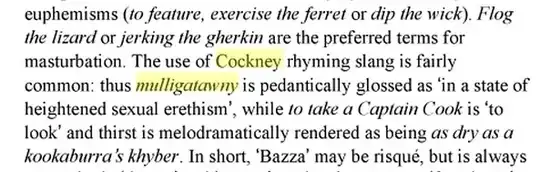
From Swearing A Social History of Foul Language Oaths and Profanity in English Geoffrey Hughes, The term, mulligatawny is modern cockney slang for horny.

enter image description here

Mari-Lou A
  • 91,183
  • I also found that definition but I really don't see how it applies in this context! – Chris McKeown Jun 19 '14 at 19:10
  • That’s because it doesn’t rhyme with horny for the majority of native speakers. – tchrist Jun 19 '14 at 19:40
  • Soup doesn't rhyme with good so I'm not sure where that was from! I like the stew theory though - do you have any citations of it? – Chris McKeown Jun 19 '14 at 21:04
  • If you look at the links I posted you'll see that "chicken soup" and "Irish stew" are mentioned. As for pronunciation, remember this is (East) London, typically working class speech, so allow a bit of leeway. As for "that's the truth" it's the only expression which kinda made sense to me. – Mari-Lou A Jun 19 '14 at 21:14
  • Your citation for Chicken Soup isn't rhyming slang. Soup doesn't rhyme with good regardless of the accent! Second link says it's more likely related to 'Kosher' – Chris McKeown Jun 19 '14 at 21:17
  • "kosher" meaning it's acceptable, genuine, legitimate and aboveboard; just another way of saying good. The first link says chicken soup is slang for acceptable, fine, OK. – Mari-Lou A Jun 19 '14 at 21:23
  • I understand, but your edited reply seems to state that 'Chicken Soup' is rhyming slang when it clearly isn't :-) – Chris McKeown Jun 19 '14 at 21:27
0

In the examples, "mulligatawny" is being used to mean "the rule; the custom" or, in military terms "the drill"

The OED is helpful in deriving the probably origin:

mulligatawny, n. 1. A spicy soup originating in India. More fully mulligatawny soup

†2. Indian English colloquial. A European official serving in the former Madras Presidency in southern India. Obsolete.

1816 ‘Quiz’ Grand Master vi. 145 A well-known Mul. popp'd out his head. Note, An abbreviation for Mulkatany, a common appellation for Madras officers.

During the 19th century and the days of the Raj in India, many Indian words and expressions entered English, either through trade or the military. Of these, a good number survived in informal speech, especially those from the military.

It appears that mulligatawny has transferred its meaning to an aspect of the military officer - a form of synecdoche or metonomy: giving orders/stating rules/being an authority, and thus being the rules, order, drill.

Greybeard
  • 41,737