It seems as if a shift occurred and the descriptive "Oriental" was replaced by "Asian" as the accepted term in polite society — what caused this shift?
Asked
Active
Viewed 1.7k times
14

-
1Perhaps, people were using "orientals" derogatorily which led to other people wanted a non-offensive term. – MrHen Mar 31 '11 at 18:51
-
7It's not melioration if a word becomes pejorative: melioration is a process by which a word “grows more positive in connotation or more elevated in meaning”. – F'x Mar 31 '11 at 19:09
-
@Ankur: since you opened a bounty on this question, could you tell us exactly what is missing from the answers given so far? – F'x Apr 03 '11 at 12:56
-
1@F'x is right. The word you should use as the opposite of melioration is pejoration. – Robusto Apr 03 '11 at 14:02
-
1You have a false assumption here: that “polite society” forbids the use of Oriental. I assure you that telling millions of Midwesterners that they are ipso facto non-members of polite society is going to come across as rude and insensitive. That’s because it is. – tchrist Apr 03 '11 at 17:40
-
@tchrist I would hope that anyone who thought themselves to be a member of “polite society” would avoid using words that dictionaries describe as “sometimes offensive”. Isn’t it the very definition of “polite” to avoid offense? – nohat Apr 03 '11 at 19:27
-
7@nohat: There are uncounted millions, perhaps even billions, of people who go by other guideposts than dictionaries. You have no idea how many people there are who have never heard of the (to them, absurd) notion that “Oriental” is somehow offensive. Asian does not mean the same thing, either. Take a drive through the middle part of the country, and you’ll see. These people are not unkind, and they are not political. They are just regular people, and their grocery sotres have “oriental foods” aisles. To them, “Asian foods” would be unclear — and an affectation. – tchrist Apr 03 '11 at 22:55
-
@tchrist Whether the word “Oriental” is used due to ignorance or insensitivity is immaterial: the word is offensive when applied to people. In parts of the U.S. where there are a lot of people of Asian descent, if someone were to refer to someone as “Oriental” in polite company, there would be gasps and glares. I have observed it myself. That phenomenon is what this question is about. – nohat Apr 03 '11 at 23:19
-
5@nohat: Do you ever get out of the Bay Area? I promise you that there would never be any gasps in Iowa or Wisconsin or Minnesota, and in fact, if one of heard such a gasp we would worry for the gasper’s health! These people are neither ignorant nor insensitive, and it is offensive that you have called them that. They simply do not share your taboos. By your metric, one must call people from Siberia, Omsk, Israel, Palestine, and Tabriz “Asians”, too, even though they would never, ever be called “Oriental”. I’d think all that lumping together of unlike peoples would be considered offensive. – tchrist Apr 03 '11 at 23:53
-
@tchrist People who don’t know the word is offensive are ignorant, by definition. People who do know a word is offensive and use it are insensitive, by definition. There are people who are sensitive to the word “Oriental” in the midwest too. I’ve been there. That you haven’t encountered them or were oblivious to having encountered them says a lot more about you than it does about the midwest. – nohat Apr 04 '11 at 00:16
-
You’re right that lumping all those groups together, whether under the term “Oriental” or “Asian” can be offensive. That’s why I only find myself having to use those terms when having conversations like this. In my ordinary life, something having to do with Korea or Korean people or Korean food has as much in common with China and Chinese people and Chinese food as it does with Mexico and Mexican people and Mexican food. But if we must refer to the Chinese, Koreans, and Japanese as a group, in polite society we use the neutral term “East Asians” because “Orientals” is offensive. – nohat Apr 04 '11 at 00:21
-
5@nohat, just because a word is offensive in one place/setting/society does not automatically make it offensive everywhere. I am neither ignorant nor insensitive when I hold up my hand, palm outwards, to greet a friend, because that is a common greeting where I am. The fact that this gesture is highly offensive in Greece is simply not relevant here. It is actually more offensive that you seem to want to dictate what is and is not offensive in different parts of the US. – Janus Bahs Jacquet Sep 03 '13 at 22:49
-
@JanusBahsJacquet well, it is even more offensive that you took offense at my comments. And no backsies! – nohat Sep 04 '13 at 20:44
6 Answers
12
The New Oxford American Dictionary says on this topic:
USAGE: The term Oriental, denoting a person from the Far East, is regarded as offensive by many Asians, esp. Asian Americans. It has many associations with European imperialism in Asia. Therefore, it has an out-of-date feel and tends to be associated with a rather offensive stereotype of the people and their customs as inscrutable and exotic. Asian and more specific terms such as East Asian, Chinese, and Japanese are preferred.
I think it's simply that Oriental implies a Europe-centric view of the world, which is linked to colonialism and imperialism. Thus, it was rejected by the nations it was applied to.

F'x
- 38,736
-
4If Westerners had referred to themselves as Occidentals, I wonder if the terms would have stuck. – Callithumpian Mar 31 '11 at 19:35
-
5If one cannot refer to anything as Oriental, then equally one must be forbidden from referring to anything as Western. There are many places where Oriental is the perfectly normal word. – tchrist Apr 03 '11 at 17:36
-
@tchrist: The offensiveness of the word stems not from its accuracy, but from its history. I'm guessing the adjective westerner was coined by westerners, whereas the adjective oriental was coined by Europeans to describe people they thought as inferior. – Matt E. Эллен Jul 14 '11 at 21:13
-
8As a Chinese person, I've never been offended by the term "oriental." "Oriental flavored" ramen however, offends me. I mean, what do we taste like? – Jin Dec 25 '11 at 08:52
-
9
I understand why the term Oriental is derogatory, but my family, who are Japanese-American, have always used the term to differentiate Japanese, Chinese, and Korean cultures, which share some common cultural threads, from other Asian cultures. For example, people from Indian are Asian, but their culture is very different from Japan, China, and Korea. Has anyone else used the term Oriental as such?

Ethan
- 99
-
Although technically Indians would also be considered 'Asians', in general usage I have noticed when used in the West, 'Asians' usually means the same as Orientals while other groups such as Indians are referred to as Indians. – Ankur Banerjee Mar 31 '11 at 20:16
-
3Interesting. When I was in England on vacation, I noticed that people used the term Asian to refer to people from India and Pakistani, and did not really associate the term with people further east. I think there is a lot of variability with the term Asian, so having a second term Oriental to refer to China, Japan, and Korea would be beneficial. Of course, I cannot change people's opinion about the word. – Ethan Mar 31 '11 at 20:31
-
1"Asian" indeed has different meanings in US vs. UK English. Ankur gives the US version and Ethan the UK version. – Charles Mar 31 '11 at 20:49
-
In British use, 'Asian' is properly understood to apply to people from all over the Far East but because there are large communities of Indian and Pakistani origin living in the UK, in some contexts it can be used to refer to those two only. Oriental is only applied to rugs. At least that is my take on it. :) – z7sg Ѫ Mar 31 '11 at 21:14
-
Though not often heard, there is the British sounding "sub-continentals" for people living or from India and Pakistan. Definitely carries shades of imperialism. – dmckee --- ex-moderator kitten Mar 31 '11 at 21:33
-
3@z7sg, 'Oriental' carries no pejorative tone in the UK; it is used in the same way people might refer to nations or peoples as 'Western'. While you're right, Asian denotes people from all over Asia, in the UK it is used almost exclusively for people from India, Pakistan, Bangladesh, etc., since that is where the majority of Britain's Asian immigrants are from. – gpr Mar 31 '11 at 23:38
-
@gpr It's not used pejoratively but the term has fallen out of use to describe people and has been replaced by 'Asian'. If someone is talking about Asians within the UK then yes that means the subcontinent but it can also have the wider meaning. There are examples of both within the BNC. – z7sg Ѫ Apr 01 '11 at 00:15
-
@z7sg. Interestingly, in the UK census, 'Asian' and 'Chinese' are separate options for ethnic origin. Apparently most non-Chinese East Asians choose to tick 'other ethnic group' rather than 'other Asian', so 'orientals' in the UK don't self-identify as Asian (if this is to be believed: http://en.wikipedia.org/wiki/Asian_people#United_Kingdom). Would be good to see evidence of 'oriental' falling out of use. – gpr Apr 01 '11 at 00:49
-
@gpr ngram Oddly, the word Asian seems to have only come into common use after 1945. – z7sg Ѫ Apr 01 '11 at 01:05
-
2Oriental is not pejorative in the American Midwest. It is perfectly customary. – tchrist Apr 03 '11 at 17:36
6
To supplement the other good answers here, I did an Ngram of Oriental, Asiatic, and Asian to provide a timeline of the various terms' use in print:
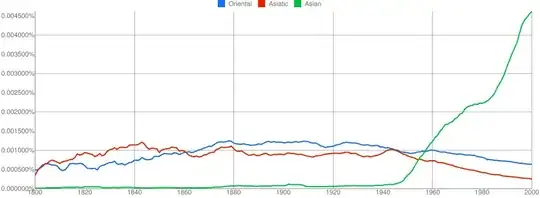
As you can see, the use of Asian increased dramatically starting in the late 1940s. One guess as to the reason is the use of Pacific-Asian Theater in popular media to define the non-European areas of WWII operations.
Also of note, former UCLA historian, Yuji Ichioka, is credited with coining the term Asian-American in the late 60s while at UC Berkeley.
Ichioka coined the term "Asian American" to frame a new self-defining political lexicon. Before that, people of Asian ancestry were generally called Oriental or Asiatic.
Wikipedia
Of course, as you can see from the graph, Asian has been in use as long as the other terms, but developments such as the trend toward immigrant groups naming themselves by their ancestry has definitely hastened the move away from imperialistic language.


Callithumpian
- 24,764
-
4Is talking about Westerners somehow “imperialist”? Of course not. People are just inventing offence where none is meant, or merited. – tchrist Apr 03 '11 at 17:38
-
4@tchrist: I understand and share your distaste for PC fundamentalism, but I think the phenomenon of different demographics choosing names for themselves rather than accepting traditional names given by others outside that particular nationality or group is a nuanced and important process. It seems to me that the main motivation behind it is not to castigate those who stick to the old names, but to nudge all towards a greater understanding of the group's history, sense of place, and internal differences. In short, to see them as a collection of humans and not just as an abstraction. – Callithumpian Apr 03 '11 at 19:23
-
1@tchrist: Possibly. But I think it could also be seen as a step away from naming people as simply "from the East" by specifying an actual group of countries. It might be seen as a first step towards more accurately identifying Asians by their specific country of origin and avoiding the Hank Hill syndrome. – Callithumpian Apr 03 '11 at 23:08
-
+1 for employing ngram. I would, however, be careful (methodologically) to include "Asiatic" as I have only seen this word used as an adjective, whereas the other two are nouns. I admit, though, at I may be demonstrably incorrect. – msanford Apr 05 '11 at 01:59
-
2@msanford It can be a noun too: https://www.amazon.com/Asiatics-Novel-FSG-Classics/dp/0374529248 – Felix Goldberg Nov 20 '16 at 14:07
4
Oriental is not considered especially offensive in the UK. It is not the preferred term for a person of Asian origin or descent, but it is not one that is universally avoided.
I should add that in the UK "Asian" almost exclusively refers to South Asian (but not Indo-Chinese) origin, unless the context requires otherwise.
In any case, the term "Asian" ought not to be used as anything other than a strictly geographic descriptor, given the cultural and geographical diversity found within Asia - if you were to try to group the various countries or nations into groups that are tolerably similar to each other (a) you would have at the very minimum three groups (b) almost everyone falling under such a grouping would object to the grouping.

Marcin
- 4,862
- 22
- 23
1
Perhaps it was caused by Edward Said's book Orientalism. I don't know when exactly the shift occurred as the term seems to have been out of favour for quite some time. Although, according to wikipedia, the US Senate only decided it was inappropriate for official use in 2002.

z7sg Ѫ
- 13,085
- 19
- 63
- 102
-
3
-
3Yes, and I'll give them up when they prise them from my cold dead hands. – z7sg Ѫ Mar 31 '11 at 21:15
-
Orientalism in this case refers to the middle east, not e.g. Japan. In fine art, one would never refer to an Asian work of art nor a European depiction of Asians as Orientalist: they are typically characterized by north african subject matter (and often including a European woman naked, holding a snake) – horatio Mar 31 '11 at 21:25
0
A possible answer to this, in much more general terms and in a parallel vein to the historical account (which I do think best explains this particular case), is that de-adjectival nouns used to denote ethic groups seem to become pejorative(s).
I'm sure you can all come up with your own examples...
Thoughts?

msanford
- 1,199
- 1
- 12
- 17