10

Here is a picture of a capacitor:
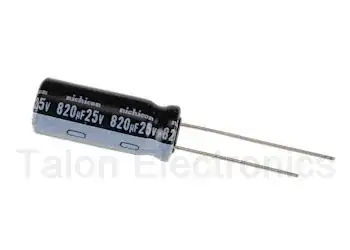
Capacitor

What are these two metal wires called in the professional world in the US?

  • The terminals, I believe. – Dan Bron Oct 20 '14 at 16:13
  • 3
    Leads, terminals, sometimes, believe it or not, simply "wires". "Pins", if the wires are reasonably stiff and cut short (for insertion into a printed circuit board). Outside of engineering spec documents there's no "grammar police" for this sort of stuff. – Hot Licks Oct 20 '14 at 22:03
  • That is a particular kind of capacitor, called an electrolytic capacitor. Electrolytics come in other packages, as well, including cylinders with the axial leads or at the ends of the cylinder. And for all you guys trying to call these wires "terminals" or "legs", please don't. A "terminal" is a fixed connection point to which you attach "leads". Only a complete amateur would call these "legs". Trust me, before I was a programmer I used to be a professional electronics technician. – Cyberherbalist Oct 20 '14 at 23:41
  • 1
    This type of question would be good for the electrical engineering stack exchange. – Alex W Oct 21 '14 at 13:09
  • @Cyberherbalist: Although this is more of an electronics issue than an English one, axial leads come from the center of each end of a cap, along the axis of the cylinder. Leads which are equidistant from the center, along different radii, are called "radial". – supercat Oct 21 '14 at 15:32
  • The long one is called the "anode", and the short one is called the "cathode". Both of them are "electrodes". But in a far more general sense: "leads". – Gorchestopher H Oct 21 '14 at 15:37
  • Yes, @supercat, that's what I said. – Cyberherbalist Oct 21 '14 at 16:20
  • @Cyberherbalist: I was adding some more detail to "axial", and also adding "radial". Also, I think the term "leg" is commonly used to describe leads in certain contexts, particularly when they serve a significant structural as well as electrical role, or when the component in question is a DIP. – supercat Oct 21 '14 at 16:54
  • @supercat: OK. My electronics experience is now more than 30 years behind me, and so "leg" may have acquired more currency than it had back then. I defer to those with more recent experience. – Cyberherbalist Oct 21 '14 at 16:57

7 Answers7

30

The pieces of wire are called leads. I've never heard them referred to as "legs" except in casual conversation. For more information, Wikipedia has a pretty comprehensive article:

http://en.wikipedia.org/wiki/Lead_(electronics)

Nick2253
  • 4,506
6

Engineers typically use “leads”, pronounced like “bleeds”.

5

Let me summarise the various answers here.

In engineering school and then later at a manufacturing plant, we called them leads.

Terminals are used when having to describe the leads in terms of electrical polarity +/-.

Legs are used by lay-people.

Blessed Geek
  • 9,623
2

Collectively, they're often figuratively referred to as legs - on a standard transistor, the three types are are called the Emitter, the Base, and the Collector, but that's probably more information than you needed.

FumbleFingers
  • 140,184
  • 45
  • 294
  • 517
  • 1
    Providing the names used on a typical bipolar transistor in a question about capacitors is just confusing for people looking for information without the knowledge to distinguish what you are talking about. Also just stating "transistor" when other names are used for what the leads connect to on other types of transistors is further confusing to people looking for information about capacitors. – Makyen Oct 20 '14 at 21:29
  • 1
    @Mayken, I've never seen a "bipolar transistor"! Can you treat the condition with some kind of electrical stimulation? – Cyberherbalist Oct 20 '14 at 23:32
  • @Makyen: If OP is asking for "capacitor-specific" terminology, I'd say it's an Off Topic domain-specific question that should be addressed on electronics.SE. Ditto when it comes to identifying/distinguishing the individual terminal names for transistors, capacitors, IC's, or whatever. I still think Anglophones in general call them legs, and it's effectively irrelevant/OT for ELU what electrical engineers call them. – FumbleFingers Oct 21 '14 at 12:58
  • @FumbleFingers: I would agree that the question borders on being off-topic. My point to you was that throwing in specific names for the leads of a type of device which was not pictured is counter productive. This is particularly true when implying the names provided apply to transistors in general when they apply to one type of transistor, not all, or even most [most depends on if we are counting only single transistor packages, or including all transistors made]. While the question did state "in the professional world in the US", I do not contest that legs is a valid response. – Makyen Oct 21 '14 at 15:23
  • @Cyberherbalist: :-). Nice. If you are interested, Wikipedia has a good description of different types of transistors. – Makyen Oct 21 '14 at 15:27
  • @Makyen: Well, to be honest, when I first started composing the answer I forgot which site I was on - I thought I was addressing a non-native speaker on English Language Learners. At the level of "ordinary English" I think the relevant distinction is such connectors are (non-figurative) leads/wires if they're bendy and/or insulated. If they're "stiffer", non-specialists usually use figurative terms - so long ones are legs and short ones are pins. – FumbleFingers Oct 21 '14 at 16:24
  • @Makyen In fact "most" does not depend on how you count them; regardless of whether you're talking about quantity of discrete devices produced, number of different part numbers, or total transistors produced including integrated circuits, the most common type of transistor is certainly the N-channel enhancement MOSFET (whose terminals are source, gate, and drain). BJTs (bipolar junction transistors), while once almost ubiquitous, are now rather rare in most modern electronics. – bcrist Oct 21 '14 at 17:49
2

You can call them leads or pins.

tchrist
  • 134,759
  • 1
    Welcome to EL&U. Your answer would be improved by linking to definitions from a reference or providing examples and explanation of the usage. I encourage you to visit the help center for additional guidance. – choster Oct 21 '14 at 00:43
1

As @dan-bron commented, 'terminals' would be valid, though the main term I've hear them referred to by would be just 'legs'. 'Electrodes' or 'conductors' would also probably be acceptable depending on the context.

davecw
  • 424
1

Collectively, and generically, in the professional world the wires are called leads. As has been mentioned, Wikipedia has a decent article on Lead (electronics). Quoting the first sentence of the Lead article:

In electronics, a lead is an electrical connection consisting of a length of wire or metal pad (SMD) that comes from a device.

Individually, the lead (wire) near the - (negative) mark is connected to the cathode of the capacitor and that lead is called the cathode (this is the shorter wire). However, it is much more common to use a term similar to "the negative lead".

The lead (wire) that is not marked with a - sign connects to the anode of the capacitor and is called the anode (the longer wire). On some capacitors the anode is marked with a +. For this lead, it is much more common to use a term similar to "the positive lead".

Technically, the wires are both leads that connect to the capacitor's anode or cathode, not the anode or cathode themselves. However, that distinction is not usually made.

Wikipedia has a long article on Capacitors.

Makyen
  • 408
  • Not one EE in ten could tell you (at least without having to think about it and maybe draw a picture to remind himself) whether it was the cathode or the anode that is "positive". – Hot Licks Oct 20 '14 at 22:04
  • True, but they will often be labeled as such in diagrams and specification sheets received from manufacturers. However, I would say that the significant majority of EEs would know that the technical terms for the positive and negative leads are anode and cathode, even if they would have to at least think about which is which. Saying "the negative lead" or "the positive lead" would tend to communicate more effectively. Thanks for the comment, I added the clarification to the answer. – Makyen Oct 20 '14 at 22:11