37

I have a friend from the southern U.S. who uses the phrase “might could” quite often. He’ll say, for example:

I might could do that this weekend.

When I first heard him say this, it made me do a double-take. I wasn’t sure whether it’s incorrect, or correct but just not idiomatic outside the southern U.S.

Laurel
  • 66,382
Doug T.
  • 2,690

5 Answers5

45

This is a construction that is restricted to certain dialects of US English. In Standard English, it is not grammatical. (This construction is also often stigmatized, which means you would want to be especially careful before using it — you could be judged!)

However, this construction is used systematically in certain dialects of American English. To describe it clearly, I want to define a few linguistic terms I will use to sort out a crucial three-way distinction:

  • grammatical: A usage is systematic and acceptable within a certain dialect, standard or not. (Often, "grammatical" is used outside of linguistics as shorthand for "used in Standard English". Note that the linguistic definition is broader than the layman's definition!)
  • speech error: In contrast to grammatical statements, speech errors are random and unpredictable.
  • standard: This usage is grammatical in a standard form of English.

People who use this "might could" construction are not making a speech error — within this dialect, it is grammatical. Informally, this is used throughout the southern US, but has not spread to any other region I am aware of. Interestingly, it so happens that the same construction is standard in German.

A description of how this works:

What is going on in "might could" constructions is a process called "modal stacking", where multiple modal verbs (e.g. "could", "should", "might", "would", etc.) can be stacked on top of each other. Each added modal verb contributes towards the overall meaning of the sentence. In Standard English, to convey the same meaning, we have to use another construction:

I might could do that. --> I might be able to do that.

We are doing effectively the same thing in standard English in terms of semantics, it's just that we have to change things around to get around a syntactic restriction.

These constructions are not redundant by definition (they are only redundant if you stack them redundantly!). Neither "I might do that" nor "I could do that" would have the same meaning as "I might could do that".

Other constructions include:

  • I might should do that. (= "Maybe I should do that")

  • I used to could do that. (= "I used to be able to do that")

To sum up:

Modal stacking is not sloppy, meaningless, or redundant; linguistically, it is a systematic process (which I think is really cool!). It is just non-standard in English — something one would avoid using outside of this particular dialect group, especially because (like many features of Southern English) it carries a certain stigma outside of where it is used. But within that group, it is a productive and useful construction.


(This answer has been edited to clarify my use of "grammaticality".)

Kosmonaut
  • 50,402
  • 5
    This comment is getting off-topic, but since you mentioned German, I will add that modal stacking is not only common there, but doesn't really have an upper limit, though constructions with more than four modal verbs are seldom. "Ich sollte können dürfen müssen" ("I should ought may can") is something a German would say without hesitation. – RegDwigнt Sep 18 '10 at 23:08
  • 1
    This construction is certainly not valid in British English. In other dialects, I'm sure it varies. – Noldorin Sep 19 '10 at 14:38
  • Informative answer, but why is "restricted to certain dialects of US English" (and considered ungrammatical elsewhere) not ungrammatical? [BTW, I think it's implicit that "grammatical" means "according to the grammar of standard English"; otherwise every construction is grammatical in the grammar of those who use the construction.] – ShreevatsaR Sep 20 '10 at 07:00
  • 7
    @ShreevatsaR: With your definition of grammaticality (which is not what linguists use), you lose a level of descriptive power. People do, in fact, make speech errors that are ungrammatical; non-native speakers also create ungrammatical sentences. It is useful to distinguish these types of errors, which are random, from systematic, linguistically well-formed structures used by a large population that just happen to not be the standard. – Kosmonaut Sep 20 '10 at 11:43
  • @Kosmonaut: Yes, hence the difference between "ungrammatical according to the grammar of US Southern English" and "ungrammatical" which without qualification, and in popular usage, refers to standard English. It's misleading to call non-standard constructions "not ungrammatical", since non-linguists would think you mean grammatical (or even acceptable) in standard English, which is false. Please add a qualifier, so I can upvote this answer. :-) – ShreevatsaR Sep 20 '10 at 12:49
  • @ShreevatsaR: Point taken — I thought I qualified it sufficiently when I wrote "that is, when someone says a sentence like this they are not making a speech error", but I guess I did not. I hope it's clear that I was never trying to say that "might could" constructions should be accepted in all situations; naturally there is value to having a standard for formal situations. I find it fascinating to learn about supposedly uneducated/slang English, and how it follows a system that often has parallels in other standard languages — it shows how deeply embedded the language faculty is. – Kosmonaut Sep 20 '10 at 13:30
  • Yes, I agree... I also find it interesting to learn about the systematic changes present in dialects and in jargon! But of course, when I see a usage question about some dialect or jargon term that I'm familiar with, I'd first say it's nonstandard before further discussion. :-) – ShreevatsaR Sep 20 '10 at 15:59
  • "when I see a usage question about some dialect or jargon term that I'm familiar with, I'd first say it's nonstandard before further discussion." But I did say that all along... I thought it was the word "ungrammatical" that you found confusing, which is what I updated with extra info. Now I think this discussion is going in circles. – Kosmonaut Sep 20 '10 at 17:31
  • 1
    No, there's nothing to add; thanks for making the change, and +1. (Yes, "ungrammatical" was the confusing part... the first two sentences seemed to say "only the southern US people say this in practice, even though it's grammatical which means that it's in principle acceptable everywhere". Now that's cleared up.) – ShreevatsaR Sep 20 '10 at 18:20
  • @Noldorin Actually, this answer says that it very much is British, in that the home of double modals today appears to be the north of England and especially Scots English, whence it migrate to Appalachia in America. I doubt a Scot would consider it invalid, and last I checked, Scots were British. – tchrist Jun 10 '12 at 15:21
  • @tchrist: As it turns out, your answer that you linked to is well-sourced, and I can easily accept it. As it turns out, this usage is utterly invalid in Received English ("Queen's English" as it's often called) -- that's what I and the majority of middle/upper-class southerners speak, of course. Haven't heard northerners (specifically Mancunians or Liverpudlians) use this form either. It's most likely only prominent in Scottish English and Northumbrian dialects. – Noldorin Jun 10 '12 at 23:02
  • @Noldorin I have indeed heard Scots use double modals; haven’t you? I also have a pal whose wife is from just south of Hadrian’s Wall, and she uses it, too. So yes, I think I can speak of the matter: even if you prefer your colonials in their places, that doesn’t mean we do. – tchrist Jun 10 '12 at 23:04
  • @RegDwigнt (Referring to your first comment) We can do that in English, too, with be going to, be willing to, be able to, be allowed to and so forth. We just can't do it with the core modals, because they lack the non-finite forms which enable it. – StoneyB on hiatus Mar 16 '14 at 19:22
  • You could definitely save a lot of breath by declaring this is "colloquial" and found in certain American dialects, rather than stacking up on details not part of English grammar. Valid in parts of America, esp., in speech; ungrammatical otherwise. – Kris Sep 12 '14 at 04:47
  • 2
    The comment about German really does nothing for this answer. German is fundamentally different from English in this regard because modal verbs in German have infinitives, which English ones don't, and can therefore easily function as the infinitive complement to a modal verb. The construction is also perfectly standard in French, Icelandic, Finnish, Chinese, Greek, and many other languages where modals themselves possess the form required for the complement of modals. – Janus Bahs Jacquet Sep 30 '14 at 21:36
  • @RegDwigнt I know this is an ancient comment of yours, but I just have to remark that all native German speakers I know would certainly hesitate to use a construction like "Ich sollte können dürfen müssen"! (Disregarding the fact that I can't think of a situation where this would actually make sense...) – sebhofer Jan 22 '15 at 22:25
  • @sebhofer: well yes, perhaps that particular example was just a bit over the top to drive home a point. Comments are like that, quick and dirty. I didn't feel like spending too much time coming up with a better example. That said, modal stacking of length three is certainly quite common, in daily conversation and on the evening news alike. (In fact, in daily conversation it's way more common than "ich buk" or "ich flöge", yet you wouldn't claim that German has no Präteritum or Konjunktiv.) – RegDwigнt Jan 25 '15 at 08:59
  • @JanusBahsJacquet: Given the fact that dialects of English do have modal stacking, which speakers use with great ease, despite the fact that the modal verbs lack an infinitive form, I don't see why you would consider the existence of infinitive forms for modal verbs to be a crucial distinction that makes German irrelevant to the discussion. I think it is perfectly relevant to mention that modal stacking is actually part of the standard in another language, even if they aren't identical in every conceivable way. – Kosmonaut Mar 22 '15 at 01:35
  • I think this answer too strongly links this construct with the south. While it probably is very common in the southern US states, it is also very common in midwestern US states. I have lived in the midwest my entire life, and it would sound perfectly normal to me to hear someone say "I might could do that" to mean either "I could possibly do that" or "Yes, I can do that." In fact, one of the people I most often hear using this construct is a Yooper, which is almost as far opposite "southern US" as you can get and still be continental. – Tony DiRienzo Jul 01 '20 at 22:46
16

I wasn't sure, though, if its incorrect or correct but just not idiomatic outside the southern US.

This construction would be considered incorrect (a grammatical mistake) in most varieties of English.

  • 8
    I upvoted both your and Kosmonaut's answer, as they are both right. As he says, it's not ungrammatical (linguistically speaking), just non-standard. As you say, it's considered incorrect in most varities. I really don't see much reason here to get upset, let alone declare that "there's no hope" for this site. – Jonik Sep 19 '10 at 12:25
  • @Jonik There’s something wrong with saying it’s “not correct linguistically speaking”. A linguist doesn’t really recognize “correctness”; he merely describes actual usage. A grammarian might prescribe against it, but that isn’t linguistics. – tchrist Jun 10 '12 at 15:37
  • 1
    @tchrist: Yes, that sounds about right, but I don't how see how it relates to my comment. Maybe you misread what I wrote. (I never used the phrase you object to.) – Jonik Jun 10 '12 at 20:00
16

Although double modals are not “standard” written English outside of “dialect” writing, they are common enough, particularly in the north of Britain and in some parts of North America. Perhaps the best reference is the chapter on “The English double modals” in Linguistic Change Under Contact Conditions (ed. Jacek Fisiak; Mouton De Gruyter, August 1995), where on page 209 it reads in part:

The historical home of the current “double modals” would appear to be in Scotland and Scot English (Montgomery 1989) since Scots speakers settled in great number in northern Ireland in the seventeenth and eighteenth centuries, and later generations migrated from there to the American south. [...] The double modals [that] have begun to emerge from the dialect literature in the last decade or so have begun to receive some attention by investigators working in the programmatic frameworks that they apparently threaten.

There is a great deal more of interest to the topic immediately following that. It’s interesting that they remark above that the usage has begun to emerge “from the dialect literature”, presumably into the main stream of standard writing. This Google n-gram shows that “might could” in particular is growing:
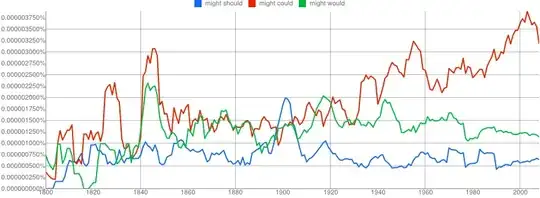
enter image description here

Note that I have not accounted for any noun uses of might in the n-gram above, such as “political might could” or “military might should”. Googling The Economist or the New York Times for double modals turns up plenty of false positives of that particular sort, so the previous n-gram alone should not be taken as actual proof of anything. It is perfectly possible that (say for example) “military might” is simply becoming a more common topic of discussion, so further work would be needed to winnow out any actual evidence from such results.

Another source attesting to the use of double modals in Modern Scots is A.J. Aitken in The Oxford Companion to the English Language (Oxford University Press 1992. p.896).

Finally, this source argues that this is not an “illiterate” use:

The use of the double modal is definitely not "illiterate," but rather typical of regional dialect. It just happens to be largely, if not exclusively, confined to spoken language or reported speech, which says more about the intolerance of dialectal forms in "standard" written English than it does about the education level of the speaker. It's generally true that more educated Southerners tend to avoid this construction, but that's due to a prejudice of perception, not to any inherent inferiority of the use.

In fact, I doubt whether the most common double modals, "might need to" and "might've used to," would clang in most English speakers' ears. However, this dialectal use is indeed mostly concentrated in the South and South Midland, according to the Dictionary of American Regional English, which also gives the following complete list of actually occurring forms, which I think is surprisingly varied:

may could, may can, may will, may shall, may should, may supposed to, might could, might oughta, might can, might should, might would, might better, might had better, may used to, might supposed to, might've used to, may need to, and might woulda had oughta (the last four are listed with no intervening punctuation; I don't know if it's a typo or not).

The use of most double modals is fading in the more northern reaches of its original range, which used to extend as far as the Pennsylvania German community. Most commonly, the may/might element takes the place of the adverb probably; in other cases, it's the can/could element that is substituted for be able to. Actually, many of the forms cited in DARE are not double modals, but examples of the way that might is being directly substituted for "probably," such as "might better" (you probably [had] better) and "might supposed to" (you are probably supposed to).

Double modals are quite common in Northern English (that's England English) and Scots. The settlement patterns of people of Scottish ancestry in the southern U.S. might would account for the concentration of the usage there.

In summary, I don’t think one can answer the question of whether might could is a “correct” construction. All we can say is that some speakers consider it grammatical, and others do not.

Personally, I myself would avoid it in formal prose or formal speech, because I do not perceive it to be part of the higher registers of spoken or written English. Nevertheless, it is perfectly common (and therefore grammatical) for many speakers on both sides of the Atlantic, and I would not hesitate to use a double modal in casual and colloquial registers. I rather like the construct, to be honest; it has a certain parsimony of phrasing that I appreciate, and it imparts a certain folksy tone to one’s words that may (or may not) come in handy.

It also seems to be on the increase. I’m not one to speculate why this might be, but the initial reference work I gave [Fisiak 1995] would seem to be the place to go to delve more deeply into that sort of question, perhaps with supporting evidence from DARE.

tchrist
  • 134,759
  • I vote +1, as I promised. :) – Elberich Schneider Jun 10 '12 at 15:27
  • 1
    I wonder why your source apparently claims that might need to is a double modal. It's not: need is a perfectly common, non-modal verb here, with an infinitive. So no, of course that doesn't clang in anybody's ears, any more than “might think” or “might floccinaucinihilipilificate”. Similarly, might’ve used to could only clang in anyone's ears because used to is rarely used in the perfect and may be ungrammatical as such to some (“I've always used to do this”?). – Janus Bahs Jacquet Oct 01 '14 at 00:23
  • @JanusBahsJacquet I don’t know. Something that takes a to-infinitive isn’t a modal in my book. Given modal-need example like He need do nothing to prove himself, then a double-modal would be he might need do nothing — which I’d be really surprised to hear anyone say, but I don’t spend much time in Scotland or Appalachia, so I’m not real judge. – tchrist Oct 01 '14 at 00:41
  • @tchrist Exactly. The need that is used here is the non-modal one that both inflects for 3sg and has an infinitive (and past participle)—which is hardly surprising, given that the modal need is limited to negated (including limited) and interrogative clauses (“He needn't do that” and “Need he do this?”, but *“He need do this”). – Janus Bahs Jacquet Oct 01 '14 at 00:45
  • 2
    Oh look a rational human being answered. This answer is great because it's data driven, aims at objectivity, and eschews subjectivity and cultural bias. – Warren P Nov 22 '19 at 21:10
10

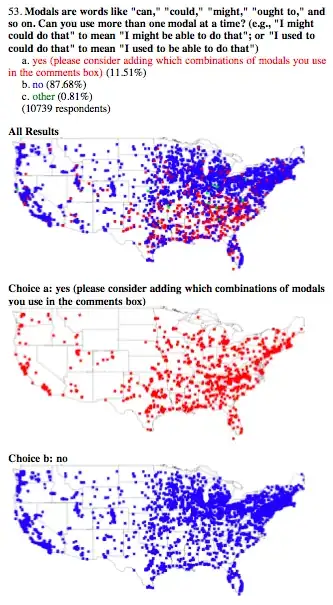
Harvard's Dialect Survey had the question,

Modals are words like "can," "could," "might," "ought to," and so on. Can you use more than one modal at a time? (e.g., "I might could do that" to mean "I might be able to do that"; or "I used to could do that" to mean "I used to be able to do that")

Here's the geographic distribution of their results from 10,739 American respondents:

http://www4.uwm.edu/FLL/linguistics/dialect/staticmaps/q_53.html

Callithumpian
  • 24,764
-3

No, it is not a valid grammatical construction, but it is (as I understand) fairly common in the Southern US. The reason for this is because both are verbs, and unless one of them is a linking verb, you cannot have two verbs next to each other. In addition, the usage is redundant:

Could - Used to show the possibility that something might happen.
Might - Used to indicate conditional or possible actions.

It would be like trying to say "the cat feline" or "he ate consumed food".


Regrettably, I must disagree with Kosmonaut's response. Although I accept that it is used in several(?) dialects of English, that does not make it a "correct construction" in English in general. Considering that the question referred to English as a whole, I must maintain that because it is not considered valid in most regions, then we cannot put forward that it is a valid construction. Furthermore, (and as a side note), I fail to see how it being valid in German has any bearing on the subject. For example, in Latin, the phrase "Ad Roma aquam portat." is perfectly valid, but to say "To Rome the water he carries" is awkward at best.

waiwai933
  • 14,563
  • 1
    thanks, might be good to add why it's not a valid construction. – Doug T. Sep 18 '10 at 20:50
  • 10
    It is a valid grammatical construction, it is just not a standard grammatical construction. In German, for example, it is a standard grammatical construction. In dialects that do not have this construction, the reason it is not grammatical is not because you can't have two verbs next to each other ("might go" is fine of course). And if you ask any Southerner if there is a difference between saying "could do that" and "might could do that", they will all tell you that there clearly is a difference. – Kosmonaut Sep 18 '10 at 21:17
  • @Kosmonaut I have responded to you in an edit. – waiwai933 Sep 19 '10 at 05:47
  • 5
    Your definition of "correct" is provincial. If there exists a significant linguistic community that uses a construction, understands its meaning, applies it in a consistent, understood manner that is distinct from similar constructions, then you ain't got no right to claim it "invalid". Saying "I don't like it" is more accurate. – msw Sep 19 '10 at 08:53
  • "Although I accept that it is used in several(?) dialects of English, that does not make it a "correct construction" in English in general." That makes it non-standard, which is how I characterized it. Anyone intending to use Standard English would avoid it. There is a big difference between valid and standard. If someone asked if "learnt" is a valid word, we would talk about British and English differences; this is no different here, except now I am addressing a standard and a dialect. Compare that to "I could to go shopping" which is simply ungrammatical in English. – Kosmonaut Sep 19 '10 at 12:13
  • Re: German. Often, people believe that certain non-standard use is inherently wrong, broken, or random. In fact, most (all?) widespread dialectal use is systematic. I find that a very compelling argument for the linguistic grammaticality of a non-standard construction is to show that it is standard in another language. In your post, you suggest that double modals are ungrammatical, and give reasons why it must be ungrammatical. But, it is only non-standard — and the only reason it is non-standard is that the dialect of English chosen as the standard did not use that construction. – Kosmonaut Sep 19 '10 at 12:36
  • shouldn't ought to more commonly heard as shouldn't oughta is rather common in English, is it not? – Dan Apr 25 '11 at 19:39
  • 2
    It’s not just the United States. Apparently the natural home of double modals in Modern English is more towards the John o’ Groats end of Britain than the Land’s End end — so to speak. See my answer. – tchrist Jun 10 '12 at 15:31
  • I appreciate your edit, but your answer is still incorrect. This construction is nonstandard, but is *not* redundant. If somebody says "I might could do that ..." (and they do say this all the time in the South), the translation into standard English is "It is possible that I will be able to do that ...", not "I might possibly do that ...", as you claim. – Peter Shor Feb 20 '15 at 13:02