89

While adding to an Answer to this question, I needed to use the above phrase, and I suddenly realised I was unsure whether to write "is" or "are".

  • There is more than one way to skin a cat.

  • If there are more than one species of cat, we will flay each species differently.

I don't think that second example above sounds quite right to me (disregarding the meaning - sorry!), but in my original Answer I felt "is" would have been even worse.

Is "are" always wrong here? If so, what exactly is the rationale? If not, is there a case where it's unquestionably preferred – and why is that?


Note that in both the problematic Answer and my example attempting to mimic the same context more briefly, the writer doesn't know how many there are. There may be one, more, or even none.

Getting even more specific, the writer might have an opinion on how many there might be, and wish to convey his leanings by choice of verb form if language allows this to be done succinctly.

FumbleFingers
  • 140,184
  • 45
  • 294
  • 517
  • 1
    Just a note: Personally, if I had to choose by heart, I'd say "There is more than one ...", also considering I'm not a native speaker... – Alenanno Jul 23 '11 at 20:17
  • @Alenanno: With no other context I agree "is" probably has to be the default. But as Wanda points out, if you know how many, you probably want the verb to agree with reality. And as I'm asking, what if you don't know, and wish to call attention to that? – FumbleFingers Jul 23 '11 at 22:41
  • 1
    At least one grammar forum out there has discussed the cat-skinning example with a conclusion that agrees with Wanda and Hydrangea below: use "there is more than one" because "is" goes with "one", whether it's one book, one species, one way... There are plenty of results for "are more than one [thing]", though usually less than the "is" version, so perhaps some speakers don't follow this rule. – aedia λ Jul 23 '11 at 23:56
  • @aedia: That 10-year-old item in The Grammar Logs is only a couple of lines, and it just touches on the trivial question of which verb form to use if you know how many you're talking about. Which I very specifically don't, and it's in that context I'm looking for help with the phrase. – FumbleFingers Jul 24 '11 at 02:34
  • 1
    Coming to this a bit late, but it seems simple enough to me: the verb must agree with the noun, and the noun is "way", i.e. singular. "More than one" is simply a compound adjective describing "way". (Which of course raises the question, why isn't it "*more than one ways"... but that's a whole 'nother can of worms.) – Marthaª Jan 07 '13 at 23:39
  • @Martha: Consider this from Merriam-Webster's Dictionary of English Usage. It ain't that straightforward. – FumbleFingers Jan 08 '13 at 02:17
  • @FumbleFingers That link seems to have rotted. – MetaEd Mar 21 '13 at 23:15
  • @MετάEd: MW don't seem to have it Googleable any more. From Wikipedia Talk: M-W's's Dictionary of English Usage has articles on one or more and more than one. It says that when one or more governs a verb, which is not that common, the plural seems to be used. More than one generally favours the singular, but there is a degree of variation. In some cases, the singular can't even be used easily, as for example in "If there are more than one, they are alphabetized among themselves." – FumbleFingers Mar 22 '13 at 01:56
  • There are more ways than one to skin a cat. – Toothrot Aug 11 '20 at 20:34
  • I can't answer yet. There is a simple answer to this that I think people are missing.
    You can consider More than one way in two ways: there are (more than one) (ways) i.e. more than one = many and ways is the subject so needs to be plural there is (more than) (one way) i.e. one way is the subject and that is singular
    – Tim Rutter Nov 24 '20 at 08:47
  • or alternatively consider "more than" to be an adjective and "one way" to be the subject and its very clear that it should be is. Similarly there is more than one way...there is suprisingly one way – Tim Rutter Nov 24 '20 at 09:31

9 Answers9

69

This question is more complex than it may appear. There seems to be consensus that a singular verb should be used in formal writing whenever the subject of a sentence is more than one [noun], or at least that this is (much) better than ?there are more than one. I subscribe to this.

It does not matter how many things the writer might expect there to be in reality: it is always if there is more than one species.

Nor does it matter what noun comes after one. It is always is; the word one forces a singular verb without apparent exception.


But why does this at all surprise us?

We are puzzled by this construction because the subject does not agree with the verb—at least not if analyzed according to conventional grammar. Consider the following sentence:

There are more men in the room.

Is would be impossible. The sentence is easy enough to analyse:

  • more men = subject
  • are = finite verb

No problem there: subject and verb agree. More men is the subject, or at least the head of the subject.

There are more men than just John in the room.

The core of the syntax remains the same; the core of the subject is still more men. The addition than x is either an elliptical clause or a prepositional phrase that is part of the subject, depending on your model; in any case, than x is not what determines whether it is are or is. More men are is the core of the sentence.

There is more than one man in the room.

Suddenly the verb changes. Has the core syntax of the sentence changed? No: for the sake of consistency, we must say more is the subject and is the finite verb. The phrase than x is still not the head of the subject, no more than in the first sentence (there are more men than just John). If more is the head, then it must be elliptical, since it is only an adjective: more of what? If we hypothetically supply the omitted noun, we get:

*There is more [men] than one man in the room.

There is no other word that we could fill in, though of course this is wrong: *there is more men is both unidiomatic in this register and in violation of the rule that subject and verb must agree.

Then what causes this singular is in there is more than one man? The phrase than x should not determine the number of the verb: and yet it does. That is why this construction is idiomatic, as opposed to regular: it violates the rule that subject and verb must agree. But it is by all means "correct". That is what idiom is: a widely accepted phrase that violates the regularity of our language. However some of us might like it to be, language is just never regular in all respects; this bit of idiom happens to have triumphed over regularity and is now the norm. Idiom must be judged case by case and often varies across registers and dialects.


But could this disagreement of subject and verb be explained away by other factors? Let's see what I can come up with.

It could be that the somewhat fixed phrase there is is what does it. But that phrase could not explain singular is in this sentence:

More than one man is still in the house.

Could this is be explained by the immediate precedence of one man? It is conceivable that the singular number of one man leads us to an anacoluthon in the next word is: we see a singular number and noun, and we cannot resist the pressure of proceeding with a singular verb. But then this phenomenon should not occur if the verb came before the subject:

Not only has more than one man been seen near the power plant, but...

*Not only have more than one man been seen near the power plant, but

It seems clear that have would be wrong, even more so than in the previous sentence patterns. So whether the verb comes before or after doesn't matter.


How can this oddity of disagreement be explained? If we look at it reductionistically, in terms of association and pattern recognition as they occur in the brain, I suspect that the word one exerts such an enormous influence on our perception of a sentence that it overrules more, despite the ordinarily forcing rule of agreement; it does so even despite the sense of multitude inherent in the phrase more than one man as a whole, which must always refer to multiple objects in reality. When we write one man, we have the image of one man at an irresistibly prominent place in our working memory. (Other, somewhat similar idioms exist, so I don't believe this to be a unique situation.)

  • I'll go for that. It's a strong idiomatic tendency kept going by usage and the reasons you give, even though there's a certain amount of "non-compliance". – FumbleFingers Aug 07 '11 at 04:27
  • 5
    The reason for the discontinuity is that There Insertion applies, and it's not only idiomatic, it has very odd restrictions. See Levin 1993, English Verb Classes and Alternations, pp 88-91. – John Lawler Dec 05 '11 at 03:10
  • 1
    @John: Then how about this example (mentioned in my answer): More than one man is still in the house. There is no there, but is is still singular. – Cerberus - Reinstate Monica Dec 05 '11 at 04:51
  • 1
    True. That's because phrases like more than one man agree with a singular verb. And it stays singular after There Insertion. Which reinforces the freezing of there's as the canonical contraction when be is the verb following there. There are, however, several hundred other verbs it applies to, as Levin points out. – John Lawler Dec 05 '11 at 05:00
  • 1
    @John: I do not disagree; but then which discontinuity did you mean? I'm not sure I understand your point. – Cerberus - Reinstate Monica Dec 05 '11 at 14:10
  • 4
    I think I disagree with your sentence analysis: I think the subject of "There is more than one man in the room" is "man". "One" is an adjective describing the subject, and "more than" is an adverbial phrase describing the adjective. Looked at this way, the singular "is" is totally unremarkable. – Marthaª Jan 07 '13 at 23:47
  • @Martha: Your analysis is quite unconventional: I have never seen anyone suggest that more than can be considered adverbial or modifying an adjective. But let's go with your analysis. Then how do you explain more ways than one exist to solve this problem? Or how about now more ways than before exist to solve this problem? Or simply more ways exist to solve this problem? Shouldn't these all be very similar constructions? – Cerberus - Reinstate Monica Jan 08 '13 at 00:12
  • I don't understand the question: ways, being plural, takes the plural verb exist. How is this surprising? – Marthaª Jan 08 '13 at 00:24
  • 1
    @Martha: Then how does the construction change between more ways than one way exist and more than one way exists? – Cerberus - Reinstate Monica Jan 08 '13 at 02:15
  • How about "More than one of us have the same problem."? – user21820 Apr 23 '15 at 06:06
  • @user21820: Very good question. I would say that construction has to be plural. It is probably the addition of a plural word (us) between one and the verb that forces plurality, wouldn't you say? – Cerberus - Reinstate Monica Jul 07 '15 at 23:06
  • @Cerberus: I have no idea. If that is the case, then it is basically saying that it is a case of attraction. Perhaps it is indeed just that, as attraction does explain a lot of strange verb-noun disagreements besides this one. – user21820 Jul 08 '15 at 06:59
  • @user21820: Exactly, attraction is the word. I did not use it in my hypothesis above because it is a technical term, but that is what I think happens with more than one, and also with more than one of [plural]. – Cerberus - Reinstate Monica Jul 08 '15 at 13:18
  • @Cerberus: Yup it occurs in so many languages that it's almost as if people use context-free grammars to generate the sentence structure but don't use them to impose constraints like verb-noun agreement. – user21820 Jul 08 '15 at 13:29
  • @user21820: Ehh could be! I know attraction mainly from Greek, attractio relativi (which also exists in English). That is, I rarely see the word used elsewhere. – Cerberus - Reinstate Monica Jul 08 '15 at 17:34
  • @Cerberus: I first learnt about attraction from (ancient) Greek too! – user21820 Jul 09 '15 at 14:29
  • @user21820: Yay! It is am important phaenomenon. – Cerberus - Reinstate Monica Jul 09 '15 at 14:35
  • I agree with Martha. In all examples mentioned so far, the rule is simple: Forget about the "more than". If the sentence contains a subject in plural form (ways/men) take the plural form of the verb, otherwise take the singular form of the verb. For example: "There are more than two men in the room" but "There is more than one man in the room". Or "There are more than two species of cats" but "There is more than one species of cats". Or "More than one of us has a problem" but "Two of us have a problem". – Bananach Nov 09 '15 at 11:42
  • 1
    @Bananach: Nobody says the verb should be plural; the rule is not in question. But don't you find it the least bit surprising that we use singular after more than one? – Cerberus - Reinstate Monica Nov 09 '15 at 12:41
  • I just noticed that Martha provided a perfect decision rule for all examples discussed so far (in some of these examples, a plural verb (are) is required, in some a singular verb (is) is required). And that the examples in your responses to both her comment COULD actually be explained with her approach. – Bananach Nov 09 '15 at 13:33
  • I do find it a bit surprising, by the way. Although it is the same in my mother tongue, German. – Bananach Nov 09 '15 at 13:37
  • @Bananach: Hmm it is the same in Dutch, now that you mention it. – Cerberus - Reinstate Monica Nov 09 '15 at 16:01
  • Some idioms are obviously the result of stupidity and can be disregarded. – Toothrot Aug 11 '20 at 20:26
  • @Toothrot: I agree that it is stupid...but the plural sounds decidedly off to me. – Cerberus - Reinstate Monica Aug 11 '20 at 20:49
  • @Cerberus_Reinstate_Monica, I hear that too, but I still disapprove of the singular. If one doesn't want to sound off, I think one should rephrase: there are more ways than one to skin a cat. (That may sound a bit peculiar as well, but less.) – Toothrot Aug 11 '20 at 21:49
  • @Toothrot: Recasting the sentence is always a good idea. – Cerberus - Reinstate Monica Aug 11 '20 at 21:56
  • I would argue that the subject has somehow changed and this construction is impersonal, and more equivalent to e.g. in French "il y a", in German "es gibt" or in Spanish "hay". – jp48 Mar 31 '21 at 16:38
15

Generally, when you are referring to a single thing, one uses 'is'; when referring to a plural, you should use 'are'. It applies here too, you just need to think about it.

There are more than one species

'One species' is actually singular: 'species' is both the singular and the plural form of the word, the nature of the sentence dictating which it is at a given time. In your example, it is singular, as indicated by the preceding word 'one'. It should be:

There is more than one species

Now, if you were speaking of twelve species you would say:

There are more than twelve species

because 'species' is a plural here, as the preceding 'twelve' signifies.

Here is a clearer example:

There is more than one knife in the kitchen.

There are more than six knives in the kitchen.

I believe your confusion stems from the term species not changing form when it becomes a plural.

  • 3
    I think you're missing my focus. It's true I chose "species" in my example because it's the same form in singular and plural (I didn't want my choice of plurality there to affect other's assessment of acceptability). But you address only contexts where the speaker knows how many there are (or is, if he knows there's only one). In which case the verb form is obvious, as you say. I'm asking about cases where it's unknown whether there's one or more (there are one or more?). I'll edit the question to clarify this. – FumbleFingers Jul 23 '11 at 22:24
  • 1
    +1: Absolutely correct. This isn't even close. – Robusto Jul 29 '11 at 01:54
  • 2
    I agree with your conclusion that there is more than one species is correct; but I contend that subject and verb in fact do not agree here, which is what makes it an idiomatic expression. If it weren't idiomatic, the verb would agree with more in all cases, which is plural: there are more would be the core of the sentence. I have investigated this problem a bit further in my answer below. – Cerberus - Reinstate Monica Jul 29 '11 at 05:26
9

The American Heritage Book of English Usage states:

When a noun phrase contains more than one and a singular noun, the verb is normally singular...

So your intuition is pretty good.

apaderno
  • 59,185
Hydrangea
  • 932
  • 1
    Umm. Would you like to guess whether "species of cat" is singular or plural in my example? It was a slightly disingenuous choice of noun phrase, I admit. But that was just to force readers here to be uncertain about the applicability of logic such as you quote. – FumbleFingers Jul 23 '11 at 22:44
  • 3
    It's pretty easy to guess, since you specifically said "one species", that it's singular.... – Hellion Jul 23 '11 at 22:56
  • "species" is what is called an aggregate noun, it is always used to refer to a grouping. By itself, you can't tell whether it is being used to refer to a plural or singular entity, so that is kind of a complicated example sentence. Thus both "there are more than one species" and "there is more than one species" are equally correct (though have subtly different meanings), but the latter sounds better since it is more what we're used to hearing. – Hydrangea Jul 24 '11 at 00:03
  • 1
    @Hellion: That doesn't make much sense. It's at least equally true that I specifically said "more than one species", by which logic it's plural. – FumbleFingers Jul 24 '11 at 02:38
  • @Hydrangea: You mean you think, for example, If there is more than one species of cat, we will flay them all differently sounds better than using "are"? – FumbleFingers Jul 24 '11 at 02:44
  • It does sound better to me, and it seems like several people here think so too. My guess is that, like I said, we're used to hearing "is" with "more than one". Perhaps also when we read "one" we expect the whole phrase to be singular and need a more obvious cue that if it isn't. – Hydrangea Jul 24 '11 at 03:48
  • @Hydrangea: I take you point, but I can't help feeling that sounds 'iffy' in my example sentence (where the phrase after the comma only applies if there are two or more). – FumbleFingers Jul 24 '11 at 17:06
  • @Hydrangea: Warming to my theme, I find that straightforward Google for quotated "if there is more than one" gets 129M hits as opposed to 97M for "are". Admittedly Google books has 126K against 18K, which is a far more marked difference. But it still doesn't seem to me that tendency should necessarily dictate the "correct" choice in my highly specific context. – FumbleFingers Jul 28 '11 at 21:40
  • Sure, but common usage very strongly informs what we think sounds "right", even if it isn't technically correct. I still mentally twitch when people say "I'm well." as opposed to "I'm good.", even thought both are fine, just because so very few people use "well" in that context. – Hydrangea Jul 29 '11 at 15:25
7

C S Lewis is rigorously pro-descriptivism with this one. The following from his Letters to Children:

About amn't I, aren't I and am I not, of course there are no right or wrong answers about language in the sense in which there are right and wrong answers in Arithmetic. "Good English" is whatever educated people talk; so that what is good in one place or time would not be so in another. Amn't I was good 50 years ago in the North of Ireland where I was brought up, but bad in Southern England. Aren't I would have been hideously bad in Ireland but very good in England. And of course I just don't know which (if either) is good in modern Florida. Don't take any notice of teachers and textbooks in such matters. Nor of logic. It is good to say "more than one passenger was hurt," although more than one equals at least two and therefore logically the verb ought to be plural were not singular was!

coleopterist
  • 31,031
  • I disagree with the last example you give. I would not say "two passenger were hurt" but I would say "two passengers were hurt". The key differences is the plurality of the subject in a singular word. Passengers is a plural word in isolation, whereas "more than one passenger" is what I'd call a "modified singular phrase". Thus logic does not dictate "more than one passenger were hurt", but could make a case that "more than one passenger was hurt" is dictated as "more than" is modifying the singular "one subject was hurt". – The Real Bill Feb 18 '13 at 09:00
  • 2
    Sadly, Oxford Professor of Literature CS Lewis is not here to defend his viewpoint. – Edwin Ashworth Aug 18 '13 at 16:54
  • Logic would surely warrant 'Several / Two or more / More than one passengers were hurt' - you have to start making special allowances for the behaviour of compound quantifiers to license the normally used expression. – Edwin Ashworth Sep 30 '13 at 15:23
6

I'm going to put this one up as an Answer, though as OP I won't be able to "Accept" it. It might sound a little archaic, but I'd settle for...

If there be more than one (which you might like better as Should there be more than one)

Quotated, that gets 20M Google hits, as opposed to 246M for "is", and 168M for "are". I may be in a linguistic minority, but at least I don't feel totally alone!

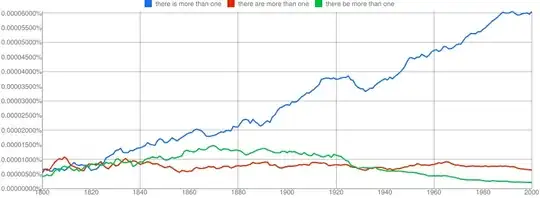
LATER: I don't know why the two downvotes. This chart may show be isn't (or at least wasn't) perhaps as unusual as some may think...

.

FumbleFingers
  • 140,184
  • 45
  • 294
  • 517
  • I love the chart. Raw data is great, and Google is fabulous for this sort of thing. – Hydrangea Jul 29 '11 at 15:29
  • 1
    @Hydrangea: It's good, but it can be misleading, which is why some here are inclined to be sceptical of anything substantiated by Google 'full web' or 'books only' search hits. I put a link to the actual NGram page so it's easy to extend the date range back in time and see that - oddly enough - originally the be form was in fact the most common. – FumbleFingers Jul 29 '11 at 15:37
  • Your answer mentions "is" two times in a row. – Noah May 02 '14 at 15:08
  • @Noah: Well spotted! While fixing it I added links to the searches. Strangely, the numbers have changed quite a bit in the three years since I posted this answer (but it doesn't affect the point I was making). – FumbleFingers May 02 '14 at 15:19
  • But that doesn't solve the general problem; what do you use in sentences where the subjunctive would be incorrect? "There be more than one way to skin a cat"? Sounds like pirate speak. – herisson Aug 17 '15 at 19:03
  • Well, specific question was about *If there are more than one...* - which is certainly a "syntactically valid" construction, and which would allow the subjunctive (if you don't mind sounding a bit formal/dated). But things get a bit complicated with *There is/are [one or more things], because [the grammatical rule is different if you contract There is*](http://english.stackexchange.com/questions/200693/there-is-vs-there-are#comment424969_200693). There's eggs and bacon for breakfast. – FumbleFingers Aug 17 '15 at 21:37
3

The verb should follow the number of the noun. If you use one then you have already picked your number. So if you say

There --- more than one species of cat.

you don't have any choice about the number agreement, since you've already committed to it being singular:

more than one species of cat
           ^--------------^
               singular!

Now let's take the full phrase you used in a comment:

If there are more than one species of cat, we will flay them all differently.

This doesn't work, because you have conflicting rules on number agreement:

are more than one species of cat, we will flay them
 ^             ^-----sing.----^                  ^
 +------------------------------plural-----------+
^^^            ^^^
 +--mismatch!---+

So the solution here is to rephrase the sentence. E.g.:

If there is more than one species of cat, we will flay each one differently

If there are multiple species of cats, we will flay them all differently

Rex Kerr
  • 1,824
0

In this kind of tricky situations, what I generally do is go to some established publication that I know mostly publishes correct English. For instance BBC. I would say, you can use "are" if the following part is plural. For instance:

There are more than three cats in the room.

And "is" in case there is only one cat:

There is more than one cat in the room.

You could verify this on BBC: just search this "there are more than one" site:bbc.co.uk and you will find references like "more than one million", more than one thousand, etc.

Also, if you use is then it would give you "more than one person, more than one twitter account, etc.

0

I was checking this site for something to help explain this construction to a student who has serious problems with core grammar. While the consensus here, that this is an idiomatic construction, is probably correct, I tried to come up with an answer that I could use in this case, and am posting it here for others to comment on--or use if it's helpful:

The "more than one" construction is analogous to an "or" in the subject. Take, say, "more than one person is coming." Supplying a number for "more" could yield "one more is coming" or "two more are coming," and thus "two more or at least one more is...." Given the indeterminate number in the subject of "more than one," the verb agrees with the closest available number.

This is probably no more than a post facto attempt to impose a logic on an idiom, but does it work?

MSM
  • 9
  • It makes sense to me. +1 – Luke_0 Oct 29 '12 at 17:42
  • For me at least, this explanation is harder to grasp than the straightforward one provided by Wanda. I don't think there's a need for an additional (il)logical "rule" in this case. If it works for you or your student, then I suppose one can't argue with that. – Zairja Oct 29 '12 at 17:48
-1

Just a comment in addition to other answers, for what it's worth:

As others have explained, it should be "is", as in "There is more than one knife in the kitchen" (to use the example used in another answer).

I think the inclination to write "are" instead of "is" stems from a subconscious perception that "more than one" would be grammatically interchangeable with e.g. "three". But, as can easily be seen by writing the whole sentence out, it isn't: "There are three knife in the kitchen".

andreasdr
  • 494