46

In the Indian subcontinent, especially India, there are many English words or phrases which are not a part of dictionary or not used in other parts of the world.

The first one is "Please don't pluck the flowers". I might not be proper, but I don't see anything wrong with this. It is pretty easy to understand what the person is trying to convey.

The second phrase is "Please do the needful". This is said to have its root in improper translation from an Indic language. Even though it might sound weird to non-Indians, it is a very simple way of saying "Please do what we expect you to do in this situation without being provided a detailed explanation".

In Indian English it is very well understood when someone asks "I have a doubt in this concept". In UK, doubt is taken in the context of "suspect", but in India, it is taken as "having a problem or not being clear".

There is another term which is actually not in any dictionary — "prepone" which is used as an antonym of "postpone". Even though it does not make sense, its meaning is pretty much straightforward.

After giving this long explanation, here are my three questions:

  • What is wrong in "Please don't pluck the flowers"?
  • What is wrong with "Please do the needful"?
  • Isn't it acceptable to use words like "prepone" even though it not in the dictionary? It is pretty much well understood (especially by people who scorn at others using this word)?

Update

I would like to explain when and where these terms are used:

  • "Please don't pluck the flowers" is used very rarely, and it is pretty much rare to hear this
  • "Please do the needful" is used mostly in corporate environments by a person to their subordinates. For example, a project manager gets a mail from marketing or quality assurance about something missing or incomplete, then he/she sends a mail to the subordinate with the body "Please do the needful". The subordinate is usually more well-versed with the work which has to be done. It might be his/her expertise so the manager might not tell what exactly needs to be done as is left upon him/her to figure out.
  • "Prepone" is used only in one context — opposite of "postpone" the event. The most common usage is "This event or meeting has been preponed".
RegDwigнt
  • 97,231
  • 3
    Related: Is there a more common phrase that means “preponed”?, Is “prepone” being used outside India? (The simple answer is that because "prepone" is unfamiliar to many speakers outside India, it may seem like a made-up word or an error, even though it fills a useful gap in the language.) – aedia λ Sep 28 '11 at 18:36
  • 2
    There's no reason these words or phrases would be wrong in your dialect, but they may be ungrammatical for speakers of other dialects, and that can change how you are perceived. People may think that you can't speak "their" English correctly. You might sometimes choose to use words more familiar or natural for your audience, to help them understand, or just to fit in better. For example, I'm from an area where people say "waiting on line", but I think I say "in line" now; my colleagues give me funny looks when I say the former :) – aedia λ Sep 28 '11 at 18:56
  • @aediaλ Actually many people don't learn English by looking at the word list. They find similarities. If post implies "later" and "pre" means "before the scheduled time", then most of the people come up with "prepone" as it fits nicely with what they have observed. – Manish Sinha Sep 28 '11 at 19:15
  • When I was told that there is so word such as prepone then my first reaction was "It should be. It sounds natural". – Manish Sinha Sep 28 '11 at 19:15
  • @aediaλ We in India use "Standing in line". Even though "Standing on line" might sound unusual, I won't scorn as I am pretty much well aware of cultural and linguistic differences. My brain says "Ah. They just use a different version of English than me". It's not that using "on" instead of "in" makes the whole phrase incomprehensible – Manish Sinha Sep 28 '11 at 19:19
  • 11
    Native english speaker here. "Pluck the flowers" makes perfect sense, I hear that all the time; but "do the needful" makes no sense to me (the needful what?). "Do what's necessary" sounds much better. – BlueRaja - Danny Pflughoeft Sep 29 '11 at 05:14
  • 1
    'do the needful' is unexceptional in Irish-English - bit surprised that other speakers were unfamiliar with it http://www.google.ie/search?q=irish+%22do+the+needful%22&hl=en&num=10&lr=&ft=i&cr=&safe=active&tbs= – cindi Sep 29 '11 at 16:11
  • 7
    I (American) have never seen or heard "do the needful" used, so I was forced to speculate. "Do" is often used as a euphemism for sexual intercourse, and "needful" quickly introduces "needy" as a possibility--"needy" being commonly used to refer to a homeless person or merely a poor person. Needless to say, the image one derives from such linguistic shoe-horning is a humorous one. – horatio Sep 29 '11 at 17:08
  • @horatio This phrase is mostly used in "Corporate Environments". Just imagine getting a mail to any of you in America from someone in India with the body "Do the needful" – Manish Sinha Sep 29 '11 at 17:14
  • 1
    Please don't 'pluck' the flowers really looks like a literal translation from Dutch, where 'plukken' is the logical verb in this context. – johanvdw Sep 29 '11 at 18:11
  • 1
    I sometimes feel "pluck" is more appropriate than "pick". When someone says "pick the flowers" I think they are picking the flowers which are lying on the ground – Manish Sinha Sep 29 '11 at 19:10
  • 6
    You should be aware that there is no *the dictionary. Instead there are lots of different* dictionaries. A good dictionary that tries to cover all of English rather than only British or American should include senses such as these. "Prepone" is included in at least The New Oxford Dictionary of English, published 1998: http://www.languagehat.com/archives/000645.php – hippietrail Oct 02 '11 at 14:36
  • 2
    "to pluck" is probably related to Dutch "plukken" which is used mostly used for flowers, but also for the removal of feathers from poultry. Perhaps "to pluck flowers" is the older expression. It is quite common for a remote language group to hold on to older idiom. – Henk Langeveld Aug 28 '12 at 13:35
  • @BlueRaja-DannyPflughoeft Do that which is needful. It isn't really that hard. "Do that which is needed", if this helps you comprehend. Regarding "the needful what?", would you complain about "the brave what and the bold what"? – Asad Saeeduddin Nov 03 '14 at 01:34
  • @Asad: Yes, I would complain about "Do the brave" and "Do the bold." Also, "Do that which is needful" is not idiomatic in English, since "needful" typically means "(someone who is) in need" rather than "(something that is) necessary" – BlueRaja - Danny Pflughoeft Nov 03 '14 at 05:40
  • 2
    @BlueRaja That is the wrong extrapolation here. You were taking exception to the absence of a noun following the adjective "needful". The existence of an arbitrary number of nonsensical "do the x" expressions does not invalidate " the <(nounal adjective>" expressions as a whole, so "do the needful" is fine, as is "eat the meek" and "remember the departed". Needful can mean someone who is in need, but it is not incorrect to use it in the sense of something that is necessary. – Asad Saeeduddin Nov 03 '14 at 19:57

8 Answers8

52

Regarding "do the needful", Wikipedia has an article on the subject. It indicates that it was more common in English in the past. I don't think it is grammatically wrong; it is just more a matter of idiom in US/UK English. There we would more likely say "do what is necessary" or "do whatever it takes".

The same is true with pluck the flowers. It is grammatically fine; it is just not the idiom.

In regards to prepone, this is an Indian coining, and I personally think it is a great word. However, it has not made its way to Europe and the US. Frankly, I think it is our loss.

Indian English is a perfectly legitimate dialect of English and need in no way feel inferior to the mother country's version. On the contrary, India has been an abundant supplier of words and phrases to British English, and we owe the Indians a debt of gratitude in that respect. "Pluck the flowers" might be a little odd sounding to the British or American ear, but Americans "could care less", while Brits "couldn't care less", and Americans don't get too pissed, and Brits don't get too pissed off at each other about the differences.

As we English speakers like to say: vive la différence.

Fraser Orr
  • 16,783
  • Thanks! This was an encouraging answer. The way "pre" an "post" are used and relate to each other, I don't find anything wrong in using "prepone" as the opposite of "postpone" – Manish Sinha Sep 28 '11 at 19:22
  • 4
    It might be obvious to you the deconstruction of 'prepone', but it takes a certain level of education and facility with language to capture that (since '-pone' is not found outside of 'postpone'). (but frankly it does fill the lexical gap nicely; I've never been able to tell which way 'move a meeting back' goes) – Mitch Sep 28 '11 at 20:07
  • @Mitch The purpose of a language is to make it easy for people to communicate and words should be such that we can try to understand from our previous experience. "I don't believe in that certain level of education" part. Is English meant to be confined within the intellectual cirlces or should be left to evolve? – Manish Sinha Sep 28 '11 at 20:39
  • 1
    @Manish: I think you are interpreting what I'm saying the wrong way. I'm not trying to keep people (or language) down, I'm just describing what I think would happen if you tried using the word 'prepone' with someone not as educated as you. Or to be all linguisticky about it, the coinage 'prepone' would only be understood at a formal, educated register. I make this comment for EFL people reading this who might get the impression they can start using 'prepone' left and right and be understood (to them I am saying they will mostly not be understood). – Mitch Sep 28 '11 at 20:57
  • 4
    I made this comment elsewhere, but I think the reason "postpone" doesn't have an easily-constructed antonym in American English is because it's not value-neutral. It's not merely moving something on the schedule, it's the act of intentionally delaying it. Viewed this way, the closest antonym in idiomatic American English would be something like "accelerate". – jprete Sep 28 '11 at 21:32
  • @Mitch I understand your point. I was just pointing out that probably this is how language evolves. It might surely take lot of time, but at the end of the day it is how(evolving) many words went out of fashion in US or UK – Manish Sinha Sep 28 '11 at 21:46
  • 2
    If I could upvote this multiple times, I would. – Alec Smart Sep 29 '11 at 06:42
  • 5
    +1 ,but note, 'do the needful' is also unexceptional in Irish English http://www.google.ie/search?q=irish+%22do+the+needful%22&hl=en&num=10&lr=&ft=i&cr=&safe=active&tbs= – cindi Sep 29 '11 at 15:54
  • 9
    As an American, I do get pissed of when I hear "could care less". Here in the Midwest, I hear about a 60/40 split of "couldn't" and "could", respectively. grumble, grumble – John Gietzen Sep 30 '11 at 23:10
  • Outstanding Answer, SE should give you an award. – Eugene Seidel Apr 24 '12 at 14:53
  • The Wikipedia article no longer exists. – Random Person Oct 20 '23 at 18:20
20

The other answers here are generally good and correct analyses of the history of these particular phrases. I just wanted to underline that there isn't anything wrong per se with these phrases; they are just not idiomatic in American and British English. They are not things that native speakers of American and British English would say, so if you say them in the U.S. or Britain, your speech marks you as a foreigner. If you are trying to master either British or American English, then part of that mastery would be understanding not to use phrases like "please do the needful" and "please don't pluck the flowers" and the word "prepone".

As a side note, I personally don't like the phrase "please do the needful" very much. I find it a little too condescending and dictatorial for my tastes, as though the details of what is necessary are too trivial for the speaker to even know what they are.

nohat
  • 68,560
  • I have seen the phrase "please do the needful" only in Corporate settings. Nowhere else. It is mostly used in mails to someone just subordinate to take necessary actions in response to a recent development. – Manish Sinha Sep 28 '11 at 21:41
  • I have an example where it is used in Corporate setting. The Project Manager gets a mail from the Marketing or Quality Team telling something is not done or missing. He will forward the mail to someone under him and write on top of the mail "Joe, please do the needful". Since it might be Joe's expertise domain, so he has to figure out what has to be done. I do agree that is sounds dictatorial. That's why it is not used in casually or in any other scenarios – Manish Sinha Sep 28 '11 at 21:43
  • 8
    I think in the case of asking subordinates to do something, I think the idiomatic thing to say would be "Joe, can you please take care of this?" – nohat Sep 28 '11 at 21:59
  • 3
    "Joe, please handle this" might also be used, to ask a subordinate to take care of something, or "Jane, please look into this for me," meaning "do what you need to do to solve the problem or report back with the information you deduce that I want." – aedia λ Sep 28 '11 at 22:47
  • I think the best "correct translation" would be "Please take of this". It is because "needful" implies that the person has to figure out himself what needs to be done. – Manish Sinha Sep 29 '11 at 05:53
  • 7
    @Manish: bear in mind that the Americans receveived the same advice from the Brits in the past, wrote their own dictionaries and moved on. We got the same lecture in Ireland : sure weren't we too busy collecting Nobel Prizes - for writing in English - to pay it any mind. – cindi Sep 29 '11 at 10:25
  • 7
    @nohat: In Indian English, "please do the needful" is in fact the opposite of condescending and dictatorial: it usually comes after the details have been suggested or hinted at, and means something like "it is not my place to tell you how to do your job, and you are the best judge of what is necessary, so kindly help me as you see fit". That is, only obsequious letters say "please do the needful" instead of explicitly dictating the details of what needs to be done. – ShreevatsaR Sep 29 '11 at 17:34
  • 2
    I think that the common intent of "pluck" is "to wholly remove from its place". To elaborate a bit, plucking feathers from a chicken, or plucking one's eyebrows means removing the entire shaft or hair from its follicle. Picking a flower in common usage means to break or cut it somewhere along its stem, leaving behind some stem and root. I would comfortably allow my children to "pick" flowers from the garden, but likely not permit them to "pluck" any. – Jace Sep 03 '14 at 22:19
15

It's purely a matter of established idiomatic usage. In standard English the normal injunction is Don't pick the flowers, but that's as much an accident of fate as because the word pick is more suitable in this context.

In India a lot of people speak and hear a reasonable amount of English, even though it's not their mother tongue. They sometimes come up with new turns of phrase which are perfectly reasonable, taken on their own merits, but which simply happen not to be standard usage among native English speakers.

Although it sounds dreadful to my ear, I'm not sure I can even fault OP's "I have a doubt in this concept" on grammatical grounds. But in "English English", I think we'd probably say "I have misgivings about this idea". Or perhaps I have [my] doubts, but it would invariably be plural.

Further investigation leads me to suspect using the needful in this context is actually very common among Indian speakers of English. Both needful and necessary are normally adjectives, so they are both 'ungrammatical' anyway, from a purist's point of view (not mine, I hasten to add!).

Here's Sir Walter Scott a couple of centuries ago in The Waverly Novels using the needful, but putting it in quote marks to acknowledge the ungrammatical usage. At that time neither form was particularly 'standard', and if anything the needful was actually the more common version. The more grammatical do the business was already around back then, but has increasingly come to be seen as informal/slang in later years.

Laurel
  • 66,382
FumbleFingers
  • 140,184
  • 45
  • 294
  • 517
  • I got got pluck and pick. What about "Please do the needful"? – Manish Sinha Sep 28 '11 at 18:23
  • 3
    "Needful" is an adjective, and "do the [adjective]" isn't a standard English construction; one would expect a noun to follow. Other than that, "necessary" is more commonly used (at least in the US) when describing things that need to get done. In this context, I generally hear the phrases "do what's right" and "do the right thing." (The latter is also a film worth watching, if you haven't already.) –  Sep 28 '11 at 18:30
  • 2
    @Manish: Sorry. The standard version there is Please do the necessary. But that one is a little bit 'stylised', because necessary isn't normally used as a noun in that way. So in practice people often say Please do what[ever] is necessary. Curiously enough, we sometimes say Please do what is needful, but that's even more 'stylised'. – FumbleFingers Sep 28 '11 at 18:31
  • @FumbleFingers I have heard "Please do the needful" so many times that now I can always make out what it means (even in slightly different contexts). Now I have problem understanding why it is wrong. – Manish Sinha Sep 28 '11 at 19:12
  • @onomatomaniak Yes. "do what's right" or "do the right thing" makes more sense. – Manish Sinha Sep 28 '11 at 19:13
  • 2
    @Manish: Perhaps I was not clear. "Please do the needful" is not wrong. Sir Walter Scott is one of our great writers, and in 1830 he chose to use needful rather than necessary. Strictly speaking both forms are "ungrammatical", but that scarcely matters hundreds of years later. The only difference is that native English speakers ended up overwhelmingly choosing to use necessary. I suspect huge numbers of Indians would choose needful. It is "acceptable" - it's just not the word native speakers would normally use in this construction. – FumbleFingers Sep 28 '11 at 21:09
  • 4
    I've almost never heard the construct "Please do the necessary" either. I have always heard "Please do what is necessary" and similar. I'm not good enough with grammar to parse these and figure out why one sounds better than the other. – jprete Sep 28 '11 at 21:24
  • 2
    @jprete: To repeat once more, this is not a matter of "grammar". Using either "the necessary" or "the needful" is, strictly speaking, ungrammatical. But because they have been said/written for hundreds of years, they are "acceptable" idiomatic usages to most English speakers. And because we actually use the word "necessary" more in this way, we find it more acceptable than "needful". – FumbleFingers Sep 28 '11 at 21:37
  • 1
    "I've a doubt." in India simply means, "I've a question". For example, in a class room setting, an Indian student might say "I have a doubt in this concept", but it sounds like as if the student doesn't believe what the professor said for native ears, but the student is just saying that he/she had a question. – pinkpanther Jun 28 '16 at 08:35
  • @pinkpanther: I have “a doubt” about whether this phrase is acceptable English. I knew at the time I asked that question on English Language Learners that it was common in IE, but "marked" (very noticeably non-standard) in BrE. I was as much calling this point to the attention of learners as genuinely seeking an answer to my specific question there, but I was a bit surprised to find at least some (limited) support for the usage among native AmE speakers. – FumbleFingers Jun 28 '16 at 12:43
  • @FumbleFingers Unlike other phrases mentioned the question, I feel this usage is in error by Indian speakers which got main stream usage. So, Indian speakers feel completely natural hearing this usage unless they think through the meaning. – pinkpanther Jun 28 '16 at 13:27
  • 1
    @pinkpanther: From the IE perspective it's not an "error". More to the point, it never was. I'm pretty sure that although it appears strange (and thus, idiomatically erroneous) to the modern BrE ear, it was actually relatively unexceptional in Victorian times. Effectively, it's one of numerous cases where IE has preserved a usage that's become outdated in mainstream BrE. Completely different to, say, *prepone* (which wasn't around in Victorian times, but is increasingly gaining currency everywhere thanks to enthusiastic adoption by IE in recent decades). – FumbleFingers Jun 28 '16 at 15:34
  • @FumbleFingers well thought. – pinkpanther Jun 28 '16 at 20:18
15

‘Please don't pluck the flowers’ and ‘Please do the needful’ are both grammatical in British Standard English. However, ‘pluck’ usually describes pulling off hair, feathers or fruit, rather than flowers, and British native speakers would normally say ‘Please do whatever is necessary’ instead of ‘Please do the needful’ (although ‘needful’ has been used as a noun since the fourteenth century). ‘Prepone’ has been in the language since the early sixteenth century, when it meant ‘to place in front of; to set before’. That meaning is now obsolete, but its use to mean ‘to bring forward to an earlier time or date’ has been around since the early twentieth century, particularly, it seems, in Indian English.

English comes in many varieties, both in those countries where it is the native language of the majority of the population, and around the world where it is a second language. The important point is not whether any particular utterance is ‘wrong’ according to some arbitrary notion of what proper English is, but whether it peforms the function which its speaker or writer intends, at a particular time and in a particular place.

Barrie England
  • 140,205
9

I would like to point out firstly that none of these examples are grammatically wrong. It's a question of lexis (i.e., vocabulary), not grammar.

You could, perfectly grammatically, pick flowers, pluck flowers, perceive flowers, synthetically-enhance flowers, google flowers, or pretty much any other verb you choose to use, providing the verb is transitive & takes a concrete direct object.

'pluck' is a vocabulary choice to do with collocations (words which typically co-occur). In British English you'd generally pluck things such as eyebrows, feathers, & chickens, rather than flowers - but you'd pick (rather than pluck) flowers, unless you were choosing the word 'pluck' for literary reasons.

Ditto 'please do the needful'. 'needful' in this usage is not grammatically incorrect. It's a nominalized adjective (just like, say, 'please help the aged', or 'blessed are the meek'. The phrase 'please do the needful' is (again, lexically rather than grammatically speaking) confined to Indian English, as far as I know, as in the phrase 'Please do the needful, and oblige', in Indian English, which in British English has no real equivalent. When signing off a letter, you would probably paraphrase it - depending on circumstances - as something like 'I hope that you will take action regarding this, and I look forward to hearing from you'.

'Prepone' is a word which is finding its way into British English (I recently added it to a dictionary produced by a well-known publisher for whom I occasionally work). But it is not as yet fully assimilated into British English, so I'd advise using it with care if addressing a non-Indian native speaker of English.

JanetG
  • 107
  • 2
    "Prepone" sounds extremely unnatural in English, but the reason I'd expect not to hear it in America in particular is because "postpone" is not a neutral word indicating a change in schedule, but has connotations that lead it in the direction of "procrastinate". – jprete Sep 28 '11 at 21:28
  • Well, The term "prepone" is used in only one context "Prepone this event". I haven't heard anyone using it in any other way till date – Manish Sinha Sep 28 '11 at 21:37
  • 4
    -1 for saying the needful is "not grammatically incorrect". Needful and necessary are adjectives - it is unquestionably incorrect to use them as if they were nouns. It would be fine if they were followed by a suitable noun, as in Please do the necessary actions - but without that, the usage is ungrammatical. However, it is established idiomatic usage, so it's of no consequence that it flouts the rules of grammar. – FumbleFingers Sep 28 '11 at 21:42
  • 3
    @FumbleFingers: "The X", where X is an adjective, means "that which is X". Why isn't "do the needful" just like "feed the hungry"? – David Schwartz Jan 17 '12 at 20:51
  • @David Schwartz: Acceptable "parts of speech" for lots of words vary by region. I imagine all anglophones accept the hungry / poor / etc. as valid "noun phrases", but per this chart, support for "the needful" has been steeply declining over the last century. Indians excepted, perhaps, we've ditched it in favour of "the necessary". – FumbleFingers Jan 17 '12 at 22:04
  • 2
    @FumbleFingers But it's not idiomatic. Using "the " as a noun is valid for pretty much any adjective to mean the set of things having the adjective's property. You're simply wrong in saying "needful" is used as a noun. It's used as an adjective. It is simply absurd to say "the elderly", "the sad", "the depressed", "the lonely", "the poor", "the unloved", and "the downtrodden" are all idioms. I agree that there are some constructs native speakers just don't use, and "the needful" is one of them. But that's not a grammatical issue, it's just word choice. – David Schwartz Jan 19 '12 at 00:11
  • 2
    @David Schwartz, JanetG: You are right. My choice of words was ill-advised. This isn't really a matter of grammatical correctness - we can and do co-opt nouns into adjectives or verbs (and vice-versa), so it's actually just a matter of word-choice, as you say. Having said that, everyone has some "seems ungrammatical" choices that they accept, and some they don't. And this seems to be one of them, compounded by the fact that there's a noticeable split between most Indian English speakers and most others. – FumbleFingers Jan 19 '12 at 00:35
  • A complicating factor in acceptability of 'please do the needful' is that 'needful' is 'not a word' (so to speak) in non-Indian English. – Mitch Jun 05 '13 at 13:13
6

I'm from Ireland. The phrase 'do the needful' is commonplace (see Google results), so I was a bit mystified by all the people who didn't understand it. In fact, I think it's just British English but perhaps overused in India. Here are references from The Guardian. I suspect it's just missing from American English.

cindi
  • 6,059
  • 1
    I've lived in Ireland for 12 years but I don't recall ever hearing "do the needful". It might be a regional/generational thing, but then I'm probably unobservant and I don't get out out much :) – tinyd Apr 12 '12 at 10:31
3

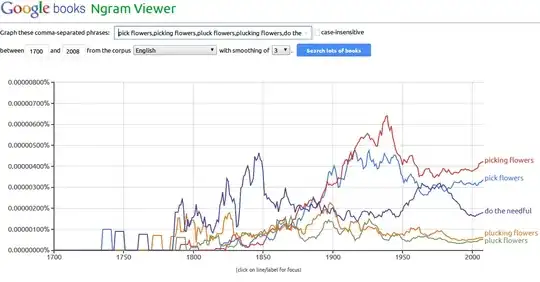
Bringing in a bit of corpus linguistics, it appears that around the year 1900, there were two people picking flowers for every person who was plucking flowers. And roughly before 1870, it was more common to pluck flowers than to pick flowers.

People have long been known to do the needful. However, they do it less often today than they did in the first half of the 1900s, and before 1870.

I don't think we have a significant enough amount of Indian English text from these periods of time to make much of a difference to Google Ngram's numbers.

enter image description here

prash
  • 2,699
1

"Please don't pluck the flowers?" would be understood by a native speaker of British or American English. It wouldn't even stand out all that much—true, a native speaker would probably never say it that way, but I might not even notice if someone said this.

I found "Please do the needful" completely opaque. My best guess at the second reading was that it meant "Do what is morally just", which is entirely different than what you meant it to mean. I would recommend not using this phrase when communicating with a non-Indian English speaker.

"I have a doubt in this concept" would be understood by a British or American English speaker, but it sounds wrong: native speakers would say something more like "I have a doubt about this concept."

"Prepone" is not in current use in non-Indian English. It would probably be understood in context.

In summary, the words "prepone" and "needful" differ from Indian English to other dialects of the language. Grammatically, "Please do the needful" and "I have a doubt in this concept" are on shaky ground (acceptable in Indian English as idiomatic, but less good elsewhere). But I think that only "Please do the needful" risks misunderstanding.


I have restricted myself to the dialects of countries where I grew up. Speakers of other regional varieties (esp. Australian English) are welcome to comment on intelligibility, grammaticality, and other aspects of these phrases.

Charles
  • 2,454