Does anyone besides my husband insist on adding an -ed to sour cream? Etymonline dates "sour cream" to 1855, but has no mention of "soured", so I don't think this is analogous to "iced tea" or "ice cream". Is this a regional thing? He grew up in New England, but English is not his parents' first language, so his accent is more Uncle Walter than This Old House.
Asked
Active
Viewed 2.4k times
8


-
5Your husband is now the source of two questions on this site. He really ought to join, just to defend himself. :D – Marthaª Oct 28 '11 at 17:27
-
1For what it's worth, I have never heard it called soured. I'm Scottish. – Rory Alsop Oct 28 '11 at 17:14
-
1@RoryAlsop I (English) have also never heard anyone in the UK say "soured cream". On the other hand, if you go to Asda, Morrisons, Sainsbury's, Tesco or Waitrose and buy the stuff, the carton will say "soured cream"; if, instead, you buy something flavoured with the stuff, that will probably be described as "sour cream and X flavour". – David Richerby Jul 20 '14 at 15:42
-
2“soured cream” is whipping cream that has been in the refrigerator for too long. :-) You put sour cream on nachos, you put soured cream in the trash. – Jim Aug 10 '17 at 17:40
-
@DavidRicherby If you met me (Berkshire resident) you would certainly hear soured cream. I always call it that - my wife disagrees. Sour cream in my view is cream which has gone sour and is not fit for consumption. Soured cream on the other hand is what we use for our beef stroganoff - yum, yum! Waitrose soured cream – WS2 Aug 10 '17 at 17:41
-
1@WS2 Interesting, especially as Jim in the comment immediately before yours makes the distinction in exactly the opposite direction! I'll have to pop over the border from Oxfordshire to investigate this phenomenon -- when are you next cooking stroganoff? :-D – David Richerby Aug 10 '17 at 17:50
-
@DavidRicherby I think it's simply that Americans call it "sour cream". The OED is on their side and calls it sour cream. I think the point is that "sour cream" is not native to British cooking, as it is to German. Hence when it started to become popular here in the 1960s, the manufacturers called it soured cream so that people would realise that it had been made sour (by the addition of lactic acid) and not just ordinary cream which had gone off! – WS2 Aug 10 '17 at 18:16
-
The comment from @Jim agrees with the usage I'm accustomed to. – Andreas Blass Aug 10 '17 at 21:16
8 Answers
7
After a quick Google Ngram search, soured cream appears to be used very little. Personally, I have never heard it used. On the product itself, (in Canada), the label declares it to be sour cream. There are 39.8 million hits for sour cream on Google, and 0.6 million for soured cream. If we change the Google Ngram to British English, soured cream's popularity increases, so I assume that this is mainly a British expression. Changing it to American English shows almost no results for soured cream.
4
Soured cream is English and sour cream is American English. We don't eat it as much, dips are not as popular here (although on the rise) and we tend to use yogurt or creme fraiche, that's why it shows lower search results.

Liz
- 41
-
1If you buy sour cream in England, what does the package say? Does it have the -ed or not? – JPmiaou Aug 20 '12 at 19:36
-
@JPmiaou I just looked at the major UK supermarkets' websites and, in all cases, the packaging says "soured cream". On the other hand, most other products containing sour(ed) cream seem to be described as, for example, "sour cream and chilli/chive/whatever". And I've never heard anyone in the UK say "soured cream" rather than "sour cream". On the other hand, I've not spent a lot of time discussing that product with my fellow countrymen. :-) – David Richerby Jul 20 '14 at 15:37
1
Looking at the entry for sour (the verb) in the NOAD, I find the following definition:
make or become sour: [with object]: water soured with tamarind | (as adjective soured): soured cream | [without object]: a bowl of milk was souring in the sun.
Soured cream is a valid alternative to sour cream.
Looking at the Corpus of Contemporary American English, I notice that the most used phrase is sour cream.
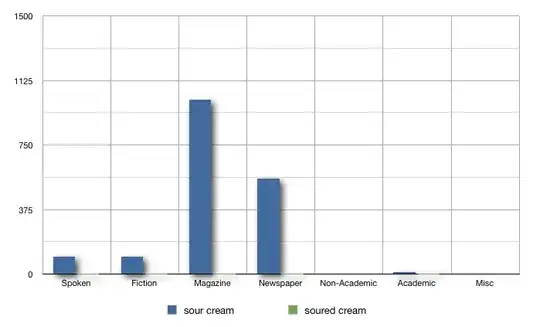
The data for soured cream is not visible because the CoCA reports just one or two sentences containing that phrase.

apaderno
- 59,185
-
2I'd be interested to see the context for usage of "soured cream": is it actually a synonym for "sour cream", or a different substance entirely, namely cream that has gone bad? – Marthaª Jun 21 '12 at 23:27
0
Surely the discussion here is not about what is correct, it is just labeling. Personally, I grew up in the UK and have always called it soured cream because that is what the label said when it was introduced to me.
Soured Cream simply means it has been soured (made sour), past tense. This in comparison with cream that has not been soured.
The other use simply says what it is - sour. This, in comparison with cream that is not sour.
One correctly defines the process that the cream has gone through. The other correctly describes the state that the cream is in.
If I leave cream out in my kitchen, it goes sour, it is sour cream - I will not eat it.
If I buy soured cream then it has gone through a process of souring with a known outcome - I will eat it.

Kevin
- 1
-
1What age did you first see this and what manufacturer? Or was it a regionally produced product? – Mitch Aug 10 '17 at 17:40
0
As a New Englander, I have never heard it called "soured cream".
According to Google ngrams, "sour cream" is FAR more popular, but this result indicates that it was originally "soured cream" (not sure how reliable it is).

yoozer8
- 8,752
0
I understand that sour cream is cream which is no longer fresh, or "gone off". Soured cream is fresh cream which has been "soured" by the addition of lemon juice (or some other agent).
From the uk.

Maureen
- 1
-
So what do you call actual sour cream, then? It contains no souring "agent", but it is not spoiled. It is formed by bacteria that occur naturally in milk (like yogurt, but different). – JPmiaou Aug 22 '22 at 15:44
-
(Milk/cream + lemon juice = cheese/curds, like ricotta, nothing whatsoever like sour cream.) – JPmiaou Aug 22 '22 at 15:45
0
Both sour cream and soured cream may be understood in two ways: as an edible food that has intentionally been made or allowed to become sour, or as an unpalatable food that had originated as fresh or sweet cream and was meant to be used in that form but then turned or went bad.
'Sour cream' as a desirable food
In searching for early instances of the expression in cookbooks, I found that the spelling sour cream seems to be older than soured cream by almost a century. The earliest such match appears in John Middleton & Henry Howard, Five Hundred New Receipts in Cookery, Confectionary, Pastry, Preserving, Conserving, Pickling; and the Several Branches of These Arts Necessary to Be Known by All Good Housewives (1734):
Hedge-Hog-Cream. Take a Quart of sweet Cream, five Yolks of Eggs well beaten, set it on the Fire ; take three or four Spoonfuls of sour Cream, give it a boil or two, 'till it is turn'd ; pour the Curds into a Cloth, and drain the Whey from it ; then blanch a pound of Almonds, and pound them with Rose-water, that they may not Oil ; then mix the Curd and Almonds together ; lay them in a Dish, in the Shape of a Hedge-Hog ; cut some Almonds in four, and stick 'em to look like Bristles, and Currants for Eyes, sweeten it with Sugar, and pour it on each side of the Curd.
From Elizabeth Moxon, English Housewifery: Exemplified in Above Four Hundred and Fifty Receipts (1752):
To make Cream Curds. Take a Gallon of Water, put to it a Quart of new Milk, a little Salt, a Pint of sweet Cream, and eight Eggs, leaving out half the Whites and Strains, beat them very well, put to them a Pint of sour Cream, mix them very well together, and when your Pan is just at boiling (but it must not boil) put in the sour Cream and your Eggs, stir it about and keep it from settling to the Bottom ; let it stand whilst it begins to ride up, then have a little fair Water, and as they rise keep putting it in whilst they be well risen, then take them off the Fire, and let them stand a little to sadden ; ...
"Sour cream" as a component of meals appears in texts from the 1699 forward. From Owen Feltham & Edward Ward, "A Trip to Holland Being a Description of the Country, People and Manners" (1699):
In there Houses, Roots and Stockfish are Staple Commodities. If they make a Feast, and add Flesh, they have Art to keep it hot more days than a Pigs-head in Pye-corner. Salt meats and sower Cream they hold him a Fool that loves not, only the last they correct with Sugar; and are not half so well pleased with having it sweet at first, as with letting it sower, that they may sweeten it again; as if a Woman were not half so pleasing being easily won, [a]s after a Scolding [f]it she comes by a man to be calmed again.
From Johannes van Egmond & Johannes Heyman, Travels Through Part of Europe, Asia Minor, the Islands of the Archipelago, Syria, Palestine, Egypt, Mount Sinai, &c. (1759):
Scarce was our arrival known in the village, especially as the Vice-consul was with us, before the principal inhabitants came to visit him. Among those were several who had borrowed money of him at interest ; and soon after the Sheik sent us a repast, consisting of pilao and broth, made from meat and fowls ; likewise beans, sour cream, and honey. In our apartment were several Arabians, who all eat after us, one taking the place of another as soon as he had finished his repast. Coffee was afterwards served up to us.
...
About noon we had the pleasure of seeing these Arabians eat their repast, which consisted of two large dishes of rice in the form of pyramids, which they call Pilao, and full of small pieces of flesh, soop, honey, grapes, water-melons, and sour cream.
From A Tour Through Part of France and Flanders (1768):
Dinner being over, the peasant's wife entered with a cake, and what the French call a Tarte. The former was tolerably good in its kind, but the latter was quite disagreeable to all the English present, as well as to myself. It is made of a kind of sour cream, covered over with a piece of dough which has leaven in it. The French are so fond of this cake, ordinary as it is, that they defer eating till it is brought in. We were regaled next with creme bouilli, or boiled cream ; the ingredients which enter into the composition of the beverage are sour cream, eggs, and milk hot from the cow, with a little rennet ; we were served with it in pans, with a spoon to sup it, and sugar was given to such as chose it. I found this beverage agreeable enough; ;it is a good refreshment upon a hot summer's day.
From a 1771 translation of Peter Kalm's Travels Into North America:
September 12, 1749. ... The farmers [in Quebec] prepare most of their dishes of milk. Butter is but seldom seen, and what they have is made of sour cream, and therefore not so good as English butter. Many of the French are very fond of milk, which they eat chiefly on fasting days. However, they have not so many methods of preparing it as we have in Sweden.
'Sour cream' as an undesirable food
An instance where sour cream seems to mean cream that has spoiled appears in Eliza Haywood, The Wife (1756):
Oh, mrs. Primwell, said she, Cupid [a pet spaniel] has been very naught, — the poor creature I believe has got the cholic ;—— I am sure they gave him sower cream in his tea this morning, tho' my impudent wench assur'd me it was sweet, and I did taste it as I never drink any myself ;— ...
'Soured cream' as a desirable or undesirable food
The earliest Google Books match for soured cream in a cookbook appears in Margaret Dods, The Cook and Housewife's Manual: A Practical System of Modern Domestic Cookery and Family Management, fourth edition (1829):
An Indian Curry.—Take a clove of garlic and a small onion ; bruise them in a mortar, with three tea-spoonfuls of the powder, described below [consisting of powdered ginger, coriander seeds, turmeric, and cayenne], and a tea-spoonful and a half of salt. Slice another onion, an fry it in a stew-pan with a good piece of butter. Let it fry till the onion is brown. Pick out the shreds of onion, and put the mixed ingredients into the pan with a tea-spoonful of good butter-milk, or soured cream ; add to this a young fowl skinned, and carved into joints ; and simmer till it is ready, stirring the whole quickly.
This cookbook, by "Mrs. Margaret Dods [actually, Christian Isobel Johnstone] of the Cleikum Inn, St. Ronan's," was originally published in Edinburgh—and there is some circumstantial evidence to suggest that soured cream originated as a variant of sour cream in Scotland. The two earliest matches for soured cream in any context that a Google Books search turns up are likewise from Scotland. From John Jameson, An Etymological Dictionary of the Scottish Language (1818):
WHIG, WHIGG, s. 1. An acetous liquor subsiding from soured cream, S[cottish]. 2. A name given by rigid Episcopalians to Presbyterians ; and by members of the Kirk of Scotland to Presbyterian dissenters, S[cottish].
And from "A True and Authentic History of 'Ill Tam',"in The Scots Magazine (February 1822):
There was a "Witch" in my immediate neighbourhood. She was in the habit of traversing the parish, and the adjoining districts, in quest of those donations with which the credulous were content to purchase her favour. If she was refused the cast of a fleece over the "fold-dyke at clipping time," the master had no want of "braxy" [a disease afflicting sheep] during the ensuing season ; or if her pitcher, which she always bore about with her, went away from the dairy, or from the kitchen, empty, every body knew to what cause to refer the soured cream, and the scalded child.
Conclusion
Both sour cream and soured cream have been in use for two centuries or more to refer either to a desirable foodstuff or to a turned or spoiled foodstuff. The earliest Google Books mentions of soured cream come from Scottish sources and are considerably younger than the earliest instances of sour cream, so it seems possible that soured cream originated there as a variant form of sour cream.

Sven Yargs
- 163,267
-1
"Sour cream" versus "soured cream"
Sour is a simply an adjective "Sour cream" is thus any cream that has a sour taste. Essentially this is a statement of the state of the cream: There is no hint in the phrase of an agent that might cause the sourness.
Soured is the passive participle "Soured cream" is cream "that has been soured" (by someone or something) and this implies an agent.
As "soured cream" is being offered for sale as an accompaniment to food, we can take this passive form as suggesting that someone has soured the cream. Moreover, as this is Waitrose, we can assume that the man who did it is a trendy chef and that chef did not sour the cream with the intentions of upsetting stomachs.
Conclusion: both "Sour cream" and "soured cream" are appropriate, but the marketing department has correctly determined that the latter panders to those who have no social choice but to shop at Waitrose.

Greybeard
- 41,737