8

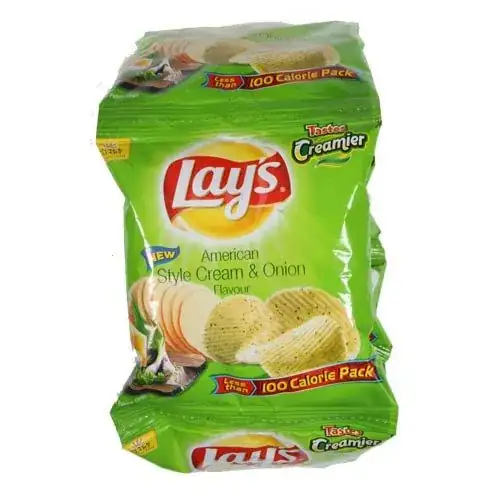
On this matter I have read other questions: “Sour cream” versus “soured cream”, “shaving cream” vs. “shave cream”. But, can someone explain what is the "Style Cream" to which this potato chips are associated to, as it seems to be from reading the following phrase on the packet:

American / Style Cream & Onion / Flavour

I have searched for "Style Cream" in Wikipedia, but I haven't found anything.

enter image description here

2 Answers2

14

I think what you have here is a problem of line-breaks. These crisps are American Style, Cream & Onion flavour. "Style" should be on the same line as "American".

  • How is it possible? Is Lay's wrong in parsing the phrase? –  Jun 29 '12 at 17:46
  • 4
    And by "cream" they presumably mean "sour cream". I wonder where this is sold; in the U.S. they have "Sour Cream & Onion", but nothing with "American" in the name. – ruakh Jun 29 '12 at 17:52
  • 6
    I agree. I think they meant to say "American Style" (line 1), then "Sour Cream & Onion" (line 2). (These kinds of errors and gaffes in packaging are not all that uncommon, particularly overseas.) "American Flavour" is rather humorous, too, in an oxymoron kind of way. – J.R. Jun 29 '12 at 17:58
  • I thought at first from the title that this was a misprint of Styling Cream, a variant of Styling Gel, but I don't think that would go well with onion, at least not on potato chips. – John Lawler Jun 29 '12 at 18:47
  • 3
    The OP is (according to his profile) in Italy. Italian cuisine doesn't use "sour cream" (panna acida) - see this question - so chips that are flavored with sour cream are definitely "American-style". – MT_Head Jun 29 '12 at 19:04
  • So is the correct phrasing "American-style Cream" & Onion? – Adam V Jun 29 '12 at 19:10
  • @AdamV - I believe so, yes. More properly, "American-style Sour Cream" & Onion. American food (especially ready-made snacks, such as potato chips) doesn't generally use "just plain" cream; ice cream, whipped cream, sour cream, and cream cheese - but not cream alone. Even for our coffee, it's generally half-and-half, not cream. ( – MT_Head Jun 29 '12 at 20:32
  • @MT_Head: I confirm: Italian people don't use "panna acida". Also, "panna" doesn't have tha same meaning of "cream" ("crema" in my language.) If you came in Italy, ask for "panna cotta". It is very good. –  Jun 29 '12 at 20:33
  • @Carlo_R. - I love panna cotta. Talking about chips didn't make me hungry, but you just did. Thanks a lot. On your first point, though - I got "panna acida" from an online dictionary, and I should know better by now than to trust them implicitly... but how should one translate "sour cream"? Would "crema acida" be correct? (I know y'all don't make or use the stuff, but if you did, what would you call it?) – MT_Head Jun 29 '12 at 20:54
  • @MT_Head & Carlo (this is a serious question): if the issue is due in part to no "sour cream" in Italy – thus no suitable translation – (as appears to be the case), why don't they package the chips and label them in Italian, instead of English? At any rate, the unusual wording makes much more sense now. – J.R. Jun 29 '12 at 21:02
  • @MT_Head: "Panna" is done only by milk, while "crema" is done by milk and several other ingredients like "farina", "uova", "limone" and "zucchero". I just don't know what "panna/crema acida" is. It is not used in Italy. The things that it seems more similar (in Italy) could it be "yogurt". –  Jun 29 '12 at 21:09
  • @Carlo_R. - Sour cream and yogurt are pretty similar; I believe (I'm not sure; I've never made either) that the bacteria involved are different. Sour cream is made with cream rather than milk, so its butterfat content is higher and its flavor is richer (although, of course, there are now "lowfat" versions... ick!). In cooking or baking, yogurt can substitute for sour cream with very little noticeable difference; uncooked - as a topping, or dropped into borsch - yogurt really doesn't taste the same. Not worse, necessarily, but not the same. – MT_Head Jun 29 '12 at 22:45
  • @J.R. - I hope you're not expecting logic from the marketing division of a multinational food corporation! – MT_Head Jun 29 '12 at 22:49
  • @MT_Head & Carlo_R. Just for discussion sake, it's not true that sour cream (or panna acida) doesn't exist in Italy, because it's frequently used in German cuisine and thus you find it in recipes from Sud Tyrol. If you don't have it (but you can find it in some supermarkets), you can use regular cooking cream to which you added lemon juice. Lays is definitely an Indian brand, which I have not yet seen on the Italian market, but which may have been introduced for its comparatively lower prices. – Paola Jun 30 '12 at 00:44
  • @Paola - Lay's is an American brand, founded in Nashville, Tennessee in 1932. It's part of the Frito-Lay corporation, which is now a gigantic multinational; the Lay's chips sold in Italy are (I gather) made by the Indian subsidiary, which explains their general strangeness to the American eye. Regarding sour cream, I'm not surprised that you can buy it there - I was actually surprised to learn that it wasn't widely available, considering its use in neighboring cuisines. And just to clarify: panna acida is the correct translation? – MT_Head Jun 30 '12 at 00:55
  • @J.R. Lays is not an Italian brand nor is it common here (at least to my knowledge). Still, English is used quite a lot in Italy not only in advertising, because it is believed to add to the value of the thing mentioned (and sometimes because the sentence is shorter if you use an English expression). Very often, however, such expressions are wrongly used, opening the way to hilarious misinterpretations. If you can read Italian, check http://it.wikipedia.org/wiki/Italians_(forum)#Italians – Paola Jun 30 '12 at 01:00
  • @MT_Head. Thank you for your explanation. I thought it was Indian because I bought those crisps in India but never in the States. I'd say that "panna acida" is the most frequently used term, certainly the one used in recipes which are of foreign origin. – Paola Jun 30 '12 at 01:14
5

This is a combination of bad layout and ambiguous punctuation.

The phrase is meant to be parsed as "(sour, by implication) cream and onion in the American style". Because the adjectival phrase "American style" is broken across two lines, miscapitalized, and does not have a hyphen in the adjectival phrase, the implication by layout is that "style", to use a programming term, binds more tightly than the full phrase, leading to the false conclusion that "style cream" is something that exists. This should have been laid out as

American-style
Cream and Onion
Flavour

to ensure that the phrase wasn't misinterpreted. Note the hyphen and lower-case "s" in style, which says "this is a single adjectival phrase, to be parsed as a unit".

American Style
Cream and Onion
Flavour

would have communicated the intended meaning, despite being ambiguously punctuated, because the layout implies the association of "American" and "Style" instead of "Style" and "Cream".

I'd guess this was the original layout, and someone tweaked the font size up, causing "Style" to move to the next line; the tweaker, not knowing the English rules for adjectival phrases, decided to move "style" to the second line because it was "looked nicer" (one word on top, one on the bottom). The little "new" flag was probably also an unconscious impetus to break the line after "American", as it crowds the first line a little.

To be completely accurate, this should have been

American-Style
Sour Cream and Onion
Flavour

There, that's thoroughly over-analyzed.