34

I've seen a thread that generally asks about Creating words with “-able” suffix But I don't think it answers my point, though they are admittedly dangerously close topics.

When do you drop the 'e' when forming words suffixed with -able. My Spell checker likes Unforgivable but dislikes Forgivable. Dropping the 'e' in the first case, and adding it in the second makes my spell checker happy. How do you determine when one is ok? Note that this is different from the linked question, where neither with or without the 'e' is accepted.

(Having checked the OED it seems there is one accepted spelling of Forgivable but two of Unforgiv(e)able)

  • 2
  • 1
    @Jim I did, but only really focuses on hyphenation. What do you want me to get from that answer that I've missed? – AncientSwordRage Jan 18 '12 at 17:13
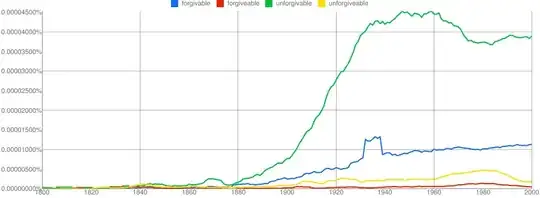
  • I expect your spellchecker doesn't like forgivable because - strange as it may seem - it's a pretty rare word compared to unforgivable. It's certainly not a matter of spelling. – FumbleFingers Jan 18 '12 at 17:21
  • @FumbleFingers that's why I referenced the OED as well. – AncientSwordRage Jan 18 '12 at 17:25
  • Yes, I didn't suppose there was any real debate on whether forgivable was a valid word, or how it's spelt. Just trying to guess why your spellchecker didn't recognise it. I can't explain why it liked the "e" version though. – FumbleFingers Jan 18 '12 at 17:32
  • 3
    @FumbleFingers: While, humph, if "forgivable" is a "pretty rare word" to you compared to "unforgivable", I guess that just says something about the kind of person you are. :-) – Jay Jan 18 '12 at 17:38
  • 1
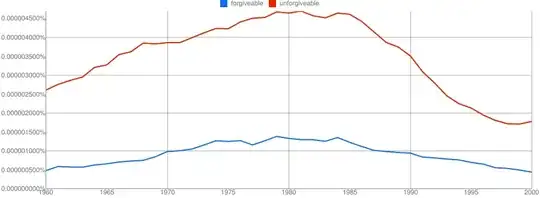
    @Jay: Obviously I'm a competent native speaker, so unforgivable certainly isn't going to cause me any problems. But it's outweighed 5:1 by unforgivable in Google Books, which is fairly unusual for word vs unword. I was just trying to guess at a possible reason for the spellchecker's behaviour, is all. – FumbleFingers Jan 18 '12 at 17:46
  • 3
  • @RegDwightѬſ道 no I hadn't seen that. It looks like a perfectly good answer. I've submitted a close request (exact duplicate). I'm note sure if it could be merged. – AncientSwordRage Jan 18 '12 at 18:43
  • @Pureferret I thought the consecutive vowels running together was relevant. Having "ea" might confuse some people to the pronounciation (I wouldn't expect this to actually happen, unless the reader had never seen the word "forgive" before), so it might be correct to use a hyphen. – yoozer8 Jan 18 '12 at 19:01
  • @Jim Ahh I see! But it doesn't change the difference between Unforgivable and Forgiveable – AncientSwordRage Jan 18 '12 at 19:05
  • 2
    @Pureferret No, it doesn't, but that difference exists in your spellchecker, which isn't necessarily the correct way to write it. It's just what that particular spell-checker thinks is right (which in this case is inconsistent). – yoozer8 Jan 18 '12 at 19:09
  • My spellchecker accepts forgivable, but doesn't accept forgiveable, which is marked in red. I am using the American English spellchecker. – apaderno Jan 18 '12 at 20:51
  • How do you know it’s -able and not -ible? The OED attests more than 400 -ible words. And no, I’m not counting Bible and such. force > forcible, fuse > fusible, immerse > immersible, reduce > reducible. There are lots and lots of those. – tchrist Jan 18 '12 at 22:18
  • @tchrist I don't really understand what you mean – AncientSwordRage Jan 18 '12 at 22:55

3 Answers3

25

The only situation that comes to mind where an -e- is absolutely required before -able is when it modifies the pronunciation of a consonant, typically g or c:

Manageable (g as in giant) versus
**managable* (g as in gut)

Traceable (c as in once) versus
**tracable* (c as in cut)

Of course, that problem would exist in reverse for -ible words, but in practice it doesn’t arise as these are less common than their -able cousins.

The -e- also serves to make a vowel long where otherwise it could be interpreted as short. Scrapeable definitely begins with scrape, scrappable definitely begins with scrap, but scrapable could go either way; and if the common misspellings of short-vowelled words ending in -able are any evidence, it is likely to be read as scrappable.

In addition, when adding -able to words that end with a syllabic consonant, the -e- tends to be retained, to stress that the consonant still comprises its own syllable. tchrist offers:

Throttleable, (un)settleable, (un)whistleable, (un)riddleable

To my mind, whistlable is three syllables—[wɪs.lə.bɫ]—whereas whistleable is four: [wɪs.l.ə.bɫ]. That says nothing about which one I’d choose, because my pronunciation varies freely between them. Although, I do think that a two-syllable pronunciation of “settlers” (thus a three-syllable “settlable”) sounds rather Southern or Southwestern.

Jon Purdy
  • 32,386
  • 2
  • scrapeable/scrappable is a good example. It's a shame we don't use a verb "to cape" (form into a cape, perhaps). There was discussion over whether the Deepwater Horizon leak could be capped ("cappable"), so given we've already got the totally unrelated word capable, that would really set the cat among the pigeons!
  • – FumbleFingers Jan 18 '12 at 17:29
  • 2
    Ah, interesting point. Let me clarify for you that there is a general rule that when "g" or "c" is followed by "e", "i" or "y" it has the soft sound (g->j, c->s), but when followed by any other letter it has the hard sound (c like k, g like ... g). – Jay Jan 18 '12 at 17:30
  • dictionary.com gives "scrapable" as the correct spelling for a word meaning "able to be scraped". I couldn't find any listing for "scrappable", though one would think that this would be a perfectly good word meaning "suitable for turning into scrap", as in, "Once we remove the motor the wire should be scrappable." – Jay Jan 18 '12 at 17:36
  • 1
    @Jay: The fact that any particular inflected form isn't explicitly given by any particular (or indeed every) dictionary doesn't necessarily mean it's not a "valid word". In the case of scrappable here are hundreds of written instances. And it'll be far more common in things written later than the stuff indexed in Google Books. – FumbleFingers Jan 18 '12 at 18:26
  • @FumbleFingers: I meant that I couldn't find "scrappable" in any of the several dictionaries I checked, not just that one I mentioned where I found "scrapable". Quite true that the failure of a word to appear in any particular dictionary does not prove that it "isn't a real word", but it would be an indication that it is unusual or specialized. What I was trying to say was that that surprised me. It seemed like it should be a fairly common word. – Jay Jan 18 '12 at 20:11
  • @Jay: A decade ago I'd have considered scrappable to be on a par with scrappage. They were both quite uncommon words, and even today Google makes me confirm I really want scrappable (20k hits) rather than scrapable (itself only 350K hits). But scrappage is right up there with over 4M hits, on account of all the government incentives to persuade us to scrap old energy-inefficient technology. Which will obviously lead a lot of people to wonder "Is my old gas-guzzler car scrappable?" (i.e. - "Will the government give me a lot of money for 'doing the right thing'?"). – FumbleFingers Jan 18 '12 at 20:27
  • The OED attests: throttleable, settleable & unsettleable, haveable, giveable, whistleable, unriddleable, &c. What model explains those sorts, hm? – tchrist Jan 18 '12 at 22:32
  • @tchrist: In throttleable, (un)settleable, whistleable, and (un)riddleable, the E is there because of the syllabic L; I’ll edit to add. I’ve never seen haveable or giveable, but they’re cromulent as there’s really no universal rule. – Jon Purdy Jan 18 '12 at 22:40
  • @Jon Purdy: I personally find liveable and livable equally acceptable, though I'd actually write the livable myself (NGram says liveable was the more common until 100 years ago). On the other hand, if I read (or needed to write) haveable/giveable I'd expect the "e" because they're at the very least "unusual" forms, so it's good to have that extra letter to make it obvious where they're coming from. – FumbleFingers Jan 18 '12 at 22:49
  • ...but let's not forget that at this level it's pointless to pontificate about "correct" spelling. – FumbleFingers Jan 18 '12 at 22:50
  • The OED gives only whistleable, and gives /ˈhwɪs(ə)ləb(ə)l/ for the pronunciation in a broad phonemic transcription. As for ‘correctness’, I’m pretty sure around here all anybody really cares about is whether they’ve won the popularity contest at the top of the ngram hit-parade, just so they can go nyah-nyah. – tchrist Jan 18 '12 at 23:18
  • @Jon Purdy: To a first approximation I have no interest at all in the concept of "correct" in things like spelling. What matters most is what people actually say/write. I don't reference ngrams in order to "win" - I reference it to show actual usage, historical trends, US/UK differences, etc. – FumbleFingers Jan 19 '12 at 02:30
  • @FumbleFingers: I think you’re @-replying the wrong person. I’m a descriptivist as well, and the only notion of “incorrect” spelling I mention is referring to nonstandard, minority use of nondoubled consonants around short vowels. – Jon Purdy Jan 19 '12 at 02:35
  • Ooops, sorry! Must have been a "senior moment" brought on by conflating the fact that you're the originator here so you don't need mailboxing, whereas @tchrist (who I mean to notify) seemed to be replying to me without mailboxing. I'm completely with you on this issue, obviously. – FumbleFingers Jan 19 '12 at 02:49
  • I just had to check when writing the word "shareable." The rules would seem to say drop the e, but that's incorrect. I tried to think of other words ending in "re," and only came up with flare, which also ends up as "flareable." Not sure if that's always true. – Rick Jul 06 '21 at 01:48
  • As for the words ending with "c" or "g", it would be really nice to use -ible suffix instead (thus tracible and managible - the same pronunciation!), but unfortunately it isn't productive anymore (i.e. us(e)able only with some Latin-origin words). – trolley813 Jan 31 '24 at 23:31