17

Take the example of

There is very little that a conforming POSIX.1 application can do by catching, ignoring or masking SIGSYS

(From the SIGSYS article)

This can be rewritten as

There is very little that a conforming POSIX.1 application can do by the catching, ignoring or masking of SIGSYS

Both the and of must be added or the sentence becomes ungrammatical. Is there a grammatical explanation for this?

Mitch
  • 71,423
  • 3
    Doesn't the insertion of the turn them functionally from verbs to nouns? (Which I believe is the reason for of). – Kris Feb 15 '12 at 09:12
  • @Kris Right, I'm asking why does a gerund require of? Or why can't a verb have it? – Matt E. Эллен Feb 15 '12 at 09:29
  • 3
    A gerund does not require of. A gerund would simply take a direct object, like X-ing Y. A noun, on the other hand, can't take a direct object, and has to use a preposition to mark that relation, as well as an article, like any noun. The preposition used with nouns derived from present participle forms is generally of. See here for details on the 5 different varieties of -ing in English. – John Lawler Feb 18 '12 at 18:02

4 Answers4

13

Morning! The below is just an hypothesis, but it sounds convincing enough to me.


A gerund is special kind of word: it is both noun and verb at once (just as a participle is both verb and adjective). In its function as a verb, it can have an object:

Augustus condemned his daughter's adultery.

By condemning Julia, he set an example for the Empire.

But it can also have an article and an of attribute like most nouns:

The public condemnation of his own daughter was part of his new policy of chastity.

His laws punishing adultery would have been hypocritical without the condemning of Julia.

Whenever the is used, the gerund is marked as a noun; that is probably why it cannot have an object then, since nouns normally can't have objects. This forces the secondary argument of the word to turn into an of attribute.

Conversely, whenever it has an object, it is marked as a verb, so that it cannot have an article. If there is no secondary argument, the article is free.

Whenever of is used, it is marked as a noun, just as with the. Even though nouns can normally exist without articles, somehow of usually forces the gerund to take the article. Apparently the pattern the + gerund + of became dominant enough to render no article + gerund + of unidiomatic. I can't really say what could have caused this, except that the lack of article may somehow mark it as a verb in this case. Perhaps some more pondering will bring inspiration.

  • Interesting, thanks. I've just realised you can remove the article if the gerund is at the beginning of the sentence Demolition of the building will happen at 10am. Not sure if that's important. P.s. surprised you're up so early! – Matt E. Эллен Feb 15 '12 at 10:59
  • @Matt: Yeah I am shifting my cycle forwards! I don't really see a gerund there...but I suppose the article can be left out in headline-like language, is that what you meant? – Cerberus - Reinstate Monica Feb 15 '12 at 11:02
  • Yeah, headline style language sounds about right. – Matt E. Эллен Feb 15 '12 at 11:48
  • 1
    @MattЭллен: The word at the beginning of the sentence would be demolishing not demolition, and it does need a determiner. – Brett Reynolds Feb 15 '12 at 14:06
  • 1
    @Brett Reynolds: Agreed the gerund there is "demolishing" not "demolition", but I don't think a determiner is any more or less "needed" just because it's a gerund. We just tend to do it because this is a convenient way of indicating that we're using the superficially "verb" form as a "noun". – FumbleFingers Feb 15 '12 at 14:33
  • @BrettReynolds: Yes. I think though in headline-like language, the elision of the delimiter is OK. – Matt E. Эллен Feb 15 '12 at 17:39
  • No, I agree the simple fact of its being a "gerund" doesn't require a determiner. There are clear cases where a determiner is options (e.g., disposal of the trash). But demolishing doesn't seem to allow for that, perhaps because demolition is occupying that space. – Brett Reynolds Feb 15 '12 at 17:49
  • I made the same mistake. It should be disposing of the trash not disposal. Also, the speculation about why demolishing needs a determiner is obviously wrong since disposal occupies the same space vis a vis disposing that demolition does vis a vis demolishing. – Brett Reynolds Feb 15 '12 at 17:57
  • 2
    +1 purely for going out on a limb with an hypothesis (I just had to defend Jeremy Paxman's an historical on BBC University Challenge a couple of nights ago :) – FumbleFingers Feb 15 '12 at 18:07
  • 3
    I think @Cerebus has the right answer here. In "Smoking cigarettes is bad for you" smoking is conceived as a verb and can therefore have a direct object. In "The smoking of cigarettes is bad for you", using the article the marks "smoking" definitively as a noun. To my knowledge, nouns cannot be followed by direct objects; they need the insertion of "of": the destruction of the city. a loss of memory, the enjoyment of music, a change of clothes, etc. – Shoe Feb 18 '12 at 16:28
3

The two sentences you have written are not exactly the same in meaning.

"There is very little that a conforming POSIX.1 application can do by catching, ignoring or masking SIGSYS"

Here catching, ignoring and masking are gerunds and they function like verbs. In other words they have a subject (a conforming POSIX.1 application) and an object (SIGSYS). It is clear that the specific application performs these acts.

"There is very little that a conforming POSIX.1 application can do by the catching, ignoring or masking of SIGSYS"

The gerunds function as nouns here. In order to attribute genitive to nouns we use 's or the preposition of, the latter being the case in this sentence. It is not clear who or what does the catching, ignoring or masking to SIGSYS since nouns can't have a subject like verb forms (unless of course there is a technical reason I am not aware of which allows everyone to understand it is the specific application which performs the above mentioned acts and nothing else). In the meantime, the has been introduced to mark this change of function in the sentence. Without the, all three gerunds behave like verb forms and of is ungrammatical.

Irene
  • 12,562
2

There is no such thing as a gerund in present-day English (CGEL p. 1220-1222). They are only present participle verb forms (or gerund participles if you wish) and (gerundial) nouns. Verbs take objects and nouns don't. Nouns take determiners and verbs don't.

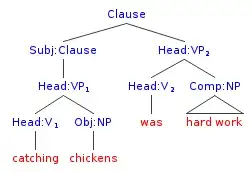
So you have catching chickens was hard work, where the subject is a non-finite clause headed by a present participle with the chickens as its object.

syntax tree for "catching chickens is hard work

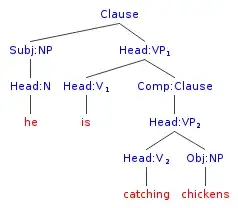
This the same catching in he is catching chickens

syntax tree for he is catching chickens

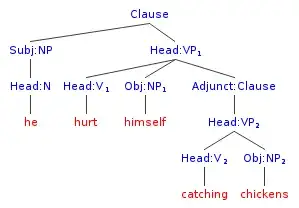
or that in he hurt himself catching chickens.

syntax tree for he hurt himself catching chickens

The alternative is the catching of the chickens was hard work in which the subject is the noun phrase the catching of the chickens. In this case, of the chickens is the complement of the noun catching. Like other singular countable nouns, This requires a determiner; thus we have the catching...

syntax tree for the catching of the chickens was hard work

  • 4
    "No such thing as gerunds"? Uh sure there is – Matt E. Эллен Feb 15 '12 at 12:52
  • Thanks for the diagrams though! – Matt E. Эллен Feb 15 '12 at 12:57
  • No, there isn't. There used to be, but there isn't now. The dictionary link where it says "verb functioning as a noun" is nonsense. Verbs function as heads and modifiers. Clauses function as subjects and complements. But verbs don't "function as" nouns any more than broadly is an adjective functioning as an adverb. Verb and noun are not functions. A word is a noun or it is a verb. – Brett Reynolds Feb 15 '12 at 13:49
  • 4
    Hmmm... I think you're presenting this as a universally acknowledged fact, but that doesn't square with (for example) the discussion in comments here. I think a lot of people agree with the CGEL on this, but not everyone does, as suggested by the fact that the CGEL actually has to make an argument. – senderle Feb 15 '12 at 14:30
  • 1
    It doesn't have to be universally acknowledge to be a fact or to be a useful way to explain something. – Brett Reynolds Feb 15 '12 at 14:32
  • 3
    That's just splitting hairs over terminology. The word gerund is often useful because it distinguishes the assigning of a term from the assignment of the same - semantically equivalent they may be, but the words have different histories. – FumbleFingers Feb 15 '12 at 14:37
  • 3
    There's a gerund complementizer construction in English that's distinguishable syntactically from other -ing constructions. I don't think CGEL is the final word -- or even close; it seems overcomplicated and a bit too fond of its own terminology, which is its right, granted. But it'll be a generation or two before the dust settles. I would say chickens in The catching of the chickens was hard work is just a noun, not a gerund, whence the article; but in Catching chickens was hard work, it's the verb in a gerund complement construction. – John Lawler Feb 15 '12 at 15:43
  • The history, while it may be different, isn't particularly relevant. As for the terminology, I don't think it's splitting hairs at all. In fact, I would hazard a guess that the puzzlement which sparked the question in the first place is caused by the use of the term to make a distinction which is not meaningful in contemporary English. – Brett Reynolds Feb 15 '12 at 17:26
  • In 'he is catching chickens', really, is it accepted practice to parse 'catching closer to 'chickens' than to 'is'? Shouldn't it be closer to '[S [N He] [VP [V is catching] [N chickens]]]' ? Are you saying 'is catching' is not -the- verb in that sentence? – Mitch Feb 15 '12 at 19:19
  • 1
    @Mitch: Yes, I'm saying is catching is not "the" verb or even a constituent. The tree above is correct. You can say he said he'd be catching chickens, and [catching chickens] he was, which shows the constituents nicely. You can also say he was [catching chickens and plucking them], which again shows the structure clearly. See CGEL pp. 1214-1220. – Brett Reynolds Feb 15 '12 at 19:43
  • @Brett: I don't know about CGEL or the other 'standards'; your analysis as constituents is compelling (that is, if you can move them around together, they are part of the same 'thing'), but a counter example to that kind of argument is the existence of phrasal verbs (where the preposition can move around, but is still considered part of the verb). – Mitch Feb 15 '12 at 20:46
  • @Mitch: Phrasal verbs are a useful pedagogical concept for learners of English, but from a syntactical point of view, in a Verb + Prep + NP combination, the Prep goes with the NP, and the PP goes with the verb. – Brett Reynolds Feb 16 '12 at 01:42
  • @BrettReynolds: By phrasal verbs I mean like 'I put out the light' or equivalently 'I put out the light' where the preposition 'out' is not the head of a PP. So it doesn't fit your pattern of V + P + NP. – Mitch Feb 16 '12 at 01:49
  • In this case, the verb takes a goal complement and a direct object. The out is part of the VP, but not part of the verb. Indeed, as you point out, the object can come between out and the verb, so how could Verb + Prep be a constituent? – Brett Reynolds Feb 16 '12 at 02:38
  • @BrettReynolds: This is an old thread, but are you saying constituents can never be split, there can never be another word in between parts of the same constituent? – Cerberus - Reinstate Monica Aug 31 '14 at 15:04
  • @Cerberus, for lexical constituents, yes, I'd say they can never be split. Phrasal constituents can be split. – Brett Reynolds Sep 01 '14 at 02:06
  • @BrettReynolds: So what is the difference? And what are the limitations on that rule? English only? Appositions excepted? Prose only? – Cerberus - Reinstate Monica Sep 01 '14 at 04:22
  • The difference between a lexical constituent and a phrasal one? Lexical constituents are almost always words. When they are more than words, they are insuperable. These are things link verb, nouns, prepositions, etc. Phrases are a head (lexical) and any associated dependents and adjuncts. – Brett Reynolds Sep 01 '14 at 18:24
1

I want to try to analyze this without the onerous term "gerund". That's just a distraction, I think. I think what this is about is ambiguity resolution. Let's consider the 4 possibilities of article + preposition:

1 The Taming of the Shrew
2 Taming the Shrew
3 *The Taming the Shrew
4 ?Taming of the Shrew

1 and 2 sound fine but perhaps have subtly different meanings. 3 is right out. 4 is iffy but all right. The question here is, why does this situation obtain?

Look at 3, which I think we can all agree is ungrammatical. Here the word 'taming' must not be acting as a verb form. If it were a verb, then the transitivity of tame would allow 'the shrew' to be a direct object. But here, we know that 'taming' is not a verb because it has a determiner, the article 'the'. Determiners modify nominals. So a determiner with an -ing word means we are interpreting the -ing word as a noun.

[Det] [-ing word] => [-ing word] = [N]

But this means 3 must be of the form

[Det] [N] [Det] [N]

Which we don't know how to interpret as grammatical.

Now consider 1. This is straightforward:

[Det] [-ing word] [Prep] [Det] [N] => [Det] [N] [Prep] [Det] [N]

That is, a noun phrase modified by a prepositional phrase. Easy.

When there is no [Det], we by default interpret an -ing word as a verb.

[-ing word] => [V]

which means 2 is like:

[-ing word] [Det] [N] => [V] [Det] [N]

which we interpret as a verb and its direct object, based on default SVO word order assumptions.

4 is interesting since we could have 2 paths for resolving the ambiguity.

[-ing Word] [Prep] [Det] [N] => [V] [Prep] [Det] [N]

which could be just a V with a prepositional object. Except transitive tame takes a plain DO (direct object), not a prepositional object, so it's not quite right. But:

[-ing Word] [Prep] [Det] [N] => [N] [Prep] [Det] [N]

could just be a noun phrase modified by a prepositional phrase again. The first noun just doesn't happen to have a determiner, which is ok. So 4 is easy to interpret.

So I think, again avoiding loaded terms like gerund, that in English we want to be able to assign N or V categories to words, and then semantic roles like DO based on those categories. When we can't do so unambiguously, we call the sentences ungrammatical.

Mark Beadles
  • 22,642
  • Okay, all clear; so why do you think 4 is often not really possible, or at least less idiomatic? – Cerberus - Reinstate Monica Feb 23 '12 at 01:42
  • Less idiomatic I think is how I'd put it; but this is only my native-speaker intuition. Compare ?"Learning of French" vs "The Learning of French" or "Learning French". The lack of a determiner makes it seem headline-ese. – Mark Beadles Feb 23 '12 at 02:02
  • More hypothetically - perhaps with the lack of a determiner we are primed to expect the -ing word to be a V; and then when we see it must be an N we must reinterpret. – Mark Beadles Feb 23 '12 at 02:09
  • 1
    Right, but then the question is: why are we primed to expect it to be a verb when there is no "the", even though normally all kinds of nouns exist without articles? It is not a typical expectation for nouns. There is some small step missing that I can't pinpoint either. It has something to do with a fixed pattern the + -ing + of + noun, it seems: somehow it became all or nothing, but for no apparent (good) reason. // Matt and I came up with headline language too in the comments. But I guess it doesn't really count: all kinds of words are left out in headlines. – Cerberus - Reinstate Monica Feb 23 '12 at 02:18
  • @Cerberus, we may be primed to expect -ing forms to be verbs for the mundane reason that most of the times we enounter -ing forms they are indeed verbs. As an addendum to the OP: Adjectives preceding -ing forms behave like determiners in that they mark the -ing form definitively as a noun and thus require of. It needs to be careful reading of this post not careful reading this post. (Conversely, adverbs preceding -ing forms mark the -ing form as a verb and can be followed by a direct object. Google example: "Blindly following instructions can lead you into deep water"). – Shoe Feb 23 '12 at 14:35
  • @Shoe: Hmm so you would say it is best characterised as a verb be default in simply I like swimming (i.e. in the absence of any markers of verb or noun)? I suppose that makes sense. // I think there is also an issue with adjectives: somehow your blindly following instructions sounds much better than (the) blind following of instructions. Why don't we like adjectives with gerunds so much (or at least not without the)? Perhaps following as a gerund-noun is a red herring, because it can also be a regular noun (the philosopher had a large following)? – Cerberus - Reinstate Monica Feb 23 '12 at 15:13
  • I gave this question more thought today. I think that this behavior is lexically conditioned - and specifically I suspect it has to do with the wprd's lexical aspect/aktionsart. I need to ponder some more on this. – Mark Beadles Feb 24 '12 at 02:20