4

In certain pieces often written by journalists and others in the publishing profession, I have come across phrases like the one below (my own example):

Tinker Hatfield, today a legend of the Nike design team, put all his efforts into redesigning the iconic Jordan sneaker.

What I'm interested in is the temporal adjunct 'today,' which is used alongside a noun phrase acting as a supplement anchored by 'Tinker Hatfield.'

I am familiar with the term 'external adjunct,' which I read about in Oxford Modern English Grammar, and I would be tempted to place 'today' into this category, as it seems to fall within the scope of the noun phrase. However, the book mentions external adjuncts in the context of focus words, such as 'only.'

How would you categorise this adjunct? If you can provide a citation from CGEL, I am particularly inclined to accept your answer, since this is the most comprehensive analysis of grammar I am aware of.

MJ Ada
  • 371
  • For those who see whiz-deletion as a valid comparator and not just a perhaps misleading term describing not-closely-related constructs, 'today' ('once' / 'formerly' ...) can be regarded as modifying the retrievable (non-defining) relative clause 'who is (/was) a legend of the Nike design team'. – Edwin Ashworth Sep 18 '23 at 15:54
  • 4
    I think in a strict definition of apposition, the phrase beginning with today a (or formerly a or even former) would not be considered an appositive for the subject, since such a phrase cannot stand as the subject of the matrix verb. The two phrases that stand in apposition must have the identical syntactic relationship to the sentence if one were substituted for the other. – TimR Sep 18 '23 at 16:27
  • @Araucaria-Him No, I mean a narrow definition of apposition such as the one BillJ uses, where the appositive must be a post-modifier of a noun or noun-phrase and be coreferential with it and be able to play the identical syntactic role, versus the much broader definition of apposition, such as we find in Merriam-Webster, which largely incorporates that definition but widens its scope to include phrases other than nominals. I wouldn't make the difference into a value judgment and call the one inadequate or the other too broad. – TimR Sep 26 '23 at 14:13
  • As we say in the American boondocks, I have no dog in that fight. – TimR Sep 26 '23 at 14:22
  • @TimR Ain't got no dog in this fight, man. :} //Why is there a problem with this being a straight-out apposition?? Also, it can be elipted from: [who] today is] a legend of Nike design team. – Lambie Sep 26 '23 at 22:28
  • @Lambie: If, by "straight-out" apposition, you mean "satisfying the strict definition", then it is not one because [today a legend of the Nike design team] cannot be substituted for the subject and fit syntactically perfect with the rest of the sentence: [today a legend of the Nike design team] [put all his efforts into redesigning the iconic Jordan sneaker] and mean exactly the same thing as [Tinker Hatfield][ditto]. However, if the sentence read "Tinker Hatfield, the most famous member of the Nike design team,[ditto] " then it would qualify as apposition. – TimR Sep 26 '23 at 23:18
  • @TimR Well, I think it does fit syntactically perfectly and I see no reason to bewail the time adjunct. – Lambie Sep 26 '23 at 23:21
  • @Lambie We disagree. You have swept today under the carpet. But I think even without today, "a legend" and "Tinker" are not coreferential, strictly speaking. But my attempts to get the grammarians here to define "coreferential" have not been successful. The answers have been on the order of "what's not to understand?" – TimR Sep 27 '23 at 13:22
  • And "legendary member of..." without the definite article doesn't work syntactically as subject of the verb. – TimR Sep 27 '23 at 13:28
  • @TimR A legend and Tinker? Tinker Hatfield is a proper noun, a person. – Lambie Sep 27 '23 at 15:44
  • @Lambie: I know. Surely you've heard phrases like 'Baseball legend Smokin' Joe Jones". "Legendary" can mean "famous in one's own time". – TimR Sep 27 '23 at 15:56

2 Answers2

4
  1. Tinker Hatfield, today a legend of the Nike design team, put all his efforts into redesigning the iconic Jordan sneaker.

There is not enough, syntactically, for me to be certain about this, but I suspect that the section in bold in (1) is a verbless clause functioning as an Adjunct, more specifically, a Supplement within the larger clause.

This would be part of the relevant discussion from CGEL (p. 1359—1360):
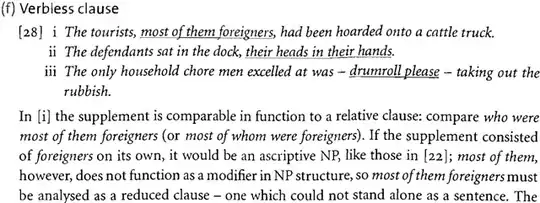
See postscript for accessible text See postscript for accessible text

My intuition is that the pronoun today cannot function as a peripheral Modifier in a noun phrase in initial position:

  1. *Today accidents will have repercussions for years to come

It can, however, post-modify nouns:

  1. Accidents today will have repercussions for years to come.

It is this fact, comparable to the situation with regard to [28i] in CGEL, which makes me think that this is a small clause, rather than an NP functioning as an ascriptive modifier.

With the clause expanded, this might read:

  1. Tinker Hadfield--who today is a legend of the Nike design team--put all his efforts into redesigning the iconic Jordan sneaker.

or

  1. Tinker Hadfield--today he's a legend of the Nike design team--put all his efforts into redesigning the iconic Jordan sneaker.


Below is the text from the CGEL excerpts, in case it's useful.
(f) Verbless clause
[28] i The tourists, most of them foreigners, had been hoarded onto a cattle truck.
ii The defendants sat in the dock, their heads in their hands.
iii The only household chore men excelled at was - drumroll please - taking out the rubbish.
In [i] the supplement is comparable in function to a relative clause: compare who were most of them foreigners (or most of whom were foreigners). If the supplement consisted of foreigners on its own, it would be an ascriptive NP, like those in [22]; most of them, however, does not function as a modifier in NP structure, so most of them foreigners must be analysed as a reduced clause - one which could not stand alone as a sentence. The supplement in [28ii] could likewise not stand alone, but differs in its internal structure in that their heads is subject. An equivalent integrated construction would have a modifier with the form of with + verbless clause: with their heads in their hands.

  • "Tinker Hatfield, he today being a legend of the Nike design team,.." Is this the correct paraphrasing if it were not reduced? Sorry if I misunderstood. – user424874 Sep 26 '23 at 17:12
  • 1
    @user424874 Yes, something like that. Maybe even "Tinker Hadfield--who today is a legend of the Nike design team--blah" or "Tinker Hadfield--today he's a legend of the Nike design team--put all his efforts into redesigning the iconic Jordan sneaker". – Araucaria - Him Sep 26 '23 at 17:19
  • 1
    As usual, I enjoyed reading your comprehensive answer. Thanks. – user424874 Sep 26 '23 at 17:45
  • 1
    I think I found something relevant. See my answer. – user424874 Sep 27 '23 at 06:04
2

I think this may support Araucaria's verbless clause analysis.

A similar example from Quirk's CGEL (page 1015)

As it is, we could regard it as a verbless clause functioning as an adverbial. Indeed, many instances of partial apposition with noun phrases (c/ 17.66)could be equally regarded as verbless clauses, eg:

Judge Clement Turpin, now a federal appeals court judge, is being considered for appointment to the US Supreme Court. (italics mine)

[Possible expansion: Judge Clement Turpin, who now is a federal appeals court judge, is being considered for appointment to the US Supreme Court.]
