13

I am looking for a minimal triple for a particular set of phonemes. By minimal triple, I mean three actual English words that differ in one and only one phoneme between them. Examples therefore include:

  • phony, tony, pony
  • swim, swam, swum
  • bad, bat, bath

The three phonemes that must appear one apiece in each of the three words are: /ɑ, ɒ, ɔ/. I can get pairs, but no triples, and I wonder why.

Length doesn’t count, so for example /aː/ counts as /a/ and /ɔː/ counts as /ɔ/.

If such a triple exists, what is it?

If no such triple exists, could it? Or do the various mergers preclude a threefold phonemic distinction here?

These have all to be in the same accent, of course. And preferably a rhotic one, too, because I’m trying to figure out something in particular about phonemic perception in rhotic speakers of North America, and non-rhotic accents will not further that goal.

As a last resort, if the only such triple you can find is a non-rhotic one, then go ahead and offer that one, perhaps along with some suggested explanation why there “can’t” be an equivalent rhotic triple.

Laurel
  • 66,382
tchrist
  • 134,759

8 Answers8

13

For RP, doesn't khan, con, corn work?

If you allow widely-known foreign foods, how about pawed, pod, pad, where pad is as in pad thai (and that one even works for rhotic accents).

Peter Shor
  • 88,407
  • I think you win. Pawed, pod, pad are very attractive. It takes a lot of conscious effort to generate three different phonemes there, for me personally. I keep wanting to merge either pawed with pod *or else* pod with pad, although never all three the way the LA (well, SoCal/LoCal) accent does. The difference between pawed and pod is pretty subtle for me; I must be keying on roundedness without caring how much. That’s the thing I was trying to track down. Are they all 3 distinct for you? You’re a Massachusetts native, or import? Boston, or elsewhere? – tchrist Aug 08 '12 at 03:27
  • I'm an import, and I pronounce pad and pod the same, but pawed is distinct. With a Boston accent (I just realized), pod and pawed are pronounced the same but pad is distinct. I may have been living here long enough that I think of all three as distinct. So maybe I don't win. – Peter Shor Aug 08 '12 at 03:41
  • My hypothesis is that there is no North American accent with more than two out of three distinct words in pawed / pod / pad. I have two, and you have two, and people with the cot–caught merger have only one. You win because you have picked a good triple to test this hypothesis with. That’s just what I was looking for, even if it isn’t a threefold distinction for me personally. – tchrist Aug 08 '12 at 03:43
  • This answer helped me better understand the O.P.'s question. I pronounce "pawed" and "pod" as homophones; I'd pronounce "I pawed my iPod" the same as "iPod my I pawed" (though only the former would be sensical). – J.R. Aug 08 '12 at 09:48
  • 1
    I've always heard the "pad" as in "pad thai" pronounced the same as any other "pad"; that is, with /æ/. – nohat Oct 26 '12 at 22:09
  • I think the vowel charts you recently mentioned explain why this is so tough. See my CW answer below. – tchrist Jan 14 '13 at 15:08
  • 2
    The word pad in pad thai is pronounced with the same vowel as bath in RP. (I'm Thai, by the way.) +1 for mentioning my favorite dish. – Damkerng T. Dec 16 '13 at 06:09
  • @tchrist I grew up in NYC and NJ and always heard (there), and still make, three distinct vowel sounds: pawed, mawed, clawed, Claude / pod, mod, clod / and pad, mad, clad. And I distinguish fairy, furry, and ferry too. :) – DjinTonic Oct 29 '23 at 22:57
  • @DjinTonic No, that doesn't count. Your pad / mad / clad set does not have the /ɑ/ of FATHER but the /æ/ of TRAP as in sass, Lassie, cat, ham. That's why I mentioned the foreign word pad as in Pad Thai which does have the FATHER vowel not the TRAP vowel every time I've heard it. Our Thai fellow Damkerng confirmed that's what he heard also almost a decade ago now. – tchrist Oct 29 '23 at 23:25
8

Do these work?

Sawed, sod and Sade. (Sade being the last name of Marquis de Sade.)

Bought, bot and Baht. (Baht being the currency of Thailand.)

  • Those triples don’t work for me because my sawed is rounded /sɔd/ but my sod and Sade are both unrounded /sɑd/. Likewise my bought is rounded /bɔt/ but my bot and Baht are both unrounded /bɑt/. – tchrist Sep 13 '20 at 15:05
7

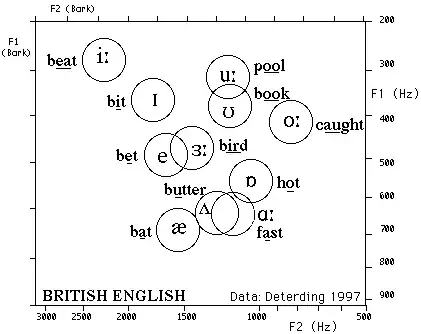
I believe I’ve just discovered something that sheds light on this mystery. Peter Shore kindly pointed out this vowel chart, in which figure the following two charts (amongst others).

First, the American one:

American vowel chart

And now the British one:

British vowel chart

This probably explains why it’s so hard for me to find a minimal triple, since General American has only two vowels there, not three. So the reason I could not find a minimal triple is because there cannot be one in General American. We just don’t have that phoneme.


Making this answer Community Wiki so that I don’t gain reps from answering my own question.

tchrist
  • 134,759
  • Just to make it clearer, can you say what 'there' is? (which items labeled in the two diagrams are you referring to? and which corresponding lexical sets? hot/pot, caught, .. which are which two? – Mitch Jan 14 '13 at 21:43
  • @Mitch Sure. I was looking for a minimal triple amongst /ɑ, ɒ, ɔ/. But it looks like GA doesn’t even have all three of those. – tchrist Jan 14 '13 at 22:29
  • That link to Uni of Helsinki website got rotten during website redesign - maybe you can find it again? This is VERY interesting comparison of vowels, explains a lot. – Peter M. - stands for Monica Oct 04 '19 at 21:33
  • The American vowel chart is a little wonky; in AmE, pot has the /ɑ/ vowel, and not the /ɔ/ vowel. – Peter Shor Dec 23 '23 at 12:23
5

I'm betting you can find this in a Scottish or Irish English accent. I'm no expert, but I would suggest looking at cat/caught/cot as a possible triple of those vowels. You'd have to find one that escaped the caught/cot merger, and that has a rather back variant of the BATH vowel. To wit:

cat /kɑt/
caught /kɒt/
cot /kɔt/

In addition, most Scottish and Irish English dialects are rhotic.

Mark Beadles
  • 22,642
  • 2
    I thought everyone had cat as /kæt/? It’s hard to find a for-sure /ɑ/; for example, I think most people fuse either baa-ed with bod, or else fuse bod with bawd; I don’t know if anyone has all three. I’ve played around with imported words like like khan, bhaat, phaal, trying to get something that won’t merge without requiring a nonrhotic accent to get there. I know only some Scots accents, and not enough Irish ones, myself. I know there are a lot more than any I have ever heard, from that page I linked to. – tchrist Aug 08 '12 at 02:37
  • 1
    That page is what made me think of it ... some of the Scottish dialects, e.g. Hawick, don't seem to have an /æ/ at all. – Mark Beadles Aug 08 '12 at 02:43
  • Well, that’s interesting! – tchrist Aug 08 '12 at 02:44
  • 1
    My East Alabama dialect distinguishes the ɑ-set from the ɒ-set in my triples above mostly by length, but there's a definite front glide at the end of the latter. And the 'mid-Atlantic' dialect I was formally taught as an actor distinguishes all three on dictionary lines - artificial, perhaps, but wholly appropriated by long use. – StoneyB on hiatus Aug 08 '12 at 02:56
  • 3
    Mine is a fairly mild Scottish accent, with more than a hint of RP, and to me cat, caught and cot sound entirely distinct, as do khan, con and corn and pawed, pod and pad. – Rory Alsop Aug 08 '12 at 08:44
  • @RoryAlsopThanks very much, that’s just the confirmation of direct experience that I was looking for! I would never have thought of using cat for that. – tchrist Aug 08 '12 at 12:17
5

I have found the following triple, which however is only valid for non rhotic accents :

bard /bɑːd/
bod /bɒd/
baud /bɔːd/
Paola
  • 3,129
  • 1
    I had already thought of non-rhotic cart / cot / caught but that didn’t help me because I’m rhotic. I can’t believe how much trouble I have hearing ɒ vs ɔ; I have to think about it really, really hard to generate or perceive a distinction between those. Certainly rounding-vs-nonrounding is phonemic for me, but the degree of rounding may not be. – tchrist Aug 09 '12 at 13:36
  • @tchrist: I believe /ɒ/ and /ɔ/ are allophonic in General American, which may be why you're having trouble hearing the difference; they certainly seem to be for me. My /ɔ/ covers a fairly wide range, depending on the following vowel; close to /ɒ/ for claw, and close to /o/ for cloth, so awful and often (or offal, a word I almost never use) have a significant difference in their vowels, since the first has the vowel of awe and the second of off. So I generate the two vowels without even having to think about it, but I find it hard to hear the difference. – Peter Shor Aug 09 '12 at 13:49
  • @PeterShor I bet that’s it. BTW, my awful, often, off, and awe all have a fairly “long” /ɔː/, and are completely identical in their starts for me. And awl and all are homophones with the same vowel as the other four; they sound nothing like the a in German alle or Spanish María, the way they seem to for many SoCal speakers, who’ve lost all rounding. – tchrist Aug 09 '12 at 13:51
  • And of course, I meant following consonant above, if you haven't already figured it out. My claw and my cloth would probably count as two different vowels if my clause wasn't halfway in between them. – Peter Shor Aug 09 '12 at 14:13
2

It's awkward that this is required to work in a rhotic accent, because that unfortunately removes most /a:/ syllables and a good deal of /ɔ:/ syllables, too. Perhaps you'd allow:

  • lakhs, locks, lawks!
  • mahl, moll, maul

If a portion of a word is allowed to accompany two whole words:

  • khak(i), cock, caulk
  • cast, cost, caust(ic)

With the help of a name or two:

Rosie F
  • 5,009
1

Paul, poll, pa'll (father will)

This works in my accent, I round Paul, but not pa or spa

I also don't merge poll and pole, since poll doesn't have a diphthong for me so it's a quadruplet

iopq
  • 131
1

Minimal triple: Bach’s, box, balks

On his website, Rick Aschmann provides the answer of Bach’s / box / balks as a minimal triple for /ɑ, ɒ, ɔ/, which applies only to those speakers with neither the father–bother merger nor the cot–caught merger. I don’t personally have this one because I have father–bother.

To my personal surprise, I’ve also realized since I wrote this question that I don’t myself possess the cloth–caught merger of [ɒ, ɔ] into just one of those two, even though I don’t normally think of /ɒ/ being phonemically distinct from /ɔ/. Because I have the father–bother merger but not the cot–caught merger, for the longest time I hadn’t noticed that I do not have the cloth–caught merger either.

tchrist
  • 134,759