21

I’m going to the christening of my cousin’s first son soon. What is the proper name for his relation to me?

Second nephew? Nephew once removed? Nothing?

Looking at the overall picture, what's the accepted rule for the naming of all of our various relations?

herisson
  • 81,803

4 Answers4

39

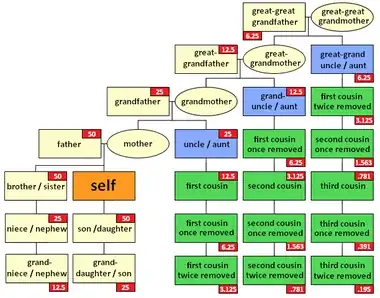
Kinship chart

Your cousin's first son is your first cousin once removed. It is quite confusing!

Kosmonaut
  • 50,402
  • 6
    +1 Nice graph, Kosmonaut! One question, what do the numbers represent? – JohnFx Aug 21 '10 at 21:24
  • I was wondering about the numbers too. It seems they are percentiles, and they seem to measure the degree of the relationship. – apaderno Aug 21 '10 at 23:19
  • 3
    I am pretty sure that they are the degree of relationship. So your son or daughter is 50% of your genes, grandfather is 25% of your genes, and so on. First cousins share 6.25%. Oh, and this came from Wikipedia (I didn't go and make this awesome graph just for this answer :) – Kosmonaut Aug 21 '10 at 23:36
  • 2
    I am familiar with this graphic, and yes, the number is the percentage of shared genes. – Chris Noe Aug 21 '10 at 23:50
  • Unless there are identical twins involved. – Dan Aug 22 '10 at 00:33
  • 1
    So, combining this with @MrShiny's answer: if I understand correctly, all the 'cousin' relationships are bi-directional/symmetrical? – Benjol Dec 08 '10 at 05:48
  • 2
    It's not quite the percentage of your genes that they share: a grapefruit will share many of your genes, and any other human will share the vast majority of your genes. It's roughly the percentage of those genes that you have, that are very rare in your community, that they share. Assuming that none of your relatives were related their partners other even distantly, which is unlikely. – bdsl Aug 11 '11 at 19:05
  • You cousin’s first son is your first cousin once removed, but your son’s first cousin is your nephew. :) – tchrist Jul 27 '12 at 18:55
17

It's very easy to determine the relationship in English.

First, find your common ancestor. Siblings have the same father, cousins have the same grandfather, etc.

  • Same grandfather means First cousin.
  • Same great-grandfather means second cousin.
  • Same great-great-grandfather means third cousin.

If you are not in the same generation, pick the shortest one, then the generation distance is how many times removed.

  • Your cousin's child is your first cousin, once-removed.
  • That person's child is your first cousin, twice removed.

The labels work the same in both directions so "first cousin, once removed" identifies the relationship to the speaker irrespective of whether that person is in the younger generation or not.

1

My brother is into genealogy, and he described for me a simple way to remember these relationships.

  1. Going up-generation uses ordinals. So your cousin is your first cousin. Your parent's cousins are your second cousins. Your grandparent's cousins are your third cousins.

  2. Going down-generation use removes. So your first cousin's child is your first cousin once-removed. Your third cousin's grandchild is your third cousin twice-removed.

This contradicts Mr. Shiny's answer though, because the relationships are not symmetrical. To my second cousin (my father's cousin), I am a first cousin once-removed.

Kit Z. Fox
  • 27,819
0

The "removed" descriptor for generational separation of cousins is bi-directional. However on my family tree website, I have adopted the additional term "infra" for generations which come after mine, not so much as to define the relationship, but because I needed to establish a boundary to my family tree. I accept that this is not a standard term.

Skelta
  • 1
  • Welcome to EL&U. Answers here are expected to be supported by authoritative reference whenever possible. A non-standard term you've adoped is a far cry from 'an accepted rule for naming all our various distant relatives' which the asker is looking for. When you build up enough reputation here, you'll be able to post comments, which the information you've supplied in this 'answer' would be much more suited to. – DW256 Sep 30 '21 at 08:36
  • Thank your for your response. I do realise that my answer was better suited to a comment, but the limitations of Stack Overflow did not allow me to post a comment, only an answer. I have tried to participate in Stack Overflow conversations before, but the system seems to have a flaw that requires answers to be posted to gain reputation before comments can be made, rather than permitting comments to be posted to gain reputation before answers can be posted. – Skelta Oct 04 '21 at 04:24