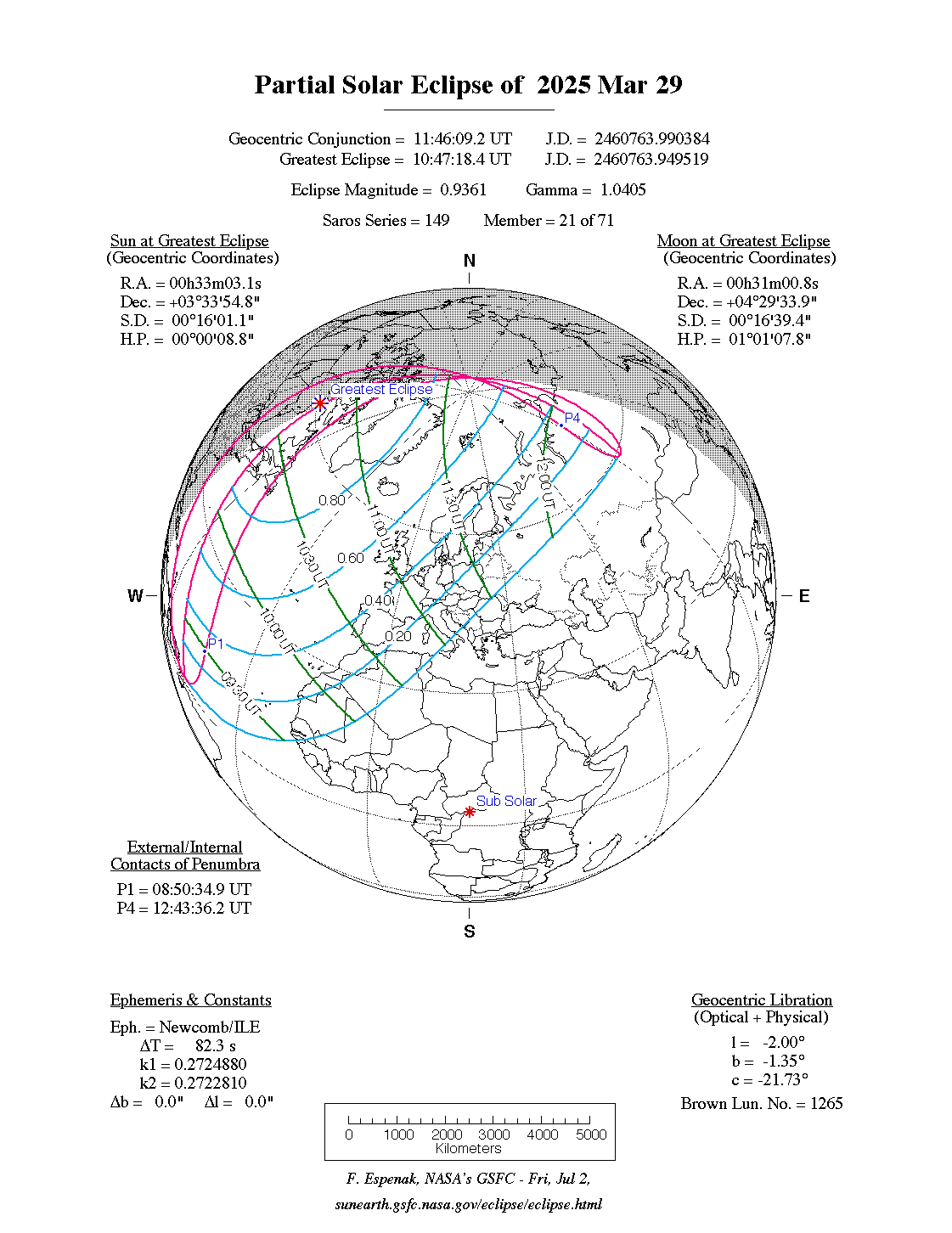
Solar eclipse of March 29, 2025
A partial solar eclipse will occur at the Moon’s ascending node of orbit on Saturday, March 29, 2025, with a magnitude of 0.9376. A solar eclipse occurs when the Moon passes between Earth and the Sun, thereby totally or partly obscuring the image of the Sun for a viewer on Earth. A partial solar eclipse occurs in the polar regions of the Earth when the center of the Moon's shadow misses the Earth.
| Solar eclipse of March 29, 2025 | |
|---|---|
Map | |
| Type of eclipse | |
| Nature | Partial |
| Gamma | 1.0405 |
| Magnitude | 0.9376 |
| Maximum eclipse | |
| Coordinates | 61.1°N 77.1°W |
| Times (UTC) | |
| Greatest eclipse | 10:48:36 |
| References | |
| Saros | 149 (21 of 71) |
| Catalog # (SE5000) | 9563 |
Images
Animated path
Related eclipses
The eclipse is a member of a semester series. An eclipse in a semester series of solar eclipses repeats approximately every 177 days and 4 hours (a semester) at alternating nodes of the Moon's orbit.[1] It is also part of Saros cycle 149, repeating every about 18 years and 11 days, contains 71 events.
Eclipses of 2025
- A total lunar eclipse on March 14.
- A partial solar eclipse on March 29.
- A total lunar eclipse on September 7.
- A partial solar eclipse on September 21.
Metonic
- Preceded by: Solar eclipse of June 10, 2021
- Followed by: Solar eclipse of January 14, 2029
Tzolkinex
- Preceded by: Solar eclipse of February 15, 2018
- Followed by: Solar eclipse of May 9, 2032
Half-Saros
- Preceded by: Lunar eclipse of March 23, 2016
- Followed by: Lunar eclipse of April 3, 2034
Tritos
- Preceded by: Solar eclipse of April 29, 2014
- Followed by: Solar eclipse of February 27, 2036
Solar Saros 149
- Preceded by: Solar eclipse of March 19, 2007
- Followed by: Solar eclipse of April 9, 2043
Inex
- Preceded by: Solar eclipse of April 17, 1996
- Followed by: Solar eclipse of March 9, 2054
Triad
- Preceded by: Solar eclipse of May 29, 1938
- Followed by: Solar eclipse of January 29, 2112
Solar eclipses of 2022–2025
This eclipse is a member of a semester series. An eclipse in a semester series of solar eclipses repeats approximately every 177 days and 4 hours (a semester) at alternating nodes of the Moon's orbit.[2]
| Solar eclipse series sets from 2022 to 2025 | ||||||
|---|---|---|---|---|---|---|
| Ascending node | Descending node | |||||
| Saros | Map | Gamma | Saros | Map | Gamma | |
| 119 Partial from CTIO, Chile |
2022 April 30 Partial |
−1.19008 | 124 Partial from Saratov, Russia |
2022 October 25 Partial |
1.07014 | |
| 129 Total from East Timor |
2023 April 20 Hybrid |
−0.39515 | 134 Annular from Campeche, Mexico |
2023 October 14 Annular |
0.37534 | |
| 139 Total from Indianapolis, USA |
2024 April 8 Total |
0.34314 | 144 | 2024 October 2 Annular |
−0.35087 | |
| 149 | 2025 March 29 Partial |
1.04053 | 154 | 2025 September 21 Partial |
−1.06509 | |
Saros 149
Solar saros 149, repeating every about 18 years and 11 days, contains 71 events. The series started with a partial solar eclipse on August 21, 1664. It has total eclipses from April 9, 2043, to October 2, 2331. The series ends at member 71 as a partial eclipse on September 28, 2926. The longest total eclipse will be on July 17, 2205, at 4 minutes and 10 seconds.[3]
| Series members 15–25 occur between 1901 and 2100: | ||
|---|---|---|
| 15 | 16 | 17 |
January 23, 1917 |
February 3, 1935 |
February 14, 1953 |
| 18 | 19 | 20 |
February 25, 1971 |
March 7, 1989 |
March 19, 2007 |
| 21 | 22 | 23 |
March 29, 2025 |
April 9, 2043 |
April 20, 2061 |
| 24 | 25 | |
May 1, 2079 |
May 11, 2097 | |
Tritos series
This eclipse is a part of a tritos cycle, repeating at alternating nodes every 135 synodic months (≈ 3986.63 days, or 11 years minus 1 month). Their appearance and longitude are irregular due to a lack of synchronization with the anomalistic month (period of perigee), but groupings of 3 tritos cycles (≈ 33 years minus 3 months) come close (≈ 434.044 anomalistic months), so eclipses are similar in these groupings.
| Series members between 1901 and 2100 | |||
|---|---|---|---|
March 6, 1905 (Saros 138) |
February 3, 1916 (Saros 139) |
January 3, 1927 (Saros 140) | |
December 2, 1937 (Saros 141) |
November 1, 1948 (Saros 142) |
October 2, 1959 (Saros 143) | |
August 31, 1970 (Saros 144) |
July 31, 1981 (Saros 145) |
June 30, 1992 (Saros 146) | |
May 31, 2003 (Saros 147) |
April 29, 2014 (Saros 148) |
March 29, 2025 (Saros 149) | |
February 27, 2036 (Saros 150) |
January 26, 2047 (Saros 151) |
December 26, 2057 (Saros 152) | |
November 24, 2068 (Saros 153) |
October 24, 2079 (Saros 154) |
September 23, 2090 (Saros 155) |
|
Metonic series
The metonic series repeats eclipses every 19 years (6939.69 days), lasting about 5 cycles. Eclipses occur in nearly the same calendar date. In addition, the octon subseries repeats 1/5 of that or every 3.8 years (1387.94 days). All eclipses in this table occur at the Moon's ascending node.
| 21 eclipse events, progressing from south to north between June 10, 1964, and August 21, 2036 | ||||
|---|---|---|---|---|
| June 10–11 | March 27–29 | January 15–16 | November 3 | August 21–22 |
| 117 | 119 | 121 | 123 | 125 |
June 10, 1964 |
March 28, 1968 |
January 16, 1972 |
November 3, 1975 |
August 22, 1979 |
| 127 | 129 | 131 | 133 | 135 |
June 11, 1983 |
March 29, 1987 |
January 15, 1991 |
November 3, 1994 |
August 22, 1998 |
| 137 | 139 | 141 | 143 | 145 |
June 10, 2002 |
March 29, 2006 |
January 15, 2010 |
November 3, 2013 |
August 21, 2017 |
| 147 | 149 | 151 | 153 | 155 |
June 10, 2021 |
March 29, 2025 |
January 14, 2029 |
November 3, 2032 |
August 21, 2036 |
References
- van Gent, R.H. "Solar- and Lunar-Eclipse Predictions from Antiquity to the Present". A Catalogue of Eclipse Cycles. Utrecht University. Archived from the original on September 7, 2019. Retrieved 6 October 2018.
- van Gent, R.H. "Solar- and Lunar-Eclipse Predictions from Antiquity to the Present". A Catalogue of Eclipse Cycles. Utrecht University. Retrieved 6 October 2018.
- Saros Series Catalog of Solar Eclipses NASA Eclipse Web Site.
External links
- Earth visibility chart and eclipse statistics Eclipse Predictions by Fred Espenak, NASA/GSFC