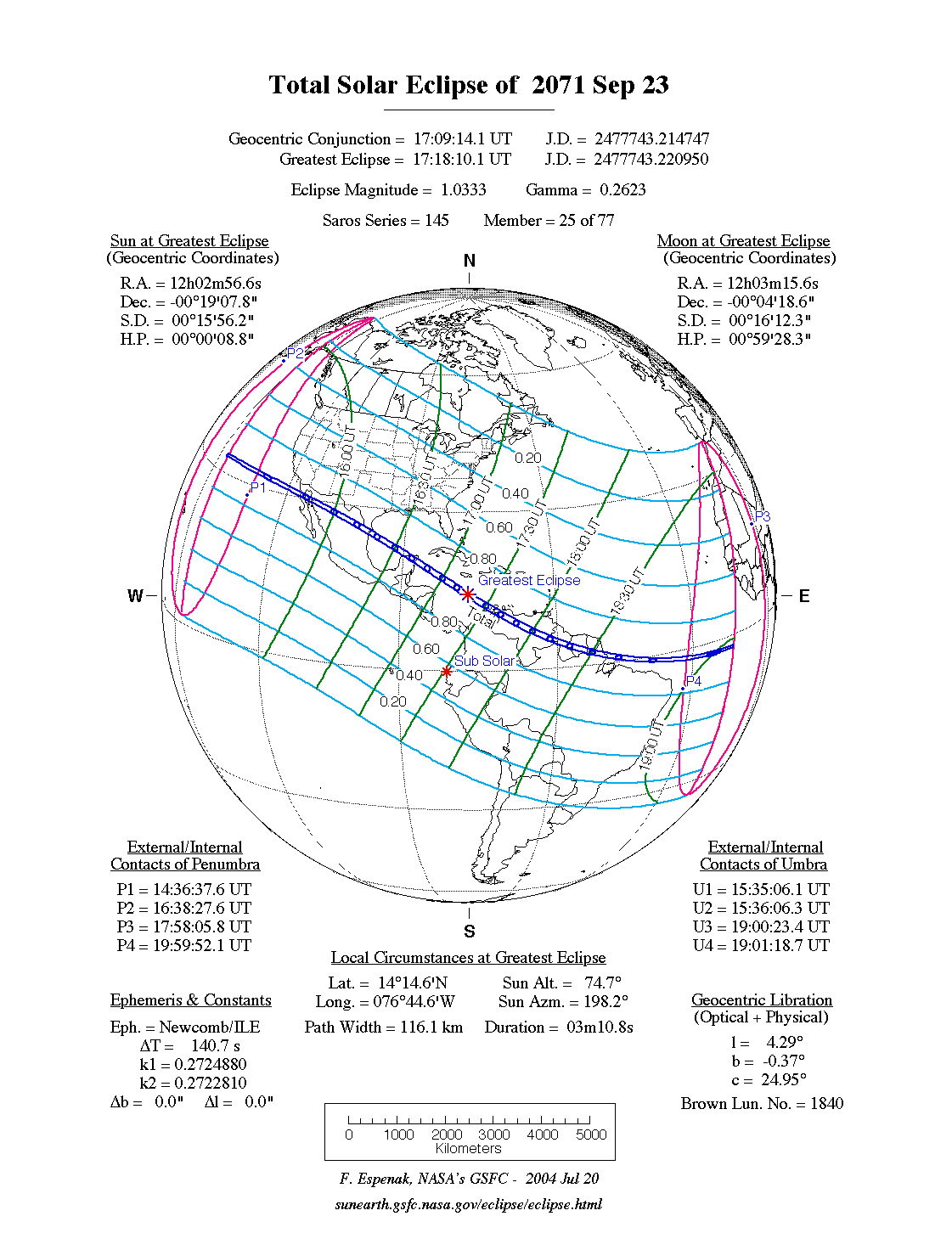
Solar eclipse of September 23, 2071
A total solar eclipse will occur on Wednesday, September 23, 2071. A solar eclipse occurs when the Moon passes between Earth and the Sun, thereby totally or partly obscuring the image of the Sun for a viewer on Earth. A total solar eclipse occurs when the Moon's apparent diameter is larger than the Sun's, blocking all direct sunlight, turning day into darkness. Totality occurs in a narrow path across Earth's surface, with the partial solar eclipse visible over a surrounding region thousands of kilometres wide.
| Solar eclipse of September 23, 2071 | |
|---|---|
Map | |
| Type of eclipse | |
| Nature | Total |
| Gamma | 0.262 |
| Magnitude | 1.0333 |
| Maximum eclipse | |
| Duration | 191 s (3 min 11 s) |
| Coordinates | 14.2°N 76.7°W |
| Max. width of band | 116 km (72 mi) |
| Times (UTC) | |
| Greatest eclipse | 17:20:28 |
| References | |
| Saros | 145 (25 of 77) |
| Catalog # (SE5000) | 9668 |
Related eclipses
Solar eclipses 2069–2072
This eclipse is a member of a semester series. An eclipse in a semester series of solar eclipses repeats approximately every 177 days and 4 hours (a semester) at alternating nodes of the Moon's orbit.[1]
| 120 | April 21, 2069 Partial |
125 | October 15, 2069 Partial |
| 130 | April 11, 2070 Total |
135 | October 4, 2070 Annular |
| 140 | March 31, 2071 Annular |
145 | September 23, 2071 Total |
| 150 | March 19, 2072 Partial |
155 | September 12, 2072 Total |
Saros series 145
This solar eclipse is a part of Saros cycle 145, repeating every 18 years, 11 days, 8 hours, containing 77 events. The series started with a partial solar eclipse on January 4, 1639, and reached a first annular eclipse on June 6, 1891. It was a hybrid event on June 17, 1909, and total eclipses from June 29, 1927, through September 9, 2648. The series ends at member 77 as a partial eclipse on April 17, 3009. The longest eclipse will occur on June 25, 2522, with a maximum duration of totality of 7 minutes, 12 seconds. All eclipses in this series occurs at the Moon's ascending node.
| Series members 10–32 occur between 1801 and 2359 | ||
|---|---|---|
| 10 | 11 | 12 |
April 13, 1801 |
April 24, 1819 |
May 4, 1837 |
| 13 | 14 | 15 |
May 16, 1855 |
May 26, 1873 |
June 6, 1891 |
| 16 | 17 | 18 |
June 17, 1909 |
June 29, 1927 |
July 9, 1945 |
| 19 | 20 | 21 |
July 20, 1963 |
July 31, 1981 |
August 11, 1999 |
| 22 | 23 | 24 |
August 21, 2017 |
September 2, 2035 |
September 12, 2053 |
| 25 | 26 | 27 |
September 23, 2071 |
October 4, 2089 |
October 16, 2107 |
| 28 | 29 | 30 |
October 26, 2125 |
November 7, 2143 |
November 17, 2161 |
| 31 | 32 | 33 |
November 28, 2179 |
December 9, 2197 |
December 21, 2215 |
| 34 | 35 | 36 |
December 31, 2233 |
January 12, 2252 |
January 22, 2270 |
| 37 | 38 | 39 |
February 2, 2288 |
February 14, 2306 |
February 25, 2324 |
| 40 | ||
March 8, 2342 | ||
Inex series
This eclipse is a part of the long period inex cycle, repeating at alternating nodes, every 358 synodic months (≈ 10,571.95 days, or 29 years minus 20 days). Their appearance and longitude are irregular due to a lack of synchronization with the anomalistic month (period of perigee). However, groupings of 3 inex cycles (≈ 87 years minus 2 months) comes close (≈ 1,151.02 anomalistic months), so eclipses are similar in these groupings.
| Inex series members between 1901 and 2100: | ||
|---|---|---|
January 3, 1927 (Saros 140) |
December 14, 1955 (Saros 141) |
November 22, 1984 (Saros 142) |
November 3, 2013 (Saros 143) |
October 14, 2042 (Saros 144) |
September 23, 2071 (Saros 145) |
September 4, 2100 (Saros 146) |
||
Metonic series
The metonic series repeats eclipses every 19 years (6939.69 days), lasting about 5 cycles. Eclipses occur in nearly the same calendar date. In addition, the octon subseries repeats 1/5 of that or every 3.8 years (1387.94 days). All eclipses in this table occur at the Moon's ascending node.
| 21 eclipse events, progressing from south to north between July 13, 2018, and July 12, 2094 | ||||
|---|---|---|---|---|
| July 12–13 | April 30-May 1 | February 16–17 | December 5–6 | September 22–23 |
| 117 | 119 | 121 | 123 | 125 |
July 13, 2018 |
April 30, 2022 |
February 17, 2026 |
December 5, 2029 |
September 23, 2033 |
| 127 | 129 | 131 | 133 | 135 |
July 13, 2037 |
April 30, 2041 |
February 16, 2045 |
December 5, 2048 |
September 22, 2052 |
| 137 | 139 | 141 | 143 | 145 |
July 12, 2056 |
April 30, 2060 |
February 17, 2064 |
December 6, 2067 |
September 23, 2071 |
| 147 | 149 | 151 | 153 | 155 |
July 13, 2075 |
May 1, 2079 |
February 16, 2083 |
December 6, 2086 |
September 23, 2090 |
| 157 | ||||
July 12, 2094 | ||||
Notes
- van Gent, R.H. "Solar- and Lunar-Eclipse Predictions from Antiquity to the Present". A Catalogue of Eclipse Cycles. Utrecht University. Retrieved 6 October 2018.
References
- Earth visibility chart and eclipse statistics Eclipse Predictions by Fred Espenak, NASA/GSFC