Solar eclipse of September 21, 2025
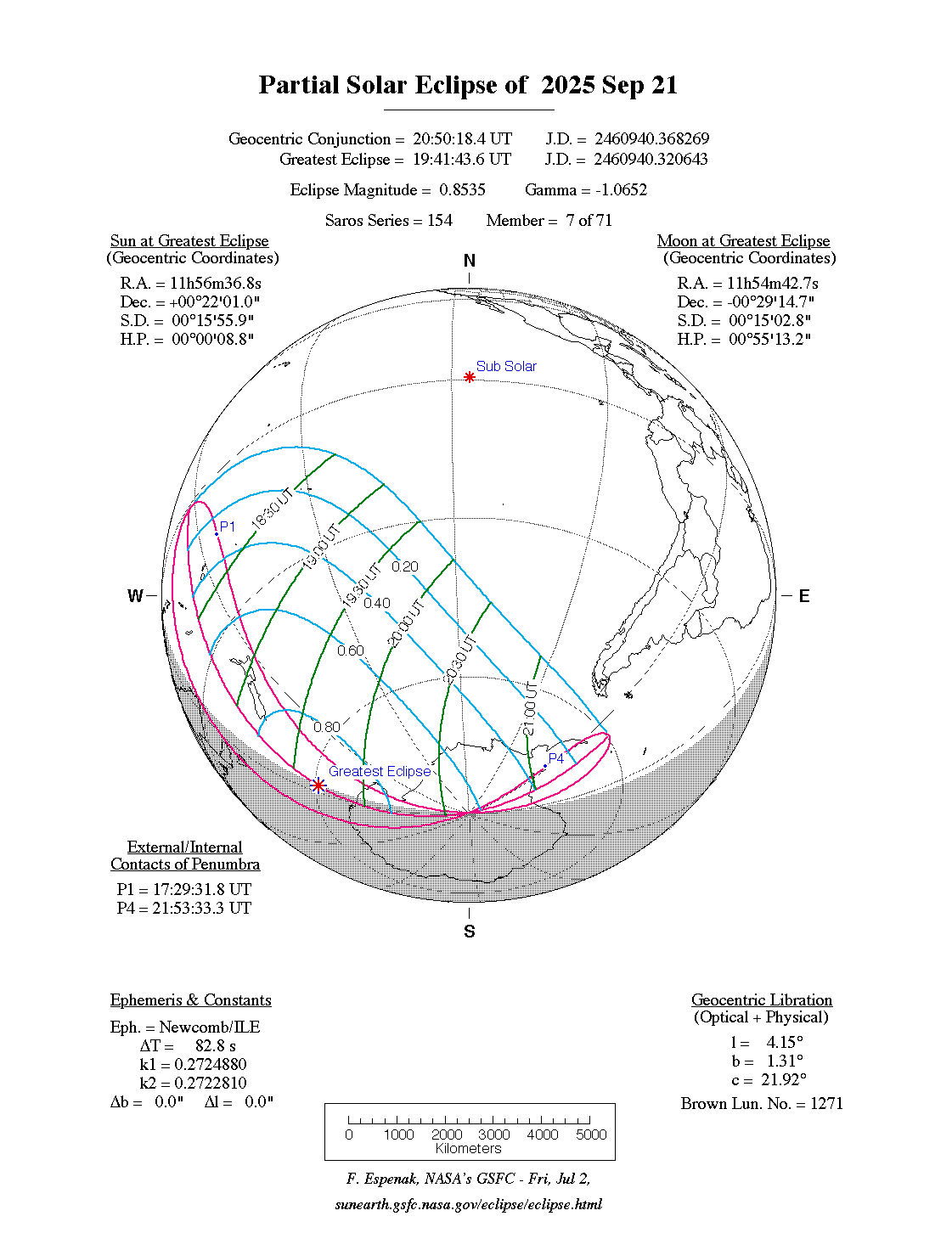
A partial solar eclipse will occur at the Moon’s descending node of orbit on Sunday, September 21, 2025, with a magnitude of 0.855. A solar eclipse occurs when the Moon passes between the Earth and the Sun, thereby totally or partly obscuring the image of the Sun for a viewer on Earth. A partial solar eclipse occurs in the polar regions of the Earth when the center of the Moon's shadow misses the Earth. Partiality will be visible across much of the South Pacific and Antarctica, with up to 73% coverage being visible in mainland New Zealand.[1]
| Solar eclipse of September 21, 2025 | |
|---|---|
Map | |
| Type of eclipse | |
| Nature | Partial |
| Gamma | −1.0651 |
| Magnitude | 0.855 |
| Maximum eclipse | |
| Coordinates | 60.9°S 153.5°E |
| Times (UTC) | |
| Greatest eclipse | 19:43:04 |
| References | |
| Saros | 154 (7 of 71) |
| Catalog # (SE5000) | 9564 |
Images
Animated path
Related eclipses
Eclipses of 2025
- A total lunar eclipse on March 14.
- A partial solar eclipse on March 29.
- A total lunar eclipse on September 7.
- A partial solar eclipse on September 21.
Metonic
- Preceded by: Solar eclipse of December 4, 2021
- Followed by: Solar eclipse of July 11, 2029
Tzolkinex
- Preceded by: Solar eclipse of August 11, 2018
- Followed by: Solar eclipse of November 3, 2032
Half-Saros
- Preceded by: Lunar eclipse of September 16, 2016
- Followed by: Lunar eclipse of September 28, 2034
Tritos
- Preceded by: Solar eclipse of October 23, 2014
- Followed by: Solar eclipse of August 21, 2036
Solar Saros 154
- Preceded by: Solar eclipse of September 11, 2007
- Followed by: Solar eclipse of October 3, 2043
Inex
- Preceded by: Solar eclipse of October 12, 1996
- Followed by: Solar eclipse of September 2, 2054
Triad
- Preceded by: Solar eclipse of November 21, 1938
- Followed by: Solar eclipse of July 23, 2112
Solar eclipses of 2022–2025
This eclipse is a member of a semester series. An eclipse in a semester series of solar eclipses repeats approximately every 177 days and 4 hours (a semester) at alternating nodes of the Moon's orbit.[2]
| Solar eclipse series sets from 2022 to 2025 | ||||||
|---|---|---|---|---|---|---|
| Ascending node | Descending node | |||||
| Saros | Map | Gamma | Saros | Map | Gamma | |
| 119 Partial from CTIO, Chile |
2022 April 30 Partial |
−1.19008 | 124 Partial from Saratov, Russia |
2022 October 25 Partial |
1.07014 | |
| 129 Total from East Timor |
2023 April 20 Hybrid |
−0.39515 | 134 Annular from Campeche, Mexico |
2023 October 14 Annular |
0.37534 | |
| 139 Total from Indianapolis, USA |
2024 April 8 Total |
0.34314 | 144 | 2024 October 2 Annular |
−0.35087 | |
| 149 | 2025 March 29 Partial |
1.04053 | 154 | 2025 September 21 Partial |
−1.06509 | |
Saros 154
It is a part of Saros cycle 154, repeating every 18 years, 11 days, containing 71 events. The series started with a partial solar eclipse on July 19, 1917. It contains annular eclipses from October 3, 2043, through March 27, 2332, hybrid eclipses from April 7, 2350, through April 29, 2386, and total eclipses from May 9, 2404, through May 29, 3035. The series ends at member 71 as a partial eclipse on August 25, 3179. The longest duration of totality will be 4 minutes, 50 seconds on July 25, 2530.
| Series members 1-16 occur between 1901 and 2200: | ||
|---|---|---|
| 1 | 2 | 3 |
July 19, 1917 |
July 30, 1935 |
August 9, 1953 |
| 4 | 5 | 6 |
August 20, 1971 |
August 31, 1989 |
September 11, 2007 |
| 7 | 8 | 9 |
September 21, 2025 |
October 3, 2043 |
October 13, 2061 |
| 10 | 11 | 12 |
October 24, 2079 |
November 4, 2097 |
November 16, 2115 |
| 13 | 14 | 15 |
November 26, 2133 |
December 8, 2151 |
December 18, 2169 |
| 16 | ||
December 29, 2187 | ||
Metonic series
The metonic series repeats eclipses every 19 years (6939.69 days), lasting about 5 cycles. Eclipses occur in nearly the same calendar date. In addition, the octon subseries repeats 1/5 of that or every 3.8 years (1387.94 days). All eclipses in this table occur at the Moon's descending node.
| 21 eclipse events, progressing from north to south between July 11, 1953 and July 11, 2029 | ||||
|---|---|---|---|---|
| July 10–12 | April 29–30 | February 15–16 | December 4–5 | September 21–23 |
| 116 | 118 | 120 | 122 | 124 |
July 11, 1953 |
April 30, 1957 |
February 15, 1961 |
December 4, 1964 |
September 22, 1968 |
| 126 | 128 | 130 | 132 | 134 |
July 10, 1972 |
April 29, 1976 |
February 16, 1980 |
December 4, 1983 |
September 23, 1987 |
| 136 | 138 | 140 | 142 | 144 |
July 11, 1991 |
April 29, 1995 |
February 16, 1999 |
December 4, 2002 |
September 22, 2006 |
| 146 | 148 | 150 | 152 | 154 |
July 11, 2010 |
April 29, 2014 |
February 15, 2018 |
December 4, 2021 |
September 21, 2025 |
| 156 | 158 | 160 | 162 | 164 |
July 11, 2029 | ||||
References
- "Partial Solar Eclipse on September 21, 2025: Path Map and Times". www.timeanddate.com. Retrieved 2024-04-11.
- van Gent, R.H. "Solar- and Lunar-Eclipse Predictions from Antiquity to the Present". A Catalogue of Eclipse Cycles. Utrecht University. Retrieved 6 October 2018.
External links
- Earth visibility chart and eclipse statistics Eclipse Predictions by Fred Espenak, NASA/GSFC