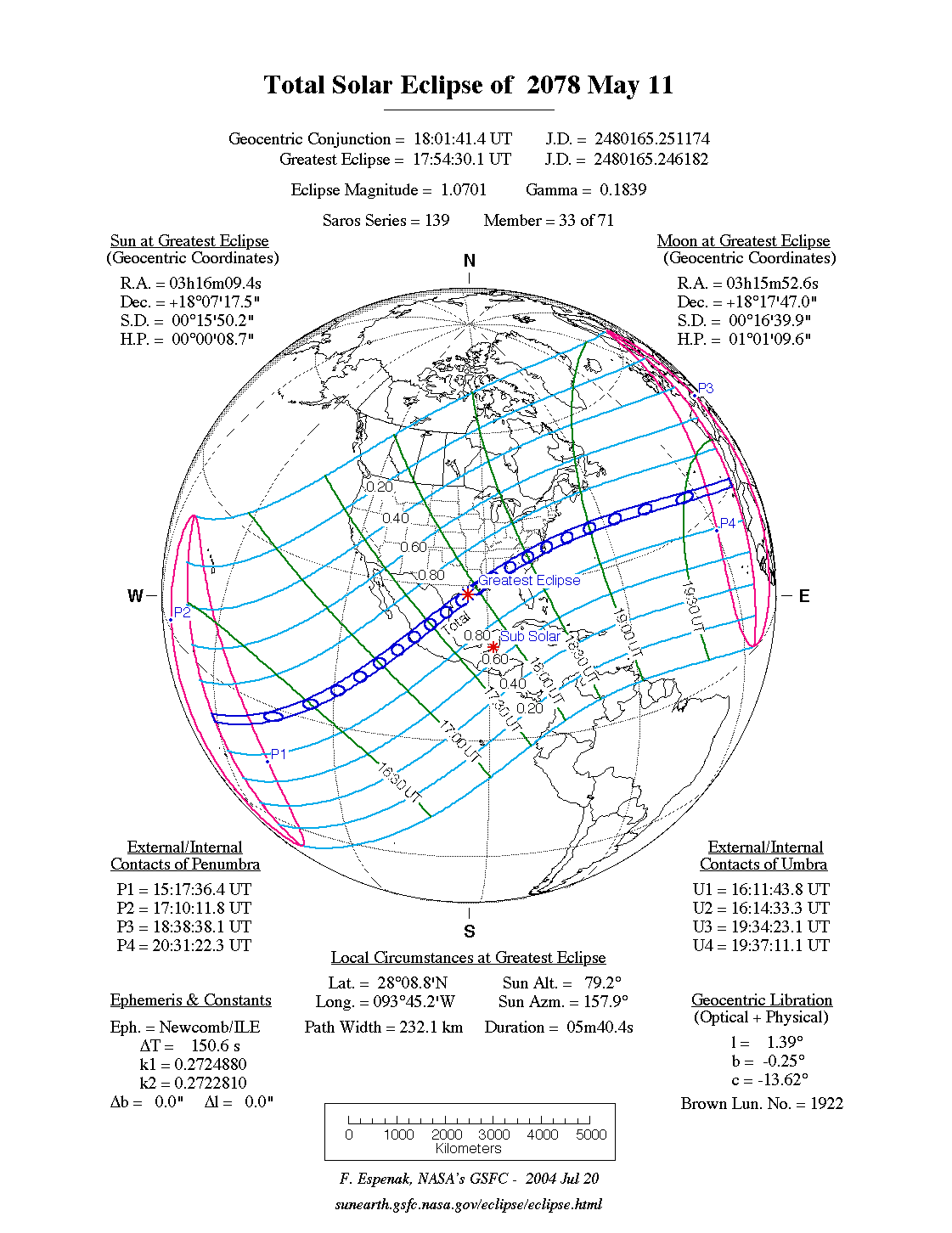
Solar eclipse of May 11, 2078
A total solar eclipse will occur at the Moon's ascending node of orbit on Wednesday, May 11, 2078, with a magnitude of 1.0701. A solar eclipse occurs when the Moon passes between Earth and the Sun, thereby totally or partly obscuring the image of the Sun for a viewer on Earth. A total solar eclipse occurs when the Moon's apparent diameter is larger than the Sun's, blocking all direct sunlight, turning day into darkness. Totality occurs in a narrow path across Earth's surface, with the partial solar eclipse visible over a surrounding region thousands of kilometres wide.
| Solar eclipse of May 11, 2078 | |
|---|---|
Map | |
| Type of eclipse | |
| Nature | Total |
| Gamma | 0.1838 |
| Magnitude | 1.0701 |
| Maximum eclipse | |
| Duration | 340 s (5 min 40 s) |
| Coordinates | 28.1°N 93.7°W |
| Max. width of band | 232 km (144 mi) |
| Times (UTC) | |
| Greatest eclipse | 17:56:55 |
| References | |
| Saros | 139 (33 of 71) |
| Catalog # (SE5000) | 9683 |
Path description
The path of totality will begin over the Pacific Ocean near Caroline Island, Kiribati. From there, it will track northeast towards North America, making landfall on the Mexican coast. In Mexico, totality will be visible in the cities of Manzanillo, Guadalajara, Aguascalientes, Zacatecas, San Luis Potosí, Ciudad Victoria, and Matamoros, Tamaulipas. The path then briefly crosses into the United States in southern Texas, including McAllen and Brownsville before crossing the Gulf of Mexico. It then re-enters the United States, passing through Louisiana (including New Orleans and Baton Rouge), Mississippi (including Biloxi), Alabama (including Mobile and Montgomery), far northwestern Florida, Georgia (including Atlanta, Athens, and Augusta), South Carolina (including Columbia and Greenville), North Carolina (including Charlotte and Raleigh), and Virginia (including Virginia Beach). It then passes over the Atlantic Ocean and ends near the Canary Islands.[1]
Related eclipses
Eclipses in 2078
- A penumbral lunar eclipse on April 27, 2078.
- A total solar eclipse on May 11, 2078.
- A penumbral lunar eclipse on October 21, 2078.
- An annular solar eclipse on November 4, 2078.
- A penumbral lunar eclipse on November 19, 2078.
Metonic
- Preceded by: Solar eclipse of July 24, 2074
- Followed by: Solar eclipse of February 27, 2082
Tzolkinex
- Preceded by: Solar eclipse of March 31, 2071
- Followed by: Solar eclipse of June 22, 2085
Half-Saros
- Preceded by: Lunar eclipse of May 6, 2069
- Followed by: Lunar eclipse of May 17, 2087
Tritos
- Preceded by: Solar eclipse of June 11, 2067
- Followed by: Solar eclipse of April 10, 2089
Solar Saros 139
- Preceded by: Solar eclipse of April 30, 2060
- Followed by: Solar eclipse of May 22, 2096
Inex
- Preceded by: Solar eclipse of May 31, 2049
- Followed by: Solar eclipse of April 23, 2107
Triad
- Preceded by: Solar eclipse of July 11, 1991
- Followed by: Solar eclipse of March 12, 2165
Solar eclipses of 2076–2079
This eclipse is a member of a semester series. An eclipse in a semester series of solar eclipses repeats approximately every 177 days and 4 hours (a semester) at alternating nodes of the Moon's orbit.[2]
| Solar eclipse series sets from 2076 to 2079 | ||||
|---|---|---|---|---|
| Ascending node | Descending node | |||
| Saros | Map | Saros | Map | |
| 119 | June 1, 2076 Partial |
124 | November 26, 2076 Partial | |
| 129 | May 22, 2077 Total |
134 | November 15, 2077 Annular | |
| 139 | May 11, 2078 Total |
144 | November 4, 2078 Annular | |
| 149 | May 1, 2079 Total |
154 | October 24, 2079 Annular | |
Saros 139
This eclipse is a member of saros series 139, repeating every 18 years, 11 days, 8 hours, containing 71 events. The series started with partial solar eclipse on May 17, 1501. It contains hybrid eclipses on August 11, 1627, through to December 9, 1825; and total eclipses from December 21, 1843, through to March 26, 2601. The series ends at member 71 as a partial eclipse on July 3, 2763. Its eclipses are tabulated in three columns; every third eclipse in the same column is one exeligmos apart, so they all cast shadows over approximately the same parts of the Earth.
The solar eclipse of June 13, 2132, will be the longest total solar eclipse since July 11, 1991, at 6 minutes, 55.02 seconds.
The longest duration of totality will be produced by member 39 at 7 minutes, 29.22 seconds on July 16, 2186.[3] After that date, the durations of totality will decrease until the series ends. This date is the longest solar eclipse computed between 4000 BC and AD 6000.[4] Saros series eclipses occur during the Moon's ascending node (a term related to our equator and polar-naming conventions).
| Series members 24–45 occur between 1901 and 2300 | ||
|---|---|---|
| 24 | 25 | 26 |
February 3, 1916 |
February 14, 1934 |
February 25, 1952 |
| 27 | 28 | 29 |
March 7, 1970 |
March 18, 1988 |
March 29, 2006 |
| 30 | 31 | 32 |
April 8, 2024 |
April 20, 2042 |
April 30, 2060 |
| 33 | 34 | 35 |
May 11, 2078 |
May 22, 2096 |
June 3, 2114 |
| 36 | 37 | 38 |
June 13, 2132 |
June 25, 2150 |
July 5, 2168 |
| 39 | 40 | 41 |
July 16, 2186 |
July 27, 2204 |
August 8, 2222 |
| 42 | 43 | 44 |
August 18, 2240 |
August 29, 2258 |
September 9, 2276 |
| 45 | ||
September 20, 2294 | ||
Inex series
This eclipse is a part of the long period inex cycle, repeating at alternating nodes, every 358 synodic months (≈ 10,571.95 days, or 29 years minus 20 days). Their appearance and longitude are irregular due to a lack of synchronization with the anomalistic month (period of perigee). However, groupings of 3 inex cycles (≈ 87 years minus 2 months) comes close (≈ 1,151.02 anomalistic months), so eclipses are similar in these groupings. In the 18th century:
- Solar Saros 127: Total Solar Eclipse of 1731 Jan 08
- Solar Saros 128: Annular Solar Eclipse of 1759 Dec 19
- Solar Saros 129: Annular Solar Eclipse of 1788 Nov 27
| Inex series members between 1801 and 2200: | ||
|---|---|---|
| Near lunar perigee | After lunar apogee Before lunar perigee |
Before lunar apogee After lunar perigee |
November 9, 1817 (Saros 130) |
October 20, 1846 (Saros 131) |
September 29, 1875 (Saros 132) |
September 9, 1904 (Saros 133) |
August 21, 1933 (Saros 134) |
July 31, 1962 (Saros 135) |
July 11, 1991 (Saros 136) |
June 21, 2020 (Saros 137) |
May 31, 2049 (Saros 138) |
May 11, 2078 (Saros 139) |
April 23, 2107 (Saros 140) |
April 1, 2136 (Saros 141) |
March 12, 2165 (Saros 142) |
February 21, 2194 (Saros 143) |
|
In the 23rd century:
- Solar Saros 144: Annular Solar Eclipse of 2223 Feb 01
- Solar Saros 145: Total Solar Eclipse of 2252 Jan 12
- Solar Saros 146: Annular Solar Eclipse of 2280 Dec 22
Tritos series
This eclipse is a part of a tritos cycle, repeating at alternating nodes every 135 synodic months (≈ 3986.63 days, or 11 years minus 1 month). Their appearance and longitude are irregular due to a lack of synchronization with the anomalistic month (period of perigee), but groupings of 3 tritos cycles (≈ 33 years minus 3 months) come close (≈ 434.044 anomalistic months), so eclipses are similar in these groupings.
| Series members between 1901 and 2100 | |||
|---|---|---|---|
September 21, 1903 (Saros 123) |
August 21, 1914 (Saros 124) |
July 20, 1925 (Saros 125) | |
June 19, 1936 (Saros 126) |
May 20, 1947 (Saros 127) |
April 19, 1958 (Saros 128) | |
March 18, 1969 (Saros 129) |
February 16, 1980 (Saros 130) |
January 15, 1991 (Saros 131) | |
December 14, 2001 (Saros 132) |
November 13, 2012 (Saros 133) |
October 14, 2023 (Saros 134) | |
September 12, 2034 (Saros 135) |
August 12, 2045 (Saros 136) |
July 12, 2056 (Saros 137) | |
June 11, 2067 (Saros 138) |
May 11, 2078 (Saros 139) |
April 10, 2089 (Saros 140) | |
March 10, 2100 (Saros 141) |
|||
Notes
- "2078 May 11 Total Solar Eclipse - Interactive Google Map". Retrieved June 27, 2024.
- van Gent, R.H. "Solar- and Lunar-Eclipse Predictions from Antiquity to the Present". A Catalogue of Eclipse Cycles. Utrecht University. Retrieved 6 October 2018.
- Saros Series Catalog of Solar Eclipses NASA Eclipse Web Site.
- Ten Millennium Catalog of Long Solar Eclipses, −3999 to +6000 (4000 BCE to 6000 CE) Fred Espenak.
References
- Earth visibility chart and eclipse statistics Eclipse Predictions by Fred Espenak, NASA/GSFC